
News
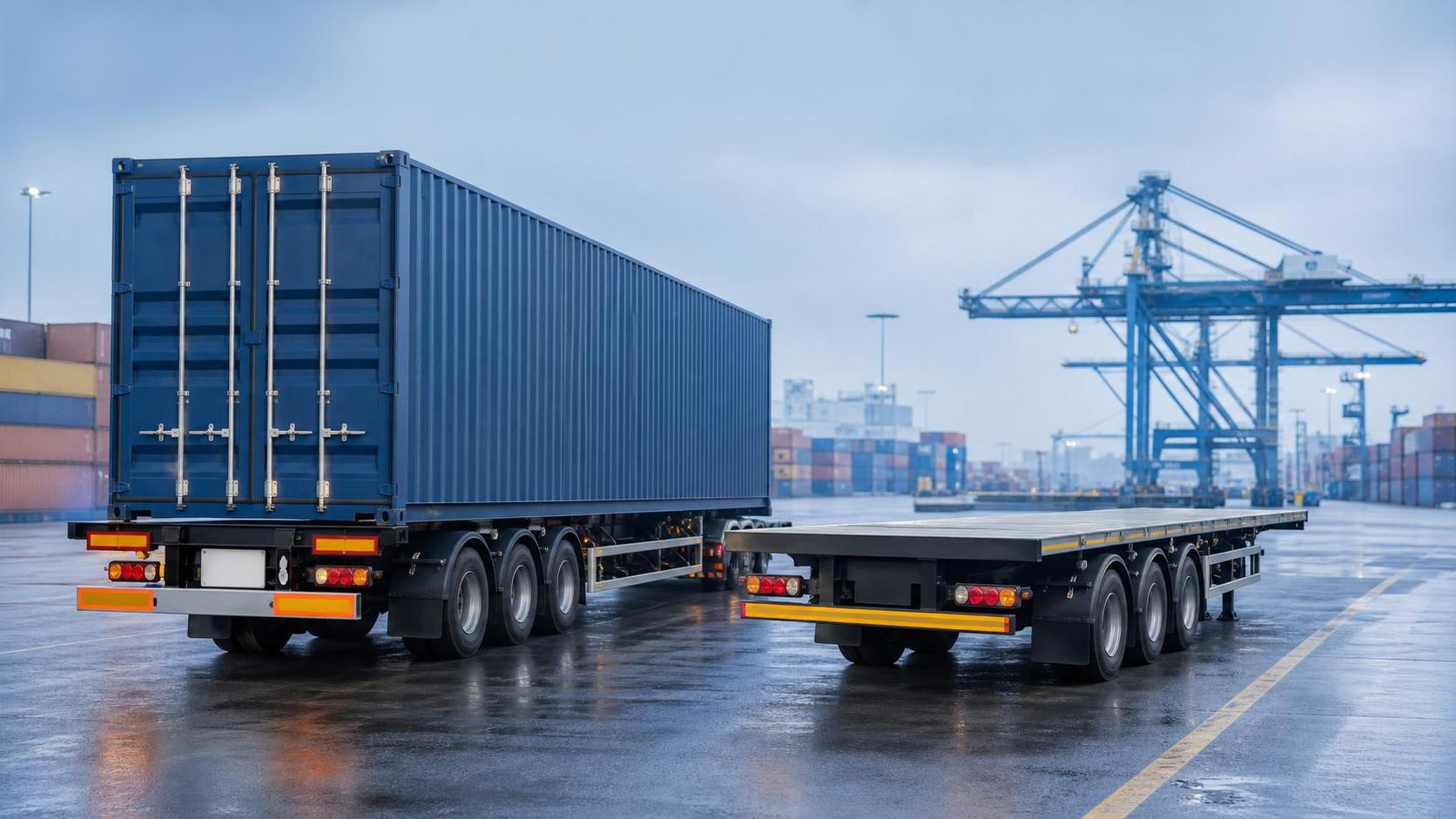
Choosing between a Skeleton (Container) Semi-Trailer and a flatbed is not a minor equipment decision. In container haulage, trailer structure shapes loading speed, safety, legal compliance, and total operating cost.
That is why the comparison matters across ports, inland depots, construction supply routes, and cross-border freight corridors. The better option depends less on headline payload figures and more on how the trailer fits real container movement.
For companies handling engineering vehicle logistics or mixed commercial transport, the gap is practical. A mismatch can create avoidable downtime, difficult securing work, and higher wear on both trailer and tractor.
What separates the two trailer types
A Skeleton (Container) Semi-Trailer is built specifically for ISO container transport. Its frame supports container corner castings, usually through twist locks positioned for standard 20ft, 40ft, or combined configurations.
A flatbed is broader in purpose. It uses an open platform that can carry machinery, steel, building materials, and sometimes containers, provided the container is secured correctly.
This design difference changes almost everything in operation. The Skeleton (Container) Semi-Trailer treats the container as the load structure. The flatbed treats it as one cargo type among many.
Why the frame design matters
A skeleton chassis removes unnecessary deck material. That lowers tare weight and can improve payload efficiency where axle regulations and route conditions allow.
By contrast, a flatbed carries its own full deck structure. That offers flexibility, but it usually means more empty weight and less optimization for repeated container cycles.
Where container haulage creates the real difference
Container transport is not only about moving a box. It involves terminal interfaces, crane handling, chassis positioning, securing standards, road limits, and turnaround timing.
In these conditions, a Skeleton (Container) Semi-Trailer usually fits the workflow better. The trailer is aligned with the geometry, locking points, and handling rhythm of containerized freight.
A flatbed can still move containers, especially in occasional or mixed-load operations. Yet repeated container work often exposes its compromises.
Operational advantages of a Skeleton (Container) Semi-Trailer
The strongest case for a Skeleton (Container) Semi-Trailer is consistency. When the load is mostly standard containers, the trailer reduces unnecessary adaptation during each trip.
Twist-lock positioning simplifies securing. That shortens loading and unloading time, reduces manual intervention, and lowers the risk of cargo movement caused by poor restraint practice.
Ground clearance, axle arrangement, and chassis proportions can also be selected around route demands. This matters on port roads, industrial parks, mining support routes, and regional highways.
Cost value beyond the purchase price
Initial price is only one layer. A Skeleton (Container) Semi-Trailer may improve return over time through lower tare weight, quicker terminal handling, and fewer securing accessories.
It can also help standardize fleet operation. Standardization often reduces training variation, inspection inconsistency, and mistakes during urgent dispatch periods.
When a flatbed still makes sense
Flatbeds remain useful where freight mix changes often. If the same trailer must alternate between containers, equipment modules, pipes, steel sections, and palletized materials, flexibility has real value.
This is common in engineering vehicle support operations. One week may involve containerized parts, while the next may require oversized construction components that a skeleton chassis cannot carry.
In that case, a flatbed can reduce fleet complexity. The trade-off is lower specialization and more attention to cargo restraint, deck loading pattern, and legal transport configuration.
- Choose flatbed when cargo variety is high and container moves are occasional.
- Choose flatbed when non-container dimensions exceed skeleton chassis utility.
- Keep flatbed only if securing procedures are well managed and repeatable.
What technical evaluation should focus on
The key question is not which trailer is better in general. It is which trailer aligns with the dominant load pattern, route profile, and compliance requirement.
A useful evaluation starts with container frequency. If container transport is the core task, a Skeleton (Container) Semi-Trailer usually outperforms a flatbed in practical efficiency.
Then look at container type. Operations carrying mainly 20ft units may need different axle balance and lock configuration from fleets focused on 40ft or mixed container movements.
Road conditions also matter. Port shuttles, rough industrial access roads, and long-distance export corridors place different demands on suspension, tire specification, frame strength, and brake setup.
Checklist for practical comparison
- Expected ratio of container loads to general cargo loads
- Common container sizes and weight distribution
- Local axle-load and overall dimension regulations
- Terminal handling method and turnaround pressure
- Maintenance access for locks, suspension, and braking systems
- Need for future customization or tractor matching
Why supply capability and configuration support matter
Trailer choice does not end with the chassis type. Build quality, parts support, documentation accuracy, and delivery reliability affect project timing and lifecycle cost just as much.
This becomes more important in export trade. Configuration mistakes can create customs delays, mismatched tractor-trailer combinations, or compliance gaps after arrival.
Shandong Livol Truck International Trade Co., Ltd. operates in this part of the process rather than only the sales stage. With authorized access to FOTON, SHACMAN, and SINOTRUK resources, plus broad 4S network support, it can connect specification planning with actual delivery capacity.
That matters when evaluating a Skeleton (Container) Semi-Trailer for export fleets. Selection, customization, documentation, customs handling, logistics, and after-sales coordination need to work as one chain.
Typical use cases where skeleton trailers lead
Port-to-warehouse shuttles are the clearest example. The operation is repetitive, time-sensitive, and strongly standardized, so a Skeleton (Container) Semi-Trailer usually delivers the cleaner workflow.
Cross-border container transport is another. Predictable locking, lower empty weight, and easier inspection support more stable long-haul performance.
Construction material imports can also favor a Skeleton (Container) Semi-Trailer when parts, fittings, or packaged systems arrive in containers and move directly to project staging areas.
Flatbeds tend to lead only when that same route must also absorb irregular freight that cannot be containerized.
A balanced conclusion for container-focused fleets
For regular container haulage, the Skeleton (Container) Semi-Trailer is usually the better fit. It supports faster handling, more direct securing, and better alignment with standard container transport practice.
A flatbed remains valuable when cargo diversity is the priority. But once container volume becomes dominant, its flexibility often starts to work against efficiency.
The most reliable next step is to compare route conditions, container ratios, compliance limits, and tractor matching as one system. That approach makes the trailer decision clearer and far more defensible in actual operations.
Search Starts Here