
News
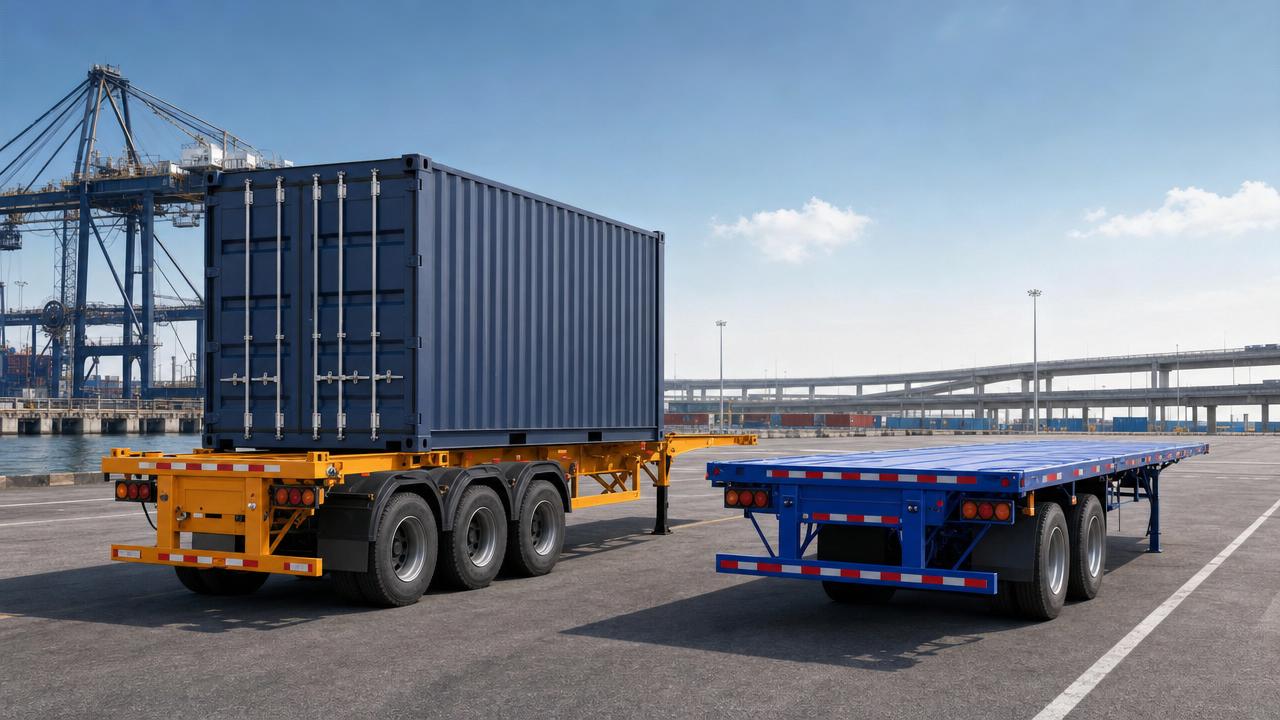
Choosing between a Skeleton (Container) Semi-Trailer and a flatbed is not a minor equipment decision. In port transfer and road haul, trailer structure affects loading speed, legal payload, container security, and daily operating consistency.
That matters even more in engineering vehicle fleets handling containerized cargo across terminals, highways, depots, and inland delivery routes. A trailer that looks more flexible on paper may create avoidable inefficiencies once real route conditions and container workflows are considered.
In practice, the better option depends less on broad versatility and more on transport logic. If the cargo is primarily container-based, the comparison usually favors technical fit over general-purpose use.
Why this comparison matters in container transport
A flatbed can move many cargo types. That flexibility is useful in mixed operations. However, container logistics is a specialized workflow with its own handling standards, yard processes, and safety expectations.
A Skeleton (Container) Semi-Trailer is built around that reality. Its frame is designed to carry standard containers through twist locks, optimized axle layout, and reduced deadweight.
For port drayage and road haul, this design directly affects turnaround time. It also influences bridge compliance, tire wear, fuel use, and driver workload during pickup and delivery.
This is one reason many fleets separate container work from general platform transport instead of using a single trailer type for both.
The structural difference is more than frame shape
At a glance, the two trailer types seem easy to distinguish. A flatbed offers a full deck. A Skeleton (Container) Semi-Trailer uses an exposed frame with container connection points.
The real difference is operational purpose. A flatbed supports cargo placed on a continuous platform. It often requires straps, blocks, or custom securing methods.
A Skeleton (Container) Semi-Trailer is designed for ISO container dimensions. The trailer works with the container as a standardized transport unit, not as loose cargo placed on top.
That changes loading behavior. Yard cranes and reach stackers can position the container directly onto the locking points. There is less need for manual adjustment after placement.
Core operating implications
- Lower tare weight can improve legal payload margin.
- Twist-lock fixing reduces container movement risk.
- No full deck means less unnecessary structure for container-only work.
- Standardized loading points improve terminal compatibility.
Port transfer usually favors the Skeleton (Container) Semi-Trailer
Port environments reward speed, repeatability, and equipment compatibility. Vehicles queue, load, move short distances, and cycle frequently. Small delays add up quickly over a shift.
In this context, a Skeleton (Container) Semi-Trailer often performs better than a flatbed. The container can be set directly into position and locked in a predictable sequence.
A flatbed may require more care in positioning. Even if the container can be carried, securing methods are less integrated into container handling practice.
Terminal operators also tend to prefer standardized equipment interfaces. That reduces loading disputes, alignment problems, and time spent checking non-typical setups.
For high-frequency transfer between quay, yard, and nearby depot, dedicated container chassis logic is usually the cleaner operational solution.
Road haul requires a wider evaluation
Longer road transport introduces more variables. Route limits, center of gravity, suspension tuning, maintenance intervals, and return-load opportunities all become relevant.
Even here, the Skeleton (Container) Semi-Trailer remains strong when the cargo is consistently containerized. Lower self-weight and dedicated securing still support efficient line-haul movement.
A flatbed gains ground when operations include machinery, steel, palletized project cargo, or irregular loads on the return trip. It may reduce empty backhaul risk in mixed fleets.
So the road haul answer is not simply about distance. It depends on whether the route is part of a container chain or part of a broader cargo portfolio.
The decision often comes down to workflow, not preference
Many selection mistakes happen because equipment is judged by visual familiarity rather than process fit. A flatbed can appear more practical because it seems able to do everything reasonably well.
But container transport rewards specialization. If most loads are 20ft, 40ft, or other standard container formats, a Skeleton (Container) Semi-Trailer usually aligns better with the workflow from gate entry to final unloading.
The better question is not which trailer is more universal. The useful question is which trailer removes friction from the actual job being repeated every day.
Operational questions worth checking
- How often is the trailer carrying only containers?
- Are loading points mainly ports, ICDs, or logistics parks?
- Do local regulations penalize unnecessary tare weight?
- Is backhaul cargo containerized or irregular?
- How important is fast turnaround per trip?
Engineering vehicle fleets should also examine configuration details
Trailer type is only the first layer. Axle count, suspension choice, steel grade, lock arrangement, and compatibility with tractor head specifications also matter.
For example, poor matching between trailer design and tractor capacity can reduce braking stability or accelerate component wear. This becomes more visible in rough port access roads and overloaded regional corridors.
A well-selected Skeleton (Container) Semi-Trailer should match the container sizes in use, expected road conditions, and jurisdictional weight rules. Otherwise, the theoretical advantage may not translate into field performance.
This is where experienced commercial vehicle suppliers add value. Shandong Livol Truck International Trade Co., Ltd. works across vehicle selection, customization, documentation, customs clearance, and logistics support.
With access to FOTON, SHACMAN, and SINOTRUK resources, plus broad 4S network coverage and inventory support, the practical focus is not only product supply. It is matching the transport unit to real operating conditions.
When a flatbed still makes sense
A flatbed should not be dismissed. It remains a sensible choice when routes are unpredictable, container volume is secondary, or cargo diversity is structurally built into the business.
It can also help when local loading resources are less standardized. In some inland areas, operators may need the freedom to shift between containers, equipment, and building materials within the same weekly schedule.
In short, flatbeds fit mixed transport logic. Skeleton trailers fit dedicated container logic. The wrong decision usually appears when these two operating models are treated as interchangeable.
A practical way to reach the better fit
For port transfer, the Skeleton (Container) Semi-Trailer is often the more technically appropriate choice. It supports secure locking, cleaner loading workflow, and better alignment with container handling systems.
For road haul, the answer depends on cargo consistency. If the route remains container-led, the same trailer usually continues to make sense. If cargo patterns vary widely, a flatbed may offer more commercial flexibility.
A useful next step is to map the actual movement chain. Check container ratio, average trip length, legal weight margin, loading equipment, backhaul type, and maintenance demands.
Once those factors are clear, the comparison becomes less theoretical. It becomes a measurable decision about efficiency, compliance, and transport reliability across the full operating cycle.
Search Starts Here