
News
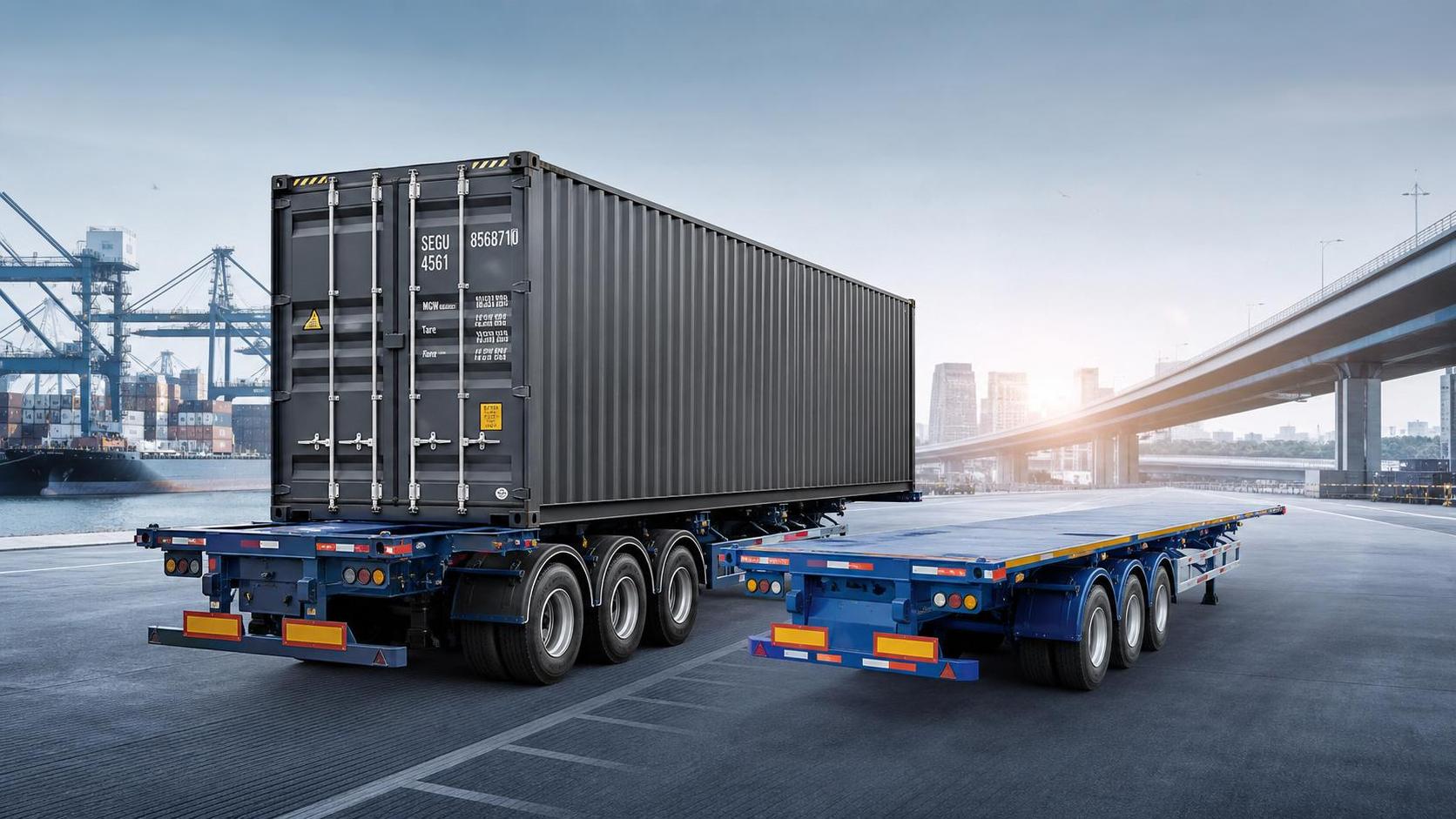
Skeleton Container Semi-Trailer vs Flatbed: Which Fits Port and Highway Loads?
Choosing between a Skeleton (Container) Semi-Trailer and a flatbed shapes daily efficiency, cargo safety, and long-term operating cost.
For port work and highway distribution, the decision is rarely about preference alone.
It depends on load type, route rules, turnaround speed, and how often container handling appears in the transport cycle.
A Skeleton (Container) Semi-Trailer is built around container transport logic.
A flatbed is designed for broader cargo flexibility.
That difference sounds simple, but in real operations it changes everything from axle loading to dispatch planning.
If the goal is a cost-effective, reliable fleet decision, the structure and mission profile of each trailer must match the job.
What Makes a Skeleton (Container) Semi-Trailer Different?
A Skeleton (Container) Semi-Trailer uses a lightweight chassis frame instead of a full cargo deck.
Its main purpose is carrying ISO containers through twist locks positioned for 20ft, 40ft, or mixed container lengths.
Because there is no full platform, tare weight is usually lower than a comparable flatbed.
That lower weight can improve payload efficiency, especially where legal gross weight limits are strict.
More importantly, loading and unloading at ports becomes faster.
Terminal cranes can place containers directly onto the Skeleton (Container) Semi-Trailer without extra deck positioning.
Key structural traits
- Open frame layout with cross-members optimized for container corner loads.
- Twist locks for secure container retention during port transfer and highway travel.
- Lower self-weight, often supporting better payload economics.
- Compatibility with standard container handling systems.
Where Flatbeds Still Win
A flatbed offers a continuous platform for many cargo types beyond containers.
Steel sections, bagged materials, machinery, timber, pipes, and oversized freight often fit better on a flatbed.
This versatility matters if cargo mix changes every week.
In those cases, a flatbed can reduce idle time because it adapts to more contracts.
Still, flexibility usually comes with trade-offs in container handling speed, locking precision, and empty weight.
Typical flatbed strengths
- Carries palletized, irregular, and project cargo with fewer loading restrictions.
- Allows side loading by forklift or crane.
- Supports custom lashing methods for non-containerized loads.
- Fits operations where container volume is too low for dedicated equipment.
Port Loads: Why the Skeleton (Container) Semi-Trailer Often Leads
In port environments, speed and standardization matter more than broad cargo flexibility.
That is where the Skeleton (Container) Semi-Trailer usually has a clear advantage.
Containers move through defined workflows, and ports are built around those workflows.
With a dedicated container chassis, drivers spend less time adjusting load position or adding temporary securing methods.
Turnaround time improves because cranes align directly with the trailer’s lock points.
That can increase daily trip frequency, which often matters more than nominal payload capacity.
Port-specific evaluation points
- Check twist lock layout against container mix, especially 20ft heavy containers.
- Review chassis strength around concentrated corner loads.
- Confirm landing gear durability for high-frequency terminal operations.
- Assess corrosion protection if the trailer operates in coastal environments.
Highway Loads: The Decision Becomes More Nuanced
On highways, the better trailer depends on what stays on the trailer after leaving the port.
If the cargo remains inside a sealed container for the full inland route, a Skeleton (Container) Semi-Trailer remains highly efficient.
It keeps the container secure and avoids unnecessary transloading.
That reduces handling damage, labor hours, and scheduling complexity.
However, if cargo must be unpacked and distributed to multiple inland sites, a flatbed may fit better.
The advantage grows when freight shape, loading direction, or securing needs vary from trip to trip.
A practical rule
Use a Skeleton (Container) Semi-Trailer when the container itself is the transport unit.
Use a flatbed when the cargo becomes the transport unit.
Payload, Weight Compliance, and Stability
Weight law compliance is one of the most overlooked selection factors.
A Skeleton (Container) Semi-Trailer may provide payload benefits because the frame is lighter than a full-deck trailer.
But that does not automatically mean better legal loading.
Containerized cargo can create concentrated axle loads, especially with dense 20ft containers.
A poor axle arrangement can push one axle group over limit before total gross weight is reached.
That is why suspension layout, kingpin position, and extendable design deserve close attention.
Maintenance and Lifecycle Cost Comparison
Purchase price alone does not settle the trailer choice.
The real comparison is lifecycle cost across utilization, maintenance, downtime, and residual value.
A Skeleton (Container) Semi-Trailer has fewer deck components, but it depends heavily on lock condition and frame integrity.
A flatbed may face more deck wear, lashing point damage, and cargo surface impact.
The lower-cost option is the one that matches utilization pattern with the least wasted capability.
Common cost drivers to compare
- Annual container volume versus mixed cargo volume.
- Frequency of empty returns.
- Brake, tire, and suspension wear under typical lane weights.
- Downtime linked to loading complexity or cargo damage claims.
How to Choose for Real Operating Scenarios
In actual business, trailer selection should start with route and load mapping, not catalog comparison.
Look at the last six to twelve months of shipment data.
Then separate movements into pure container runs, mixed distribution runs, and project cargo runs.
That usually reveals whether a dedicated Skeleton (Container) Semi-Trailer fleet is justified.
Choose a Skeleton (Container) Semi-Trailer if:
- Most loads are standard containers moving between ports, yards, and inland depots.
- Fast turnaround is more valuable than cargo versatility.
- Weight compliance and payload efficiency are critical.
- You want fewer handling steps and lower damage risk.
Choose a flatbed if:
- Cargo types change often and many are not containerized.
- Side loading, crane loading, or irregular securing is common.
- Container work is occasional rather than core business.
- Trailer utilization depends on multi-purpose deployment.
Supplier Strength Also Matters
Even the right trailer specification can disappoint if supply and support are weak.
For international buyers, delivery reliability, documentation accuracy, and after-sales response are part of technical risk control.
Shandong Livol Truck International Trade Co., Ltd. brings that supply-side stability into the evaluation process.
Based in Shandong, China, the company is a professional commercial vehicle exporter with strong industry resources.
As an official authorized dealer for FOTON, SHACMAN, and SINOTRUK, it supports sourcing with stable inventory and faster delivery.
Its export team also supports customization, documentation, customs clearance, logistics coordination, and after-sales service.
That matters when matching a Skeleton (Container) Semi-Trailer specification to route, tractor, and market requirements.
Final Decision: Dedicated Efficiency or Broad Flexibility?
If the operation centers on standard containers, the Skeleton (Container) Semi-Trailer is usually the stronger choice.
It aligns with port handling systems, reduces extra loading work, and supports cleaner container security on highways.
If cargo variety drives revenue, a flatbed still offers valuable flexibility.
The best decision comes from matching equipment structure to actual freight behavior, not assumed usage.
Review container share, route design, axle limits, turnaround targets, and handling steps before finalizing the purchase mix.
That process usually makes the answer clear.
When container transport is the core mission, a well-specified Skeleton (Container) Semi-Trailer is often the smarter long-term investment.
Search Starts Here