
News
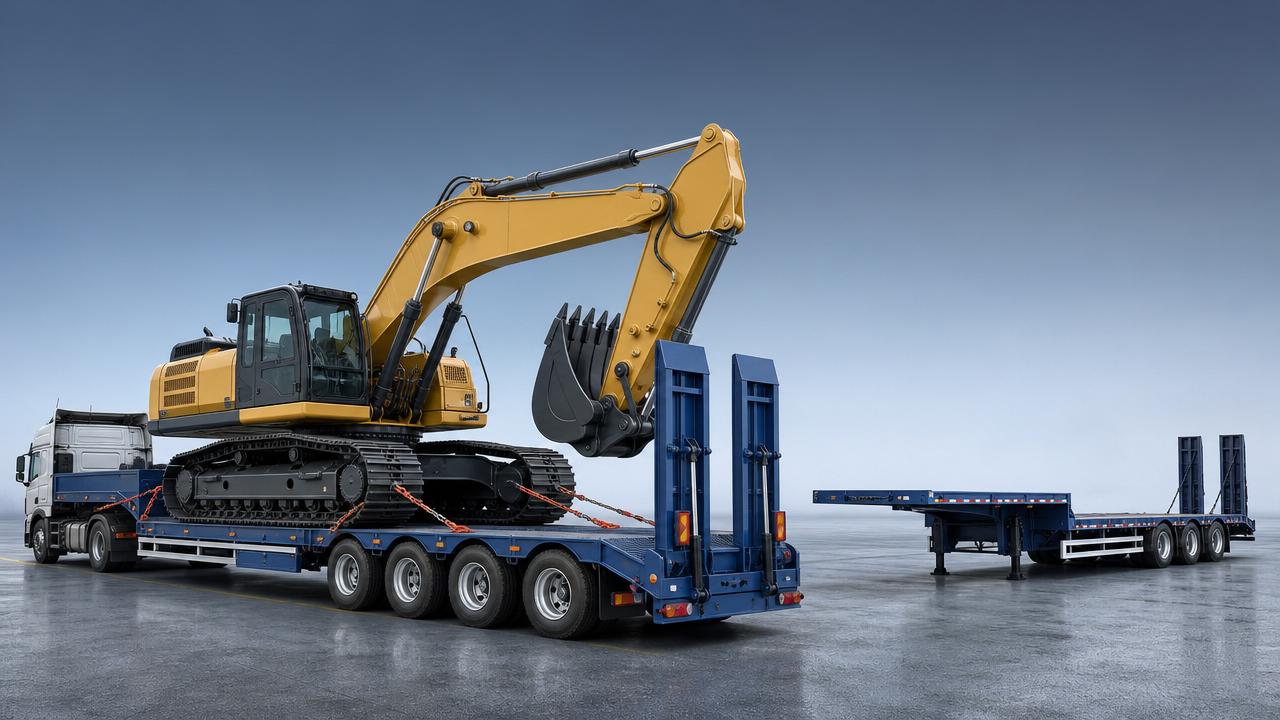
Choosing between a Low Plate trailer and a flatbed is rarely a simple equipment matching exercise. In heavy equipment transport, trailer height affects route access, axle loading influences legal compliance, and deck structure changes loading risk. For construction vehicles, excavators, rollers, pavers, and other oversized machines, the difference between a Low Plate solution and a standard flatbed can shape cost, safety, and delivery reliability across the whole project cycle.
This question matters even more when fleets operate across regions with different road limits, bridge clearances, and customs procedures. In export-oriented supply chains, trailer selection also connects with tractor compatibility, spare parts planning, and after-sales support. That is why the comparison between Low Plate and flatbed remains highly relevant in engineering vehicle logistics.
What separates a Low Plate trailer from a flatbed
A flatbed trailer uses a relatively level deck placed above the axle structure. It is flexible, widely available, and suitable for many general cargo tasks. Heavy equipment can be moved on flatbeds, but not every machine fits comfortably within height and balance limits.
A Low Plate trailer, by contrast, lowers the deck position to reduce overall transport height. That lower center of gravity improves stability and makes it easier to carry tall or heavy machines without exceeding local road regulations.
In practical terms, the Low Plate design is not only about deck height. It also affects ramp angle, weight distribution, frame reinforcement, and loading convenience. These details are what make it a preferred option for many engineering vehicle applications.
Why the comparison matters in heavy equipment transport
Heavy equipment does not behave like palletized freight. Machines often have uneven weight concentration, high ground pressure, and attachments that increase transport dimensions. A poor trailer match may create overhang issues, unstable loading, or excessive stress on tires and suspension.
For that reason, the choice between a Low Plate and a flatbed is usually tied to five operating concerns:
- Overall loaded height under bridge and tunnel restrictions
- Axle distribution for road compliance and tire life
- Ramp angle during loading and unloading
- Deck strength under concentrated machine weight
- Route flexibility across job sites, ports, and highways
These factors influence more than transport feasibility. They also affect downtime, escort requirements, permit complexity, and long-term fleet efficiency.
Performance differences that shape the decision
A direct comparison helps clarify where each trailer type works best.
The table does not mean a Low Plate trailer is always superior. It means the technical fit depends on cargo profile. Flatbeds remain useful where machine height is moderate, routes are simple, and mixed cargo movement is common.
Where a Low Plate trailer usually creates more value
A Low Plate trailer is often the stronger option when transporting excavators, wheel loaders, bulldozers, motor graders, and road-building machines with tall cabins or attachments. In these cases, reducing deck height can avoid permit complications and lower the chance of route rejection.
It also becomes valuable when loading takes place on uneven ground. Construction sites are rarely ideal loading environments. A lower deck and smoother ramp transition can reduce track slip, undercarriage impact, and operator hesitation.
Another advantage appears in repeated heavy-duty cycles. Fleets that move engineering vehicles every day often gain from the extra stability of a Low Plate configuration. Less movement during transit can support better tire wear, fewer tie-down adjustments, and more predictable arrival condition.
Typical use cases
- Tracked excavators moving between urban projects
- Compactors and rollers with concentrated axle loads
- Mining and quarry machines with high operating weight
- Cross-border shipments where compliance margin is tight
- Export orders requiring stable, repeatable loading procedures
When a flatbed still makes sense
Flatbeds continue to hold value in many transport plans. If the equipment is not especially tall, if loading is infrequent, or if the same trailer must handle different cargo categories, a flatbed may provide better utilization.
For example, smaller loaders, attachments, steel components, or packaged machinery can move efficiently on a flatbed. In these situations, the simpler structure may support easier maintenance and lower acquisition cost.
What matters is avoiding a generic assumption that all heavy equipment needs a Low Plate. Some machines are heavy but compact. Others are tall but not especially dense. The transport decision should come from dimensions, load concentration, and route conditions rather than trailer category alone.
Key evaluation points before making the choice
The most reliable decisions usually come from structured comparison rather than brand preference or unit price alone.
Check the loaded height, not only machine height
Measure the machine in transport configuration. Include cab top, boom rest position, attachments, and tire or track settlement on the deck. This is where a Low Plate often reveals its compliance advantage.
Review axle load paths
The machine’s center of mass should align with the trailer’s structural support zones. A Low Plate trailer designed for heavy equipment usually performs better when point loads are high.
Consider loading conditions at the job site
Steep ramps and uneven surfaces can turn routine loading into a damage risk. Low deck entry angles are especially helpful for tracked engineering vehicles and low-clearance equipment.
Match the trailer with the tractor and route
Trailer choice should not be isolated from the towing unit. Tractor power, fifth-wheel height, braking system, and legal axle combination all influence whether a Low Plate setup will deliver its expected advantage.
The supply side also matters
In real projects, the right trailer is not only a technical drawing. It is also a sourcing and support question. Delivery time, spare parts access, export documentation, and configuration accuracy can all affect project timelines.
This is where an experienced commercial vehicle exporter becomes relevant. Shandong Livol Truck International Trade Co., Ltd. works with major Chinese brands such as FOTON, SHACMAN, and SINOTRUK, while supporting customers through selection, customization, customs clearance, and logistics coordination.
That background is useful when a transport plan involves more than one vehicle type. A Low Plate trailer may need to be evaluated together with the tractor head, inventory availability, regional regulations, and after-sales response. Integrated supply capability reduces mismatch risk.
A practical way to move forward
If the equipment is tall, heavy, and frequently moved, a Low Plate trailer often provides the safer and more compliant starting point. If the cargo mix is broader and transport conditions are less restrictive, a flatbed may remain the more economical fit.
The most useful next step is to compare actual machine dimensions, operating weight, route limits, and loading conditions in one checklist. From there, the decision between Low Plate and flatbed becomes less about preference and more about transport performance.
When that checklist is linked with reliable vehicle sourcing, customization support, and export execution, the selected trailer is more likely to perform well not only on paper, but across the full life of the project.
Search Starts Here