News
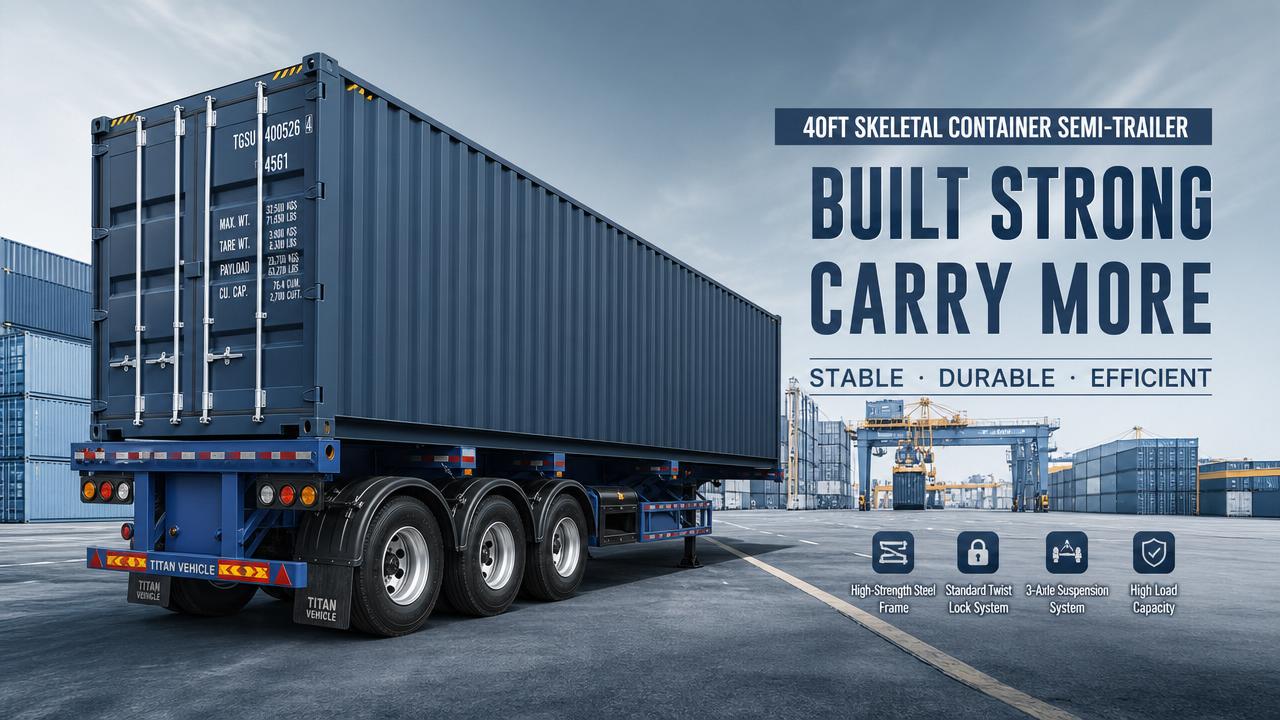
Choosing a Skeleton (Container) Semi-Trailer for port and yard haulage is not just about matching a container size. It is really about balancing loading efficiency, chassis durability, safety margins, and long-term operating cost.
In busy terminals, a trailer may run short-distance cycles all day, turn frequently, brake hard, and carry containers with uneven weight distribution. That is why small specification differences can create big cost differences later.
A well-chosen Skeleton (Container) Semi-Trailer helps reduce downtime, protects container stability, and keeps yard flow smooth. A poor choice often leads to faster tire wear, frame stress, loading delays, and avoidable repairs.
The points below focus on what actually matters when comparing options for port and yard work, especially where reliability, fast turnaround, and steady supply are priorities.
Start with the real operating conditions
Before looking at brands or prices, define the daily job clearly. Port shuttle, empty container transfer, yard repositioning, and short regional haulage all place different demands on a Skeleton (Container) Semi-Trailer.
If the trailer spends most of its time inside a terminal, turning radius, quick locking, and brake response may matter more than highway comfort. If it also runs outside the port, axle load compliance and suspension durability become more important.
- Map container mix first. Confirm whether operations mainly use 20ft, 40ft, or mixed sizes, because the wrong locking layout slows loading and creates unnecessary handling risk.
- Check route surface conditions. Rough yard pavement, ramps, potholes, and speed bumps increase frame fatigue, so chassis reinforcement should match actual operating intensity, not brochure claims.
- Review daily cycle frequency. High-frequency short hauls usually need simple, strong, easy-service components rather than lightweight configurations designed mainly for long-distance fuel savings.
- Define legal payload limits early. Local axle regulations and port rules can change the ideal axle count, suspension type, and tare weight target for each trailer.
Pay close attention to container compatibility
Container compatibility sounds basic, but it is one of the most overlooked buying points. A Skeleton (Container) Semi-Trailer should fit the container types used today and leave room for future operating changes.
The key issue is not only whether it can carry a container. The real issue is whether it can lock, support, and release containers quickly and safely under daily yard pressure.
- Verify twist lock positions carefully. Fixed or extendable layouts should match current container sizes and loading routines to avoid rework, delay, or unsafe partial engagement.
- Confirm support structure under load points. Proper cross-member placement improves stability and reduces local stress when carrying heavier containers on uneven yard surfaces.
- Ask about loading tolerance. A practical trailer should still allow efficient container placement even when crane or reach stacker positioning is not perfectly centered.
- Check lock operation speed. In port work, easy-to-operate locking systems help reduce turnaround time and lower the chance of missed locking steps.
A quick comparison point
Look beyond tare weight and focus on frame strength
Many buyers first ask about tare weight, which is reasonable. Lower tare weight can improve payload efficiency. Still, for port and yard haulage, durability often matters more than chasing the lightest possible structure.
A Skeleton (Container) Semi-Trailer works under frequent impact loading. Twisting at ramps, sudden braking, and repeated uneven loading all stress the chassis. If the frame is too light for the job, repair costs rise quickly.
- Inspect main beam dimensions, steel grade, and weld quality. These factors matter more than headline weight because they directly affect fatigue resistance and service life.
- Ask where reinforcement is added. Neck area, axle connection zones, and lock support sections often see the highest repeated stress in container handling work.
- Avoid over-light designs for harsh yards. Saving a small amount of tare weight can become expensive if cracking, deformation, or alignment issues appear early.
- Check anti-corrosion treatment. Port environments can be humid and salty, so coating quality strongly affects long-term appearance, maintenance effort, and resale value.
Choose the right axle and suspension setup
Axle configuration should match load pattern, route compliance, and maintenance preference. There is no single best setup for every operation, even within the same terminal area.
For example, a 2-axle Skeleton (Container) Semi-Trailer may suit lighter or shorter cycles, while a 3-axle model often provides better flexibility for heavier container movement and road compliance.
- Match axle count to actual payload range. More axles can improve legal distribution, but they also add tire, brake, and maintenance cost over time.
- Compare mechanical and air suspension carefully. Mechanical systems are simple and robust, while air suspension may offer better protection for cargo and chassis.
- Check axle and brake brand support locally. Even strong specifications lose value if replacement parts are slow, expensive, or difficult to source nearby.
- Review tire specification together with suspension. Tire wear patterns often reveal whether the trailer is truly suited to frequent turning and uneven yard loading.
In a busy port setting
In high-turnover port operations, braking consistency and easy service usually matter more than premium features. A reliable, easy-to-maintain running gear package often delivers the best total result.
It also helps to standardize axles and brake parts across the fleet. That reduces spare inventory complexity and shortens repair time when units need quick return to service.
Do not ignore coupling height, turning radius, and yard maneuverability
A trailer may look perfect on paper and still work poorly in the yard. Practical fit with existing tractor heads, loading lanes, ramps, and turning space is a major part of the buying decision.
This is where many hidden inefficiencies appear. A Skeleton (Container) Semi-Trailer that is hard to maneuver can slow the entire operation, especially in congested terminal zones.
- Confirm kingpin setting and fifth-wheel height. Poor matching can affect stability, tire wear, and loading alignment with existing tractor units.
- Check rear overhang and turning clearance. Tight yard layouts need a trailer that can move efficiently without increasing collision risk during reversing or cornering.
- Evaluate landing gear strength and placement. Frequent drop-and-hook operations demand components that stay reliable under fast-paced daily handling.
- Ask for dimensional drawings before ordering. Basic layout verification can prevent costly adaptation work after the trailer reaches site.
Check the small details that often become expensive later
The big structural parts get most attention, but small components often decide maintenance frequency. Lighting, air lines, mudguards, locks, and electrical routing deserve a close look.
When these details are poorly protected, downtime rises. In a hard-working Skeleton (Container) Semi-Trailer, minor failures can quickly disrupt dispatch plans and yard rhythm.
- Review hose and cable routing protection. Exposed routing is more likely to suffer damage from debris, tight turns, and repeated coupling operations.
- Inspect lighting and reflective layout. Good visibility support is especially important in night shifts, rainy conditions, and crowded loading areas.
- Check mudguard, tool box, and accessory mounting. Weak brackets often loosen early under vibration, creating repeated maintenance interruptions.
- Confirm spare parts commonality. Standardized consumables simplify repairs and reduce the total support burden across multiple trailers.
For mixed yard and short-road use
When the trailer moves both inside terminals and on public roads, compliance and durability must be balanced more carefully. Suspension choice, braking performance, and lighting specification become more critical.
It is also wise to confirm document support early, including technical specifications, export paperwork, and any required conformity details for the destination market.
Supplier capability matters as much as the trailer itself
A strong product can still create trouble if supply, documentation, or after-sales response is weak. For fleet planning, supplier execution capability should be evaluated as seriously as hardware specification.
Shandong Livol Truck International Trade Co., Ltd., based in Shandong, China, offers practical advantages here. As an authorized dealer for FOTON, SHACMAN, and SINOTRUK, it supports stable sourcing, coordinated vehicle selection, and efficient export handling.
With a professional export team, authorized 4S store resources, and sufficient inventory, the company can support customization, documentation, customs clearance, logistics, and after-sales coordination for commercial vehicle projects.
- Ask about stock and delivery rhythm. Fast availability is valuable when fleet expansion or replacement timing affects operational continuity.
- Confirm customization scope clearly. Lock layout, axle brand, suspension choice, and coating requirements should be fixed before production starts.
- Review export service capability. Documentation accuracy and logistics coordination are essential for avoiding shipment delays and clearance issues.
- Check after-sales response process. Reliable support helps solve technical questions, spare parts needs, and service coordination more efficiently.
Make the final decision with a simple comparison method
The easiest way to compare options is to score each Skeleton (Container) Semi-Trailer against the same practical criteria. This keeps the decision grounded in actual use instead of sales language.
A useful review includes compatibility, frame strength, axle setup, maneuverability, corrosion protection, spare parts support, lead time, and total lifecycle cost. Price should be part of the picture, not the whole picture.
If possible, request drawings, detailed specifications, and photos of key structural areas before confirming the order. That extra step often prevents the most common mismatch problems.
In the end, the right Skeleton (Container) Semi-Trailer is the one that fits the container mix, survives the yard environment, stays serviceable, and arrives with dependable support behind it.
A clear specification sheet, a realistic duty profile, and a capable export partner make the decision much easier. That is usually the fastest route to a trailer that performs well from day one and keeps working over the long term.
Search Starts Here