
News
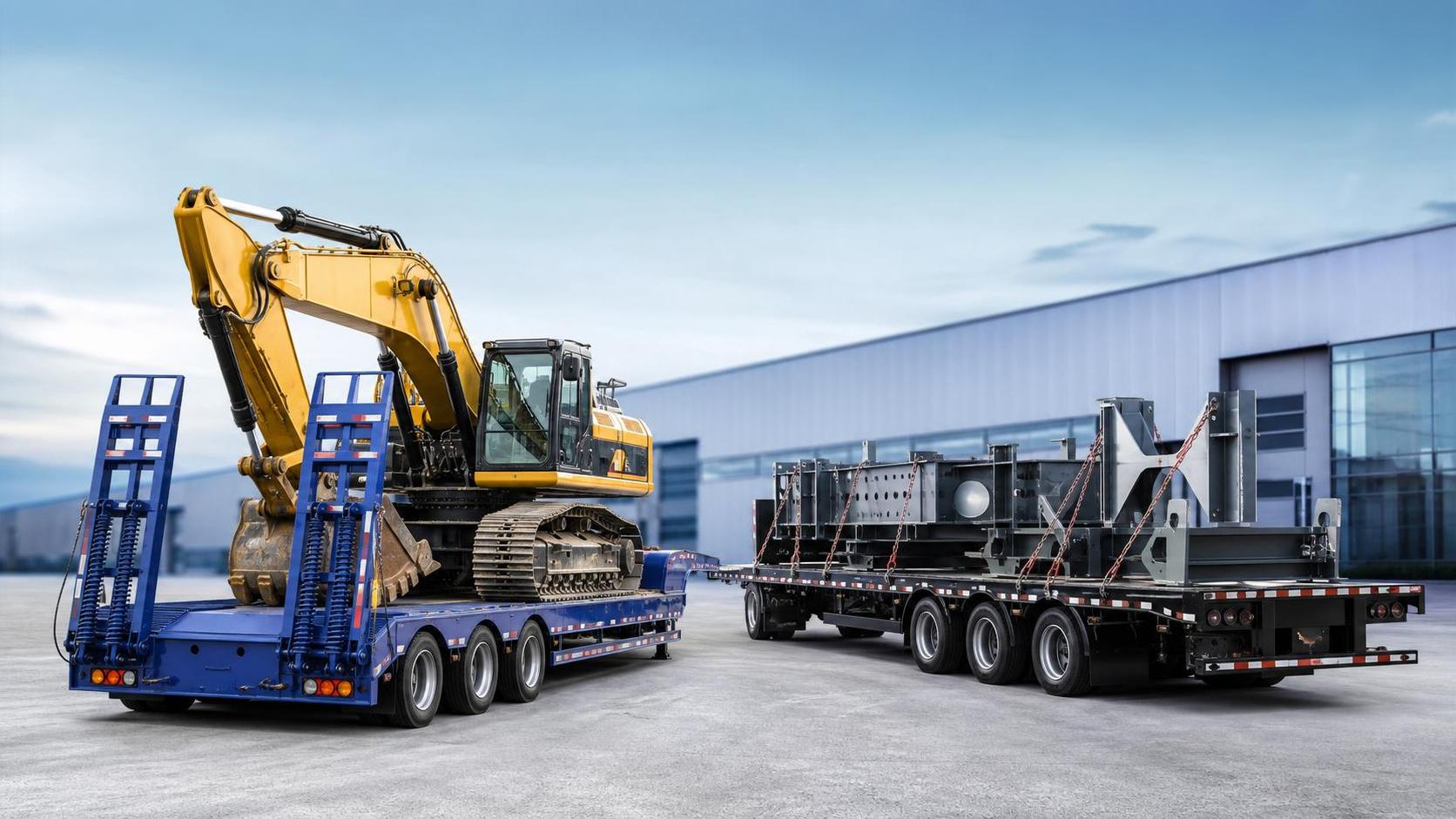
Flatbed Semi-Trailer vs Low Plate: Which One Reduces Oversize Haul Risk?
When evaluating oversize transport safety, trailer choice is never a minor detail. It shapes stability, clearance, compliance, and loading control from the first lift.
The main comparison often comes down to a flatbed semi-trailer or a Low Plate. Both can move heavy cargo, but they manage risk very differently.
For oversized machinery, steel structures, and construction equipment, the safer option depends on cargo dimensions, road limits, and loading method.
In practice, a poor trailer match creates preventable failures. These include rollover exposure, height violations, weak restraint angles, and damage during loading.
This article compares the flatbed semi-trailer and the Low Plate in a practical way, so risk decisions become clearer before dispatch.
Why trailer type matters in oversize hauling
Oversize haul risk is rarely caused by one issue alone. It usually comes from several small mismatches that stack up during transport.
A trailer affects center of gravity, deck height, tie-down efficiency, axle load distribution, and turning behavior. Each factor changes the safety margin.
That is why the Low Plate is often discussed in heavy haul planning. Its lower deck can directly reduce several common transport hazards.
Still, a flatbed semi-trailer should not be dismissed. For many loads, it remains efficient, available, and fully suitable when dimensions stay controlled.
The key is not asking which trailer is better in general. The real question is which one reduces risk for a specific oversize load.
Flatbed semi-trailer: strengths and hidden risks
A flatbed semi-trailer offers a simple open deck. It is widely used for equipment, pallets, containers, steel, and general project cargo.
Its biggest advantage is flexibility. Loading from the side, rear, or top is usually easier, especially where crane access is limited.
It also supports faster turnaround in busy operations. When cargo dimensions are moderate, a flatbed semi-trailer can keep cost and scheduling under control.
However, oversize hauling exposes its limits quickly. A higher deck raises the cargo position, which increases overall transport height and rollover sensitivity.
This becomes more serious with tall machinery, tanks, transformers, or tracked construction equipment. Even a few extra centimeters can trigger route restrictions.
Another issue is restraint geometry. On a taller deck, tie-down angles may become less effective, especially with irregular cargo shapes.
Loading ramps can also create risk. Steeper approach angles may cause underbody contact, track slip, or unstable transitions during self-loading equipment moves.
Low Plate: where the safety advantage becomes clear
A Low Plate is designed with a lower cargo deck, making it especially useful for heavy, tall, or awkward oversized loads.
The most obvious benefit is lower overall height. That reduces bridge clearance pressure and improves route compliance before permits are finalized.
The Low Plate also lowers the cargo center of gravity. This directly improves stability during cornering, braking, lane changes, and uneven road conditions.
For safety reviews, this is often the strongest argument. A lower center of gravity usually means more tolerance when real road conditions become less predictable.
A Low Plate can also simplify loading for wheeled and tracked machines. The loading angle is often gentler, which reduces climb stress and contact risk.
In many heavy haul jobs, the Low Plate gives better balance between regulatory compliance and operational safety. That matters long before the cargo reaches the road.
Still, the Low Plate is not automatically the best answer for every load. Its value is highest when height, weight concentration, or machine loading risk is critical.
Direct risk comparison: Flatbed semi-trailer vs Low Plate
When comparing risk, the flatbed semi-trailer and the Low Plate differ most in five practical areas.
- Height clearance: the Low Plate usually performs better because the deck sits lower.
- Center of gravity: the Low Plate reduces rollover exposure for tall or top-heavy cargo.
- Loading angle: the Low Plate often provides safer machine loading and unloading conditions.
- General cargo flexibility: the flatbed semi-trailer usually offers easier access and broader daily use.
- Availability and turnover: flatbed semi-trailer fleets are often easier to source quickly.
If the cargo is oversized mainly in width, a flatbed semi-trailer may still be acceptable. If height and stability are the main concerns, the Low Plate usually wins.
That difference may sound simple, but it has direct effects on permit success, escort planning, route approval, and accident prevention.
When a Low Plate is the safer choice
A Low Plate is usually the safer option in several common situations.
- The cargo height already approaches route or permit limits.
- The equipment has a high center of mass or uneven top weight.
- The machine must drive onto the trailer using ramps.
- The route includes curves, slopes, or rough pavement.
- The shipment crosses regions with strict oversize enforcement.
In these cases, choosing a Low Plate is not just a transport preference. It becomes a preventive safety measure.
From a quality control view, it also reduces the chance of loading rework. From a safety view, it narrows the number of high-risk variables.
When a flatbed semi-trailer still makes sense
A flatbed semi-trailer remains a practical choice when cargo is heavy but not especially tall, and when route clearance is comfortably within limit.
It also works well when lifting equipment can place cargo precisely, making ramp angle less important than deck accessibility.
For repetitive project shipments, the flatbed semi-trailer may improve fleet utilization. That matters when delivery speed is a major operating target.
But the decision should only stay with a flatbed semi-trailer after the dimensions, axle distribution, and restraint plan are checked carefully.
A practical checklist before choosing Low Plate or flatbed
Before assigning equipment, review these points in order. They help prevent costly trailer mismatch.
- Measure loaded height, not cargo height alone.
- Confirm center of gravity location and weight concentration.
- Check whether the cargo is crane-loaded or self-propelled.
- Review route obstacles, bridge limits, and road surface quality.
- Verify tie-down points and restraint angles on the actual trailer.
- Evaluate permit conditions before final vehicle assignment.
If two or more risk factors remain uncertain, moving to a Low Plate is often the more conservative and safer decision.
Building safer heavy haul operations with the right export partner
Safer transport starts with the right trailer, but it also depends on supply reliability, technical understanding, and export execution.
Shandong Livol Truck International Trade Co., Ltd., based in Shandong, China, supports global buyers with integrated commercial vehicle export solutions.
As an authorized domestic and overseas dealer for FOTON, SHACMAN, and SINOTRUK, the company offers strong product access and stable vehicle supply.
Its nationwide authorized 4S network and available inventory help shorten sourcing time, which is valuable when project schedules are tight.
The export team also supports selection, customization, documentation, customs clearance, and logistics. That reduces operational gaps during cross-border delivery.
For buyers comparing a flatbed semi-trailer and a Low Plate, that kind of support helps turn technical judgment into a workable purchasing decision.
Final answer: which one reduces oversize haul risk?
In most oversize hauling scenarios involving tall, heavy, or self-loading equipment, the Low Plate reduces risk more effectively than a flatbed semi-trailer.
Its lower deck improves stability, reduces clearance pressure, and supports safer loading angles. These are direct advantages, not minor technical differences.
A flatbed semi-trailer still has clear value for standard heavy cargo and flexible loading operations. But for oversize risk control, the Low Plate often provides a wider safety margin.
The best next step is simple: review the cargo profile, route restrictions, and loading method together. Then choose the trailer that removes the most risk before the wheels move.
Search Starts Here