
News
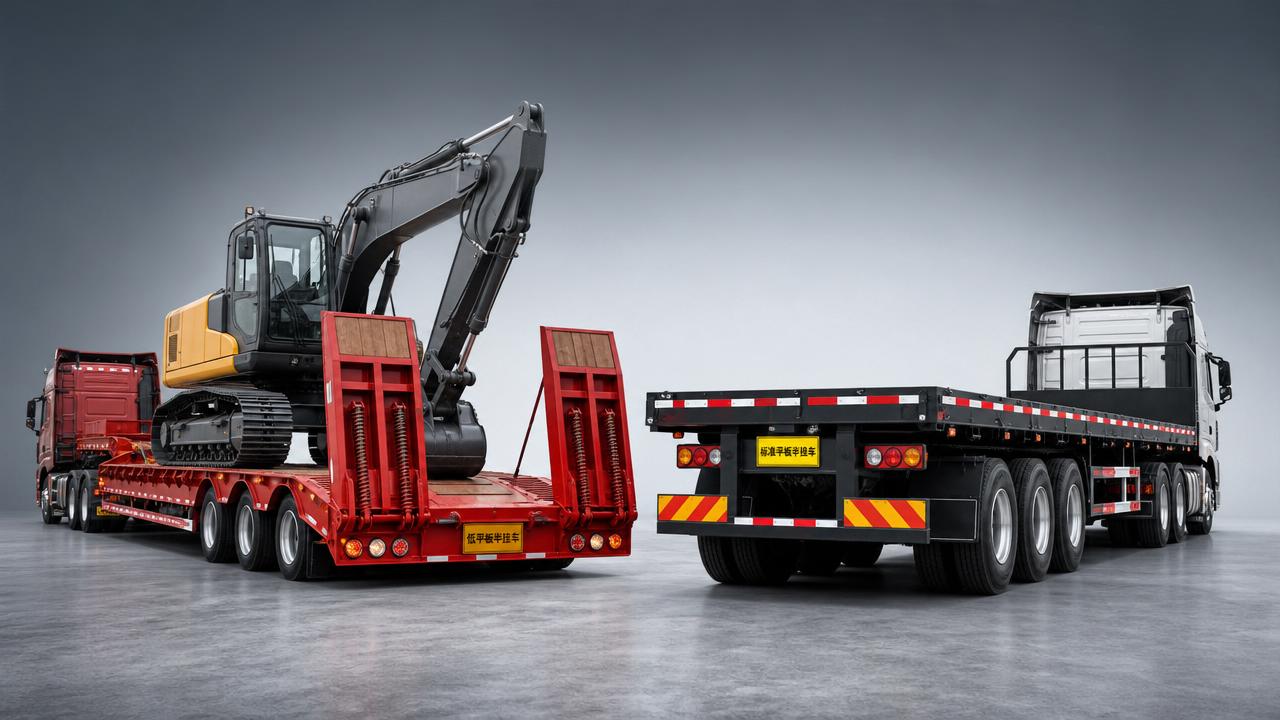
Choosing between a flatbed semi-trailer and a Low Plate is rarely a minor equipment decision. In heavy equipment transport, trailer type affects loading angle, route compliance, cargo stability, tire wear, and the real cost of moving machines between sites.
That matters even more when excavators, loaders, rollers, or bulky attachments must move on tight schedules. A trailer that looks flexible on paper may create delays at the ramp, permit issues on the road, or unnecessary risk at unloading.
For companies coordinating engineering vehicles across regions, the comparison is practical rather than theoretical. The right choice depends on equipment size, axle load, road restrictions, loading frequency, and how much margin is needed for safety.
What the two trailer types really mean in practice
A flatbed semi-trailer uses a standard deck height and a simple open platform. It is widely used because it handles general cargo, construction materials, and many wheeled machines without complex loading arrangements.
A Low Plate, by contrast, is designed with a lower deck. That lower loading surface reduces the overall transport height and improves stability when carrying tall or heavy engineering equipment.
In daily operations, this difference changes more than appearance. It influences whether a machine can be driven directly onto the trailer, whether overhead clearance becomes a route problem, and whether the center of gravity stays manageable on uneven roads.
Simple cargo often works well on a flatbed semi-trailer. Heavy equipment with high structure, concentrated weight, or demanding loading conditions often fits a Low Plate better.
Why the Low Plate gets more attention in heavy equipment transport
The engineering vehicle sector is moving larger machines more frequently. Projects are spread across mines, highways, industrial parks, ports, and urban infrastructure sites, where transport conditions vary sharply from one route to another.
In that setting, a Low Plate often becomes the safer answer because height control is no longer optional. Many excavators and road machines already sit high before loading, especially with cabs, booms, or mounted components.
The lower deck helps keep total vehicle height within legal or operational limits. It also reduces sway during braking and cornering, which is important when crossing mixed road surfaces or temporary site access roads.
Another reason for the growing focus is loading efficiency. A Low Plate usually offers a gentler approach angle. That can reduce the need for extra blocking, auxiliary ramps, or repeated positioning during loading.
Where standard flatbeds still make sense
A flatbed semi-trailer still has a strong place in fleet planning. It is often easier to source, easier to maintain, and more flexible when a vehicle must alternate between machinery transport and general freight tasks.
If the load is moderate in height, evenly distributed, and easy to secure, a flatbed may deliver acceptable performance at a lower operating cost. This is especially true for compact loaders, steel structures, generators, or palletized project cargo.
Key differences that affect project execution
The most useful comparison is not which trailer is better in general. It is which one reduces risk for the exact machine, route, and schedule in front of you.
This comparison explains why the Low Plate is common in machinery relocation plans. The benefit is not only carrying capacity, but also fewer compromises during loading and transport control.
Typical equipment and transport scenarios
Not every machine demands the same trailer. The transport profile changes according to operating weight, chassis type, dimensional height, and whether the equipment is self-propelled or lifted onto the deck.
Machines commonly suited to a Low Plate
- Crawler excavators with tall upper structures and uneven weight concentration
- Wheel loaders that need smoother loading angles and stable transit
- Bulldozers, graders, and rollers moving across longer project routes
- Oversized attachments or machines requiring strict overall height control
Loads often handled well by a flatbed semi-trailer
- Compact machinery with lower transport height
- Steel components, formwork, pipes, and project materials
- Mixed site cargo where loading variety matters more than low deck height
- Operations that prioritize broad trailer utilization across different tasks
In other words, a Low Plate is usually chosen when machine geometry creates transport risk. A flatbed is often chosen when transport variety is the bigger operational need.
What should be checked before making the choice
The most expensive mistake is selecting a trailer from habit. Good decisions start with actual machine data and route conditions, not a generic specification sheet.
- Confirm transport height after loading, not just machine height at rest
- Check weight distribution across axles and contact points
- Review ramp angle against tire type or crawler undercarriage
- Assess turning radius and road surface on project access routes
- Match tie-down positions to the machine’s securement points
- Consider how often the trailer must switch between machine types
If several machines share one transport resource, the decision becomes more strategic. Sometimes a fleet benefits from keeping both a flatbed semi-trailer and a Low Plate, each assigned to different transport patterns.
Supply, customization, and export support also matter
Trailer selection does not end with the technical drawing. In cross-border engineering projects, delivery time, documentation, parts support, and configuration accuracy can affect operations as much as deck height.
This is where an experienced commercial vehicle exporter adds value. Shandong Livol Truck International Trade Co., Ltd. works with authorized resources for FOTON, SHACMAN, and SINOTRUK, supported by broad 4S coverage and available inventory.
That background matters when buyers need more than a trailer alone. Matching tractors, transport combinations, documentation, customs handling, and logistics planning often determines whether equipment reaches the site without disruption.
For a Low Plate program, details such as axle arrangement, suspension preference, deck structure, and compatibility with local transport rules should be clarified early. Reliable exporters can help translate operational needs into workable configurations.
A practical way to decide
If the main loads are tall, heavy, or awkward to load, the Low Plate usually offers the safer and more controllable solution. It supports lower overall height, better loading geometry, and stronger confidence on demanding routes.
If operations involve mixed cargo and lower-profile machines, a flatbed semi-trailer may remain the more versatile asset. Its value comes from flexibility, especially when transport tasks change week by week.
A sound next step is to list machine dimensions, loaded height, operating weight, route limitations, and expected transport frequency. With those numbers in hand, comparing a flatbed and a Low Plate becomes clearer, faster, and far more reliable.
For heavy equipment transport, the best trailer is not the one with the broadest reputation. It is the one that fits the machine, the road, and the project rhythm without creating avoidable risk.
Search Starts Here