News
Selecting between a Flatbed Semi-Trailer and a low plate trailer is a critical decision when transporting heavy machinery, oversized equipment, or dense industrial cargo.
For technical evaluators, the choice depends on load height, center of gravity, axle configuration, route restrictions, and operational efficiency.
This article compares the structural advantages, loading capabilities, and practical applications of both trailer types to help you identify the most reliable solution for heavy-load transport.
When Does a Flatbed Semi-Trailer Make More Technical Sense?
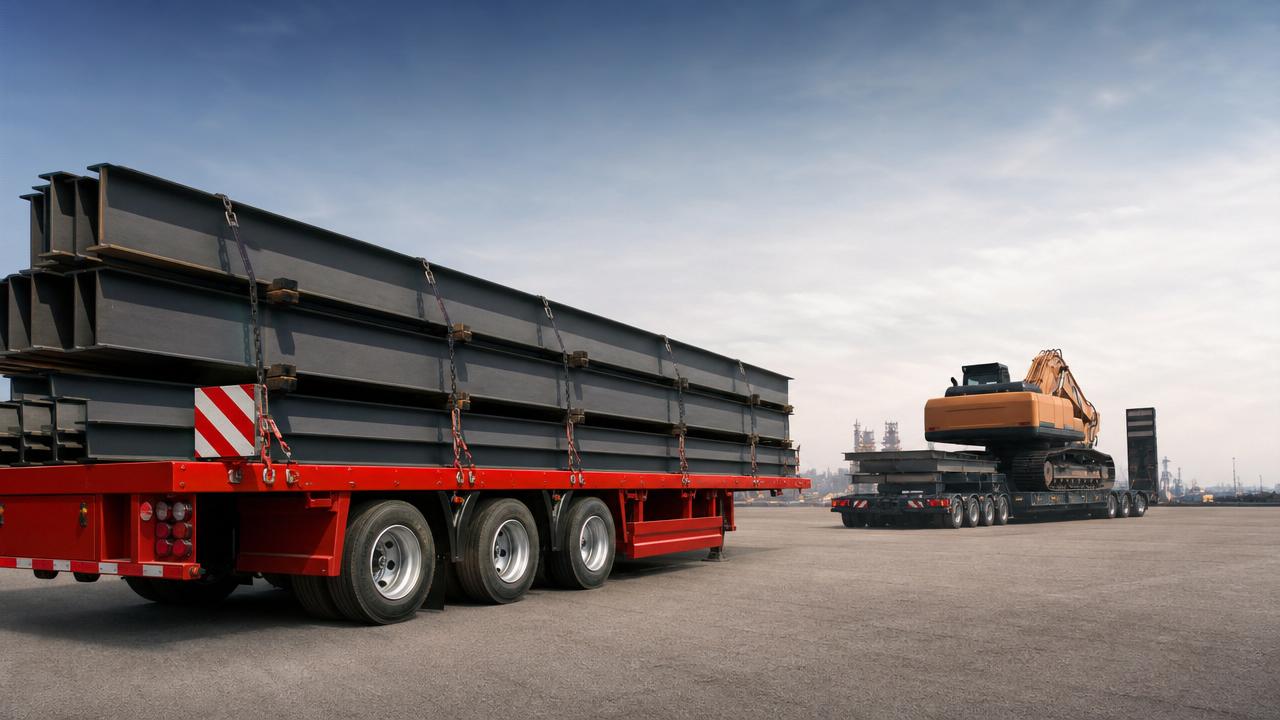
A Flatbed Semi-Trailer is an open-deck transport platform designed for cargo that can be loaded from the side, rear, or top.
It is widely used for construction materials, steel structures, containers, machinery parts, pipes, and industrial modules with manageable overall height.
Core engineering characteristics
- The straight deck simplifies loading by crane, forklift, or side loader, reducing handling complexity on construction sites.
- The frame normally supports distributed loads well, especially when cargo contact points are planned before dispatch.
- The open structure makes it easier to secure oversized length or width using chains, binders, stakes, and twist locks.
- Maintenance access is straightforward because suspension, axles, air lines, and brake components remain relatively exposed.
For evaluators comparing trailer platforms, a Flatbed Semi-Trailer is often the practical baseline because it balances payload, cost, versatility, and fast deployment.
The limitation appears when cargo height plus deck height exceeds legal road clearance, bridge limits, or local permit conditions.
Where Does a Low Plate Trailer Perform Better?
A low plate trailer, often called a low-bed or lowboy trailer in many markets, places the deck lower than standard flatbed height.
This design is preferred when transporting excavators, bulldozers, mining machinery, transformers, crushers, and other tall or heavy equipment.
Main reasons technical teams specify low plate designs
- Lower deck height helps reduce total loaded height, improving bridge and overhead clearance compliance.
- A lower center of gravity improves stability when moving crawler equipment or dense industrial units.
- Rear ramps or detachable gooseneck options allow self-propelled machinery to drive onto the deck.
- Multi-axle layouts distribute concentrated weight more effectively across road surfaces and permit requirements.
A low plate trailer is not automatically better than a Flatbed Semi-Trailer. It becomes better when cargo geometry creates height, stability, or ground-clearance constraints.
The trade-off is that low plate equipment may cost more, require more route checking, and offer less flexibility for general freight.
Flatbed Semi-Trailer vs Low Plate: Practical Comparison for Heavy Loads
The table below compares the two trailer types from a technical evaluation perspective, focusing on structure, cargo fit, and operational implications.
The comparison shows that a Flatbed Semi-Trailer fits general heavy logistics, while low plate equipment solves more difficult height and stability problems.
Before purchasing, evaluators should calculate loaded dimensions, check route restrictions, and confirm whether the cargo is distributed or concentrated.
Key Parameters Technical Evaluators Should Verify
A trailer selection report should never rely only on nominal payload. Heavy-load transport requires a complete check of structure, running gear, and coupling compatibility.
When comparing a Flatbed Semi-Trailer with a low plate trailer, the following parameters help reduce procurement risk and later modification costs.
This parameter approach prevents a common mistake: selecting by payload label while ignoring cargo height, deck stress, and tractor compatibility.
For export buyers, it is also important to align dimensions, lighting, braking, and documentation with local registration requirements.
Application Scenarios: Which Trailer Fits Your Worksite?
Different construction and industrial environments create different selection logic. A Flatbed Semi-Trailer is not chosen only for price; it is chosen for workflow fit.
Common operating scenarios
- For steel and building materials, a Flatbed Semi-Trailer allows fast side loading and flexible tie-down positioning.
- For excavators and bulldozers, a low plate trailer reduces loaded height and improves stability on long-distance routes.
- For container movement in mixed fleets, flatbed configurations support twist-lock options and frequent job changes.
- For mining equipment or plant relocation, low plate layouts handle dense, high-center cargo more safely.
Route profile should be included in every scenario assessment. Mountain roads, weak bridges, temporary access roads, and port areas change the final decision.
If a fleet carries both general cargo and machines, a Flatbed Semi-Trailer may remain the primary asset, supported by rented low plate units for special jobs.
Procurement Checklist for Budget, Delivery, and Compliance
Technical evaluators often face pressure from finance, operations, and project managers. The best decision is rarely the cheapest initial quotation.
Use this checklist when requesting quotations for a Flatbed Semi-Trailer or low plate trailer from an export supplier.
- Confirm maximum cargo weight, dimensions, support points, and whether the load is self-propelled or crane-loaded.
- Define operating roads, border crossings, port access conditions, and bridge or tunnel restrictions.
- Check tractor compatibility, including fifth-wheel height, engine power, braking system, and intended towing speed.
- Request drawings, specification sheets, spare parts list, and packing or shipping plan before contract confirmation.
- Clarify export documents, customs support, inspection requirements, and after-sales response process for your market.
Cost factors beyond purchase price
A Flatbed Semi-Trailer may have lower acquisition cost and broader utilization, but low plate equipment can reduce risk for tall cargo.
Total ownership cost should include tires, brake parts, suspension maintenance, permit costs, loading time, driver training, and possible downtime.
Common Selection Mistakes That Increase Transport Risk
Many heavy-load failures start at the specification stage, not during transport. Small mismatches can become expensive once the trailer reaches the worksite.
Mistakes to avoid
- Choosing a Flatbed Semi-Trailer for very tall machinery without checking total loaded height against bridge clearance.
- Assuming rated payload is enough while ignoring point load concentration from tracks, wheels, or support legs.
- Selecting axle quantity without reviewing local axle load limits, road permits, and enforcement practices.
- Forgetting ramp angle, ground clearance, and loading surface strength when transporting self-propelled equipment.
- Not confirming spare parts availability for axles, tires, brake chambers, valves, and suspension components.
The safest approach is to combine engineering drawings with real cargo data. Photos, dimensions, and route information help suppliers recommend practical configurations.
If your team lacks route experience in the destination country, request a conservative configuration rather than pushing the minimum specification.
FAQ for Flatbed Semi-Trailer and Low Plate Trailer Buyers
How do I decide between a Flatbed Semi-Trailer and a low plate trailer?
Start with loaded height, cargo center of gravity, and loading method. If height is acceptable, a Flatbed Semi-Trailer usually offers better fleet flexibility.
If the cargo is tall, self-propelled, or unstable at a higher deck level, a low plate trailer is usually more suitable.
Is a higher payload rating always safer?
Not necessarily. Payload rating must be matched with deck structure, axle distribution, tire capacity, braking performance, and actual cargo contact points.
A properly specified Flatbed Semi-Trailer with balanced loading may be safer than an oversized trailer used with poor tie-down planning.
What documents should international buyers prepare?
Buyers should prepare cargo dimensions, operating country, port of destination, tractor information, registration requirements, and any local road permit guidance.
These details allow the supplier to confirm trailer configuration, export documentation, customs arrangements, and logistics planning more accurately.
Can one trailer serve both machinery and general freight?
A Flatbed Semi-Trailer is usually better for mixed freight, especially steel, containers, pipes, and packaged industrial cargo.
For frequent crawler machinery transport, a dedicated low plate trailer can reduce loading risk and improve road stability.
Why Work with Shandong Livol Truck for Heavy-Load Trailer Solutions?
Shandong Livol Truck International Trade Co., Ltd. is based in Shandong, China, and focuses on commercial vehicle export solutions.
The company is an officially authorized domestic and overseas dealer for FOTON, SHACMAN, and SINOTRUK, supporting reliable vehicle sourcing.
For buyers evaluating a Flatbed Semi-Trailer, tractor head, or matched transport combination, this brand network helps improve selection confidence.
Large authorized 4S store operations across China and sufficient inventory support stable supply, faster coordination, and clearer delivery planning.
What you can consult before ordering
- Parameter confirmation for payload, axle configuration, suspension, deck length, fifth-wheel height, and brake compatibility.
- Product selection between Flatbed Semi-Trailer, low plate trailer, tractor head, and combined heavy transport solutions.
- Customization discussion for ramps, side walls, twist locks, toolboxes, spare tire carriers, and cargo securing points.
- Export support covering documentation, customs clearance, shipping arrangement, port coordination, and delivery cycle communication.
- After-sales planning for spare parts, maintenance guidance, technical questions, and operation feedback after arrival.
If your team is comparing a Flatbed Semi-Trailer with a low plate trailer, share your cargo drawings, route conditions, and target delivery date.
Shandong Livol Truck can help review the configuration, discuss compliant export options, and prepare a practical quotation for heavy-load transport projects.
Search Starts Here