News
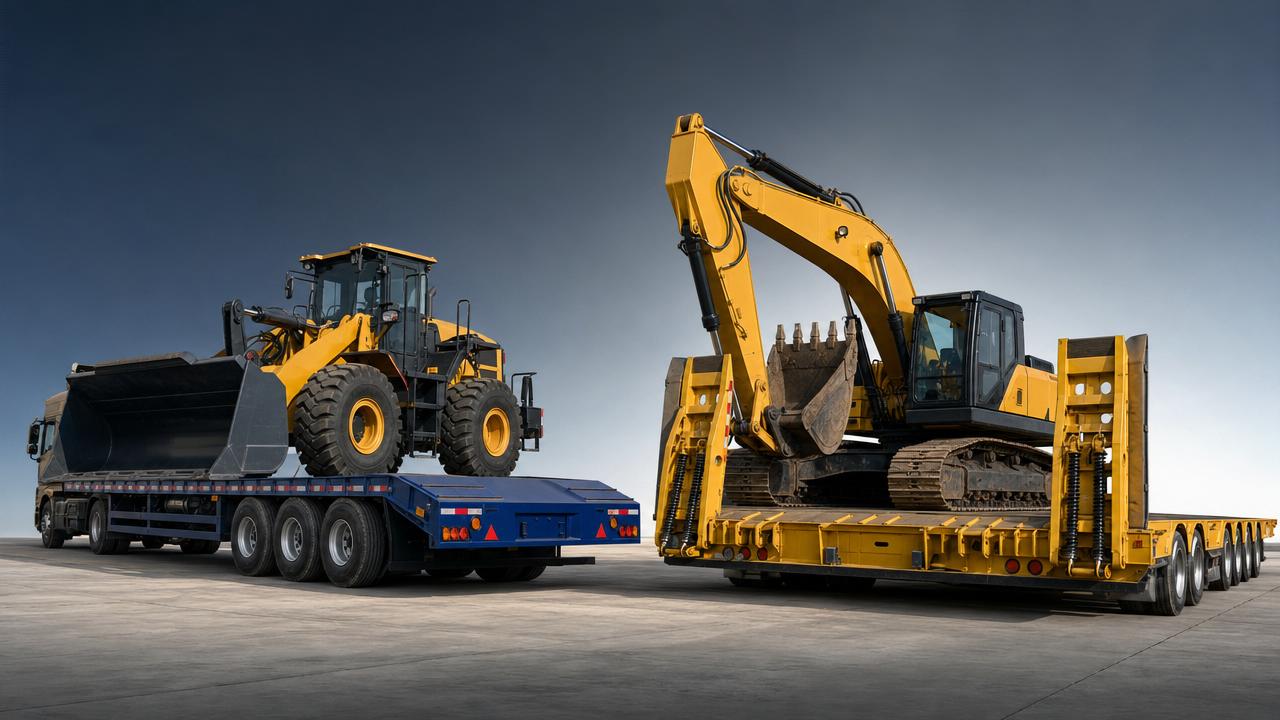
When transporting excavators, loaders, or other oversized machinery, choosing between a Flatbed Semi-Trailer and a low plate trailer can directly affect safety, loading efficiency, and project timelines. For project managers and engineering leaders, understanding the differences in structure, capacity, and application is essential to making cost-effective transport decisions. This guide will help you identify which trailer type best fits your heavy equipment transport needs.
In engineering vehicle logistics, the trailer is not just a transport tool. It directly influences route planning, loading time, manpower use, permit complexity, and total delivery cost across a 1-week, 1-month, or multi-phase project schedule.
For project managers handling road construction, mining support, municipal works, or infrastructure expansion, the decision between a Flatbed Semi-Trailer and a low plate trailer often comes down to 4 factors: equipment dimensions, operating environment, transport frequency, and risk tolerance.
A poor match may lead to slower loading, height restriction issues, unstable weight distribution, or extra escort and permit costs. A correct match can improve turnaround efficiency by 10%–25% in typical fleet operations, especially when machines are moved repeatedly between job sites.
Understanding the Core Difference Between the Two Trailer Types
Although both trailer types are used in heavy equipment transport, their structure and loading behavior are different. A Flatbed Semi-Trailer generally offers a level deck and flexible cargo area, while a low plate trailer uses a lower deck height to carry taller or heavier machinery more safely.
In practical engineering transport, these differences matter most when moving 6-ton to 60-ton machines over mixed road conditions. Height clearance, ramp angle, axle load distribution, and machine center of gravity all change the suitability of each solution.
Basic Structural Comparison
A Flatbed Semi-Trailer usually has a straight loading platform, making it effective for standard construction materials, compact equipment, and wheeled machines with moderate height. It is often selected when loading speed and deck versatility are more important than ultra-low loading height.
A low plate trailer, often called a low-bed or low-loader in many markets, places the cargo deck closer to the ground. This design reduces total loaded height and helps transport tracked excavators, bulldozers, and oversized machines that may exceed legal height if carried on a standard flatbed platform.
The table below outlines the most relevant operating differences for engineering project teams evaluating trailer type for heavy machinery relocation.
For most oversized engineering vehicle applications, the low plate trailer has a clear advantage when height and stability are the primary concerns. The Flatbed Semi-Trailer remains highly valuable for mixed cargo operations and projects needing broader cargo flexibility across different site tasks.
Why Project Teams Often Confuse the Two
In many procurement discussions, buyers focus first on payload tonnage and trailer length, but ignore deck height and loading angle. This creates selection errors, especially for machines with long tracks, low ground clearance, or upper structure dimensions that create clearance risk during road transport.
A 20-ton excavator may fit on both types in terms of weight, yet the transport result can be very different. On a standard Flatbed Semi-Trailer, the combined loaded height may trigger routing limitations. On a low plate trailer, the same machine may move with fewer restrictions and lower setup complexity.
Three Fast Identification Points
- If equipment height after loading approaches local legal road limits, low plate is usually the safer choice.
- If the load mix changes frequently between machinery and palletized materials, a Flatbed Semi-Trailer offers more flexibility.
- If projects require repeated loading on uneven temporary sites, lower deck height often reduces loading risk and ramp stress.
Which Trailer Fits Specific Heavy Equipment Transport Tasks
Not every engineering machine needs the same transport platform. Matching trailer type to equipment category helps reduce damage risk, idle hours, and unnecessary permit expenses. For project leaders managing multiple assets, this is often more important than unit trailer price alone.
A useful evaluation method is to classify transport jobs into 3 groups: standard machinery transfer, oversized machinery transfer, and mixed project cargo movement. This approach creates a more accurate equipment-to-trailer fit than relying only on gross tonnage.
Best Use Cases for a Flatbed Semi-Trailer
A Flatbed Semi-Trailer is often the better choice when the cargo portfolio includes compact machines, site containers, generator sets, steel components, or wheel-based equipment under typical legal height limits. It is especially practical when one trailer supports 2 to 5 cargo categories during the same project cycle.
For example, compact loaders, small asphalt equipment, formwork packages, and site support machinery can be loaded and secured efficiently on a flat platform. This is helpful on urban projects where fast loading and unloading at multiple stops matters more than extreme low-deck geometry.
Best Use Cases for a Low Plate Trailer
Low plate trailers are typically preferred for crawler excavators, medium and large rollers, dozers, pavers, and other machines with large operating weight or tall superstructures. They are also ideal when transport routes include bridges, tunnels, or overhead obstacles with limited safety margin.
Where a machine must be loaded in less-than-ideal field conditions, the reduced deck height can improve approach angle and lower the chance of undercarriage contact. This is important for tracked equipment moving between quarry sites, road sections, or temporary works zones every 3–7 days.
The matrix below can help engineering procurement teams align common machine categories with the more suitable trailer type before formal quotation and logistics planning begin.
This comparison shows that the Flatbed Semi-Trailer is not a weaker option. It is simply better suited to a different task profile. The right choice depends on whether your project prioritizes versatility, low loading height, or transport compliance across changing routes.
Common Misjudgment to Avoid
Some buyers assume that a higher payload rating automatically means better suitability for heavy equipment. In reality, 5 practical details often matter more: deck height, neck design, ramp strength, axle arrangement, and tie-down point distribution. These affect real jobsite usability more than a single brochure number.
Selection Criteria for Project Managers and Engineering Leaders
For decision-makers responsible for budget, safety, and schedule control, trailer selection should follow a structured checklist rather than a price-first approach. In heavy equipment transport, a 1-day delay can affect crane booking, site labor allocation, and machine utilization across several linked activities.
A practical method is to review 4 dimensions before purchase or export arrangement: equipment profile, route limitations, operating frequency, and service support. This reduces the risk of buying a trailer that works well on paper but underperforms in actual engineering operations.
1. Equipment Dimensions and Center of Gravity
Measure machine length, width, total operating weight, and loaded height. If the machine has attachments, folding booms, or detachable tools, calculate both transport and working configurations. Even a difference of 150–300 mm in loaded height may change route feasibility and permit requirements.
2. Route and Regulatory Conditions
Transport over 50 km on open highways has different priorities from repeated site-to-site movement within a 10 km radius. Long-distance moves require closer attention to axle loading, turning radius, road restriction points, and escort rules. In many regions, height and overhang issues create more delays than weight alone.
3. Loading Frequency and Site Conditions
If trailers are loaded once per week from paved yards, a standard Flatbed Semi-Trailer may perform efficiently. If loading happens 3 to 6 times per week on uneven gravel surfaces, soft shoulders, or temporary ramps, low plate designs often deliver safer and more repeatable operation.
4. Lifecycle Cost, Not Only Purchase Cost
The lower upfront price is not always the lower total cost. Extra permits, longer loading time, more escort coordination, or increased tire wear can raise the operating cost over 12 to 36 months. Project teams should compare total use cost per trip or per machine-hour delivered, not only the trailer invoice amount.
Decision Checklist
- Confirm machine operating weight and transport dimensions.
- Check legal route limits and expected travel distance.
- Review loading surface condition and frequency per month.
- Assess tie-down, ramp, and axle configuration requirements.
- Estimate full transport cost over at least 12 months.
Procurement, Export, and Service Considerations
For overseas buyers and project contractors, selecting the right trailer also means choosing a supplier that can support technical clarification, configuration alignment, and export execution. In B2B engineering vehicle procurement, after-sales responsiveness and document accuracy are as important as product specification.
Shandong Livol Truck International Trade Co., Ltd., based in Shandong, China, provides integrated support for commercial vehicle and trailer export projects. As an authorized domestic and overseas dealer for FOTON, SHACMAN, and SINOTRUK, the company works with stable inventory resources and a professional export team to support efficient delivery planning.
For customers comparing a Flatbed Semi-Trailer with a low plate trailer, this kind of service matters in 5 critical stages: vehicle selection, configuration confirmation, documentation, customs coordination, and logistics arrangement. A missing detail at any one stage can delay handover by several days or even weeks.
What Engineering Buyers Should Request from a Supplier
Before confirming an order, ask for detailed deck specifications, axle arrangement, suspension type, ramp structure, and recommended application scope. For export projects, also confirm shipping method, spare parts availability, and expected document preparation cycle, which commonly ranges from 5 to 10 working days depending on destination requirements.
- Clear dimensional drawings for transport planning
- Payload and structure matching advice for intended machinery
- Delivery schedule visibility and stock availability
- Support for customs, logistics, and handover documents
- After-sales communication path for parts and service follow-up
Why Full-Process Support Reduces Project Risk
Engineering procurement rarely ends at product shipment. It includes fit-for-use verification, compliance preparation, and operational readiness. With a supplier experienced in vehicle selection, customization, customs clearance, and logistics, project teams can reduce coordination gaps and improve deployment readiness at the destination site.
This is especially relevant when the trailer will work with other commercial vehicles in a mixed fleet. Stable supply, faster delivery response, and practical after-sales communication can help keep high-value machinery moving instead of waiting for transport alignment.
Final Recommendation for Heavy Equipment Transport Planning
If your project frequently moves oversized excavators, rollers, or tracked machinery where height, stability, and route clearance are the main concerns, a low plate trailer is usually the better fit. If your transport tasks are more varied and include general engineering cargo, support equipment, and standard-height machinery, a Flatbed Semi-Trailer offers stronger operational flexibility.
The best procurement decision comes from matching trailer structure to actual job conditions rather than relying on a single factor such as price or nominal capacity. For project managers, that means reviewing equipment type, route restrictions, loading frequency, and full lifecycle cost before final selection.
If you are planning an engineering vehicle transport solution and need help comparing a Flatbed Semi-Trailer with a low plate trailer, Shandong Livol Truck International Trade Co., Ltd. can support you with product selection, customization, export coordination, and delivery planning. Contact us today to get a tailored solution, discuss product details, and explore the right transport configuration for your heavy equipment operations.
Search Starts Here