
News
Flatbed Semi-Trailer uptime is becoming a stronger competitive factor
Keeping a Flatbed Semi-Trailer in peak condition now affects delivery reliability, safety performance, and fleet profitability more directly than before.
In engineering vehicle operations, downtime no longer means only repair cost. It also causes route disruption, cargo delay, and lower equipment utilization.
That is why maintenance teams are shifting from reactive repairs to earlier inspection, faster diagnosis, and more structured service intervals.
A Flatbed Semi-Trailer works under heavy loads, rough roads, frequent loading cycles, and changing weather. Small defects can grow into major stoppages quickly.
This article explains the maintenance points that most effectively reduce downtime and shows how maintenance priorities are evolving in real operating conditions.
Service priorities are shifting from visible damage to hidden failure risks
Traditional checks often focused on obvious issues such as broken lamps, worn tires, or loose cargo accessories.
Today, the bigger risk often comes from hidden wear in brake lines, suspension bushings, electrical connectors, and frame stress points.
For a Flatbed Semi-Trailer, downtime is increasingly linked to faults that develop gradually and remain unnoticed between scheduled service visits.
Maintenance planning therefore needs to combine routine visual checks with targeted inspection of high-failure components.
What current field conditions are signaling
- Heavier average payloads are accelerating brake, tire, and suspension wear.
- Mixed road conditions are increasing frame twist and fastener loosening.
- Faster turnaround schedules leave less time for deep workshop inspection.
- Longer operating distances expose electrical systems to more vibration and corrosion.
- Safety compliance expectations are pushing more detailed recordkeeping.
Why Flatbed Semi-Trailer maintenance demands are rising
The maintenance burden is growing because operating environments are becoming tougher while efficiency targets continue to tighten.
Engineering vehicle fleets also depend on predictable dispatch schedules, so even minor trailer faults can affect project continuity.
The highest-impact inspection points are no longer optional
A Flatbed Semi-Trailer should be inspected based on downtime impact, not only based on service tradition.
The following systems deserve priority because their failure usually stops operation immediately or creates serious safety exposure.
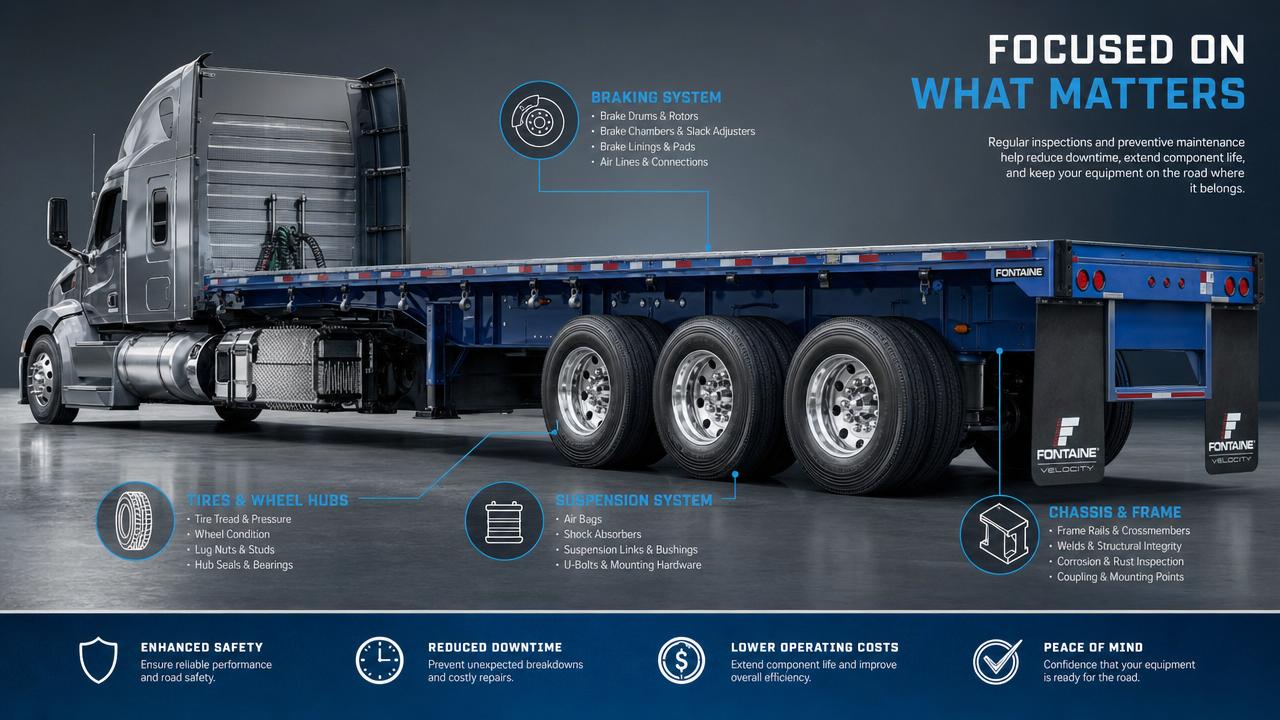
1. Brake system condition decides both safety and schedule stability
Check brake linings, drums or discs, air hoses, chambers, slack adjusters, and valves for wear, leakage, and abnormal response.
Uneven braking often signals hidden adjustment issues, contamination, or developing axle-side imbalance.
- Inspect air pressure build-up and holding stability.
- Listen for leaks near couplings and flexible lines.
- Check brake stroke consistency across all wheel ends.
2. Tire and wheel health directly affects roadside downtime
Tires on a Flatbed Semi-Trailer face high load pressure and frequent curb or debris contact.
Monitor tread depth, sidewall damage, irregular wear, valve condition, and inflation pressure at consistent intervals.
Also check wheel nuts, rims, and hub temperature trends, because looseness or bearing drag often appears before a major failure.
3. Suspension wear often appears before operators notice handling changes
Leaf springs, equalizers, hangers, U-bolts, bushings, and shock-related hardware must be checked for cracks and movement.
A small bushing gap can create uneven tire wear, unstable load support, and progressive damage to nearby components.
4. Frame integrity determines long-term service life
Inspect the main beams, cross members, landing gear mounts, kingpin area, and weld seams after heavy-duty cycles.
Pay close attention to corrosion traps, deformation near load concentration points, and any signs of metal fatigue.
5. Electrical connections are a small area with large downtime consequences
Lighting faults, connector corrosion, and harness abrasion can cause inspection failure and road safety problems.
Check plugs, sockets, grounding points, cable routing, and lamp sealing during each maintenance cycle.
The impact spreads across service efficiency, compliance, and lifecycle cost
When Flatbed Semi-Trailer maintenance is delayed, the effect reaches beyond the workshop.
Emergency repair events usually consume more labor, create parts shortages, and interrupt dispatch planning.
Poor inspection discipline can also lead to compliance issues, unstable braking performance, and avoidable structural damage.
- Workshop teams face more repeat repairs when root causes are missed.
- Operations lose asset availability during unscheduled stoppages.
- Long-term ownership cost rises through accelerated wear and secondary damage.
Maintenance focus should move toward structured prevention
The most effective response is a prevention-based system that matches actual operating intensity.
A Flatbed Semi-Trailer used on construction routes should not follow the same service rhythm as one on smoother regional transport.
Key points that deserve continuous attention
- Build inspection intervals around mileage, load pattern, and road condition.
- Record recurring faults to identify weak points by axle, route, or component group.
- Standardize torque checks for suspension, wheel, and structural fasteners.
- Use lubrication and corrosion protection as preventive tools, not cleanup tasks.
- Keep high-turn parts available to shorten workshop turnaround time.
- Verify coupling, landing gear, and load securement hardware regularly.
A practical judgment framework helps reduce Flatbed Semi-Trailer downtime
Maintenance decisions are stronger when teams classify issues by urgency, safety effect, and failure progression speed.
Reliable support also matters when maintenance standards rise
As maintenance expectations increase, dependable vehicle supply and after-sales coordination become more valuable for engineering vehicle operations.
Shandong Livol Truck International Trade Co., Ltd. combines export experience, stable inventory, and professional service support for commercial vehicle needs.
As an authorized dealer for FOTON, SHACMAN, and SINOTRUK, the company supports vehicle selection, customization, documentation, logistics, and after-sales communication.
That integrated capability helps reduce delays linked to sourcing, delivery, and service coordination across international projects.
The next step is to turn inspection knowledge into a repeatable routine
A Flatbed Semi-Trailer performs best when maintenance points are documented, prioritized, and reviewed against operating results.
Start with brake, tire, suspension, frame, and electrical checks, then refine intervals using real service data.
If support is needed for commercial vehicle export solutions or dependable engineering vehicle supply, contact Shandong Livol Truck International Trade Co., Ltd. for practical assistance.
Search Starts Here