
News
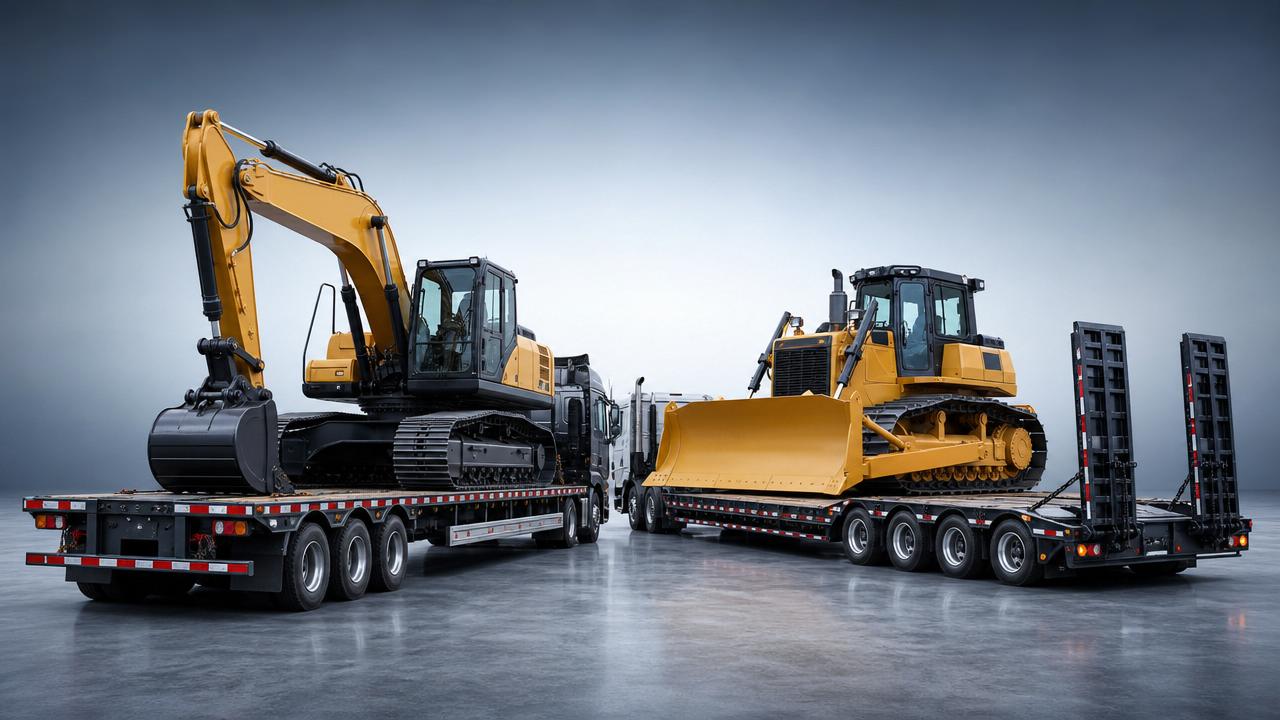
Choosing between a Flatbed Semi-Trailer and a low plate trailer can directly affect equipment safety, loading efficiency, and project timelines. For project managers handling heavy machinery transport, understanding the differences in structure, capacity, and jobsite suitability is essential. This guide compares both options to help you select the most practical solution for demanding engineering and construction operations.
Understanding the Two Trailer Types in Engineering Transport
In engineering vehicle logistics, both the Flatbed Semi-Trailer and the low plate trailer are designed to move large and heavy loads, but they are not interchangeable in every project environment. A Flatbed Semi-Trailer usually features a long, open and relatively level deck, making it suitable for a wide range of cargo, from construction materials and containers to medium and heavy machinery. A low plate trailer, often called a lowbed or low-loader in international transport discussions, has a lower deck height that helps carry taller and heavier equipment with improved stability and road compliance.
For project managers, this distinction matters because transport decisions affect not only freight cost, but also permit handling, route planning, equipment loading methods, unloading speed, and the risk of machine damage. In large infrastructure, mining, road construction, and industrial installation projects, the right trailer supports a smoother equipment cycle and reduces downtime at the jobsite.
Why This Comparison Matters in Today’s Construction and Equipment Market
Heavy equipment is becoming larger, more specialized, and more expensive. Excavators, wheel loaders, bulldozers, road rollers, cranes, pavers, and drilling equipment all place different demands on transport platforms. At the same time, projects are under pressure to shorten mobilization time and control logistics risk. That is why many engineering companies now evaluate trailer suitability as part of project planning rather than as a last-minute dispatch decision.
A Flatbed Semi-Trailer remains one of the most versatile transport assets in commercial fleets because it can serve multiple cargo categories beyond machinery. However, when equipment height, ground clearance, axle load, or center of gravity becomes critical, a low plate trailer often offers a safer and more compliant solution. Understanding these realities helps project leaders avoid route restrictions, unstable loading, or unnecessary equipment dismantling.
Core Structural Differences That Influence Performance
The most important difference is deck height. A Flatbed Semi-Trailer has a standard platform height that simplifies general loading and unloading, especially where forklifts, cranes, or side access are available. This makes it effective for mixed engineering cargo and for machines that do not exceed transport height restrictions.
A low plate trailer is built lower to the ground, with a dropped deck or specially engineered loading platform. This lower center of gravity improves stability for heavy equipment and allows taller machines to travel without violating height limits on roads, bridges, tunnels, and industrial entrances. Many low plate designs also support stronger concentrated load distribution, which is valuable for tracked machines and heavy axle-based equipment.
Another difference is loading approach. A Flatbed Semi-Trailer often relies on external ramps, cranes, or loading docks depending on cargo type. A low plate trailer is more frequently equipped for direct machinery loading with rear ramps or hydraulic systems, which can be more practical on active construction sites where lifting infrastructure is limited.
Industry Overview Table: Flatbed Semi-Trailer and Low Plate Trailer at a Glance
The table below provides a practical overview for engineering project decision-makers comparing a Flatbed Semi-Trailer with a low plate trailer.
Where a Flatbed Semi-Trailer Delivers Strong Practical Value
A Flatbed Semi-Trailer is often the preferred option when a project requires flexibility across multiple load categories. In engineering operations, this can include steel structures, formwork systems, pipes, generators, packaged site equipment, and moderate-sized machinery. For companies that want one trailer type to support different transport tasks, the Flatbed Semi-Trailer offers a strong balance between utility and operating efficiency.
It is especially useful when machinery dimensions remain within legal transport limits and when the project site has adequate loading support. Wheeled loaders, compact excavators, skid steer loaders, mobile compressors, and site support modules can often be moved effectively on a Flatbed Semi-Trailer. The open deck also simplifies cargo securing from multiple angles, which helps when carrying irregular but not extreme loads.
For fleet planning, the Flatbed Semi-Trailer can improve asset utilization because it is not limited to one narrow transport role. This is attractive for contractors, rental companies, and logistics providers that need to switch between machinery and general project cargo without keeping too many specialized trailer types in inventory.
When a Low Plate Trailer Is the Better Fit for Heavy Equipment
A low plate trailer becomes the better choice when equipment is especially heavy, tall, or difficult to stabilize on a standard deck. Large tracked excavators, bulldozers, asphalt pavers, road milling machines, and some crane components often benefit from the lower loading surface. The lower profile reduces transport height and can also make loading safer for self-propelled machinery climbing onto the trailer.
Project managers should also pay attention to working terrain. In mining zones, remote road projects, and industrial expansion sites, loading conditions are not always ideal. A low plate trailer can reduce the complexity of positioning and improve the confidence of operators loading expensive equipment. This matters when every move must be done quickly and with minimal risk to undercarriage components, attachments, or hydraulic systems.
In short, if the transport task centers on heavy equipment rather than mixed cargo, the low plate design usually provides the more dedicated solution.
Application Classification by Equipment Type
The following classification helps identify which trailer type often aligns better with common engineering transport scenarios.
Key Evaluation Points for Project Managers
Before deciding on a Flatbed Semi-Trailer or a low plate trailer, project managers should assess five practical factors. First, confirm actual equipment dimensions and operating weight, not only catalog figures. Attachments, counterweights, and protective structures can change transport requirements. Second, review route restrictions such as bridge limits, tunnel clearance, turning radius, and axle regulations. Third, consider jobsite loading conditions, including ramp availability, ground firmness, and maneuvering space.
Fourth, think about trailer utilization across the wider project cycle. If the same unit must also move general materials, a Flatbed Semi-Trailer may create more operational value. Fifth, evaluate safety and securing requirements. Heavy equipment needs correct tie-down points, load distribution, and deck compatibility. A trailer that is technically able to carry the machine is not always the trailer that carries it most safely and efficiently.
Operational Considerations Beyond Load Capacity
Many transport decisions fail because they focus only on tonnage. In practice, loading angle, deck length, suspension durability, ramp strength, and maintenance support are equally important. A Flatbed Semi-Trailer may perform well for recurring regional transport where cargo changes frequently and standardized routes are available. A low plate trailer may produce better results where oversized machine moves are common and loading safety is the top concern.
It is also wise to consider serviceability and supply support from the exporter or dealer. Reliable commercial vehicle suppliers can help match trailer specification to local regulations and application conditions. For overseas buyers and engineering companies working across borders, this support matters because trailer compliance, spare parts access, and documentation quality affect long-term uptime as much as the initial product choice.
How Professional Export Support Improves Trailer Selection
For international engineering fleets, selecting the right Flatbed Semi-Trailer is not only about the trailer itself, but also about matching export configuration, transport standards, and after-sales coordination. Shandong Livol Truck International Trade Co., Ltd., based in Shandong, China, works with customers needing dependable commercial vehicle export solutions for engineering and construction use. As an authorized dealer for FOTON, SHACMAN and SINOTRUK, the company supports vehicle selection, customization, documentation, customs clearance, and logistics coordination.
This kind of end-to-end support is valuable for project managers who want a trailer specification aligned with real job requirements rather than a generic catalog option. Whether the need is a versatile Flatbed Semi-Trailer for mixed project dispatch or a more specialized low plate solution for heavy machinery, professional guidance reduces selection errors and improves delivery confidence.
Practical Conclusion for Heavy Equipment Transport Planning
A Flatbed Semi-Trailer is generally the stronger choice when your operation needs broad cargo flexibility, frequent dispatch changes, and support for medium to heavy equipment within standard transport dimensions. A low plate trailer is usually the better fit when moving taller, heavier, or more stability-sensitive machinery that demands a lower deck and safer loading geometry.
For project managers, the best decision comes from matching trailer structure to equipment profile, route conditions, and site handling realities. If your fleet must cover a wide variety of engineering cargo, the Flatbed Semi-Trailer offers excellent versatility. If your transport work is centered on oversized machinery, the low plate trailer often delivers better control and safety. When evaluating your next equipment transport solution, use actual project conditions as the benchmark and work with an experienced export partner to ensure the final configuration supports efficient, compliant, and reliable operations.
Search Starts Here