
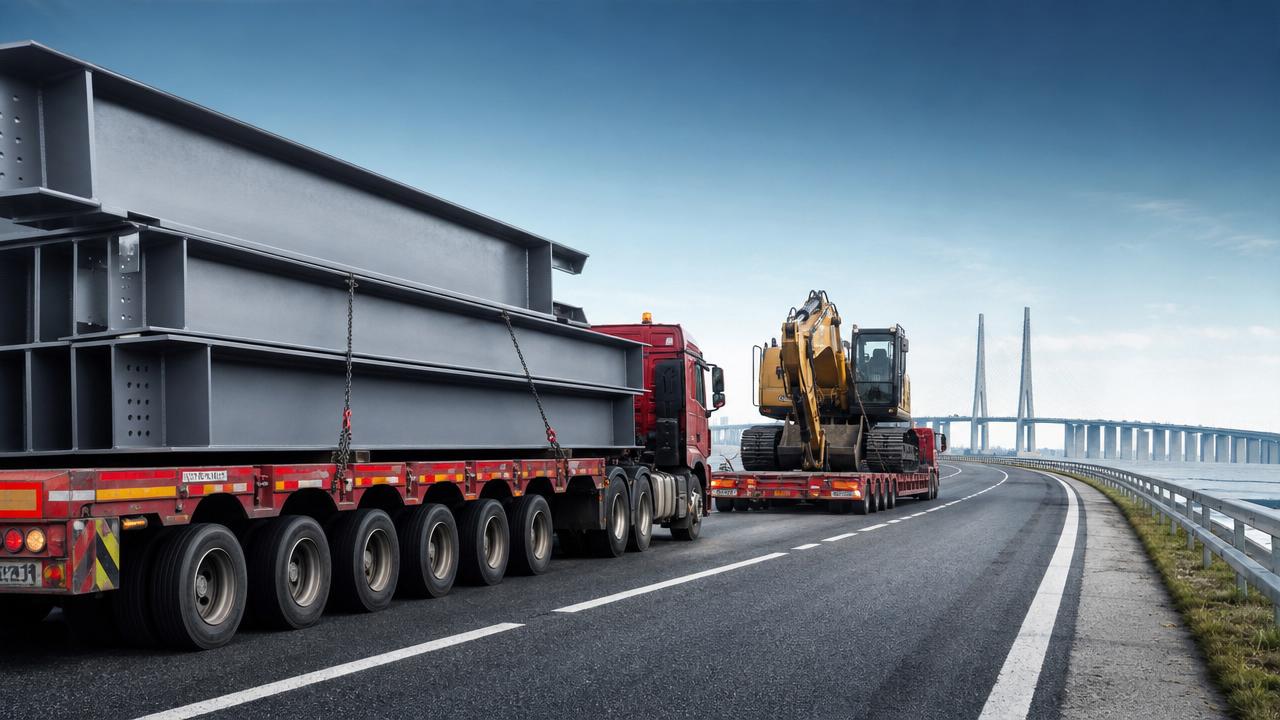
Choosing the right trailer can directly affect project timelines, transport safety, and total operating costs.
For project managers handling oversized machinery, steel structures, or construction equipment, understanding the difference between a Flatbed Semi-Trailer and a low plate trailer is essential.
Each option has unique advantages in load height, cargo flexibility, road adaptability, and compliance.
This guide compares both solutions to help you select the most efficient heavy cargo transport option for your engineering projects.
Search Intent: What Project Managers Really Need to Decide
When users search this topic, they usually want a practical buying or rental decision, not a textbook definition.
The central question is simple: which trailer reduces transport risk while keeping the project on schedule and within budget?
Project managers care about cargo dimensions, legal road limits, route restrictions, loading efficiency, and equipment availability.
They also need to know whether one trailer can serve multiple tasks across different construction or infrastructure projects.
Therefore, this article focuses on selection logic, operational value, risk control, and real application scenarios.
General explanations are kept brief, while decision factors such as cargo height, center of gravity, and compliance receive more attention.
Quick Answer: Flatbed for Versatility, Low Plate for Height and Stability
A Flatbed Semi-Trailer is usually better when the cargo is long, relatively regular, and does not exceed height limits.
A low plate trailer is usually better for tall, heavy machinery that requires a lower loading height and stronger stability.
If your project moves steel beams, pipes, containers, pallets, or prefabricated structures, flatbeds often provide better daily flexibility.
If your project moves excavators, bulldozers, crushers, transformers, or drilling equipment, low plate trailers are often safer.
The correct choice is not only about load capacity, but also about road legality, loading method, and cargo balance.
For mixed project fleets, many contractors use flatbeds for general transport and low plate trailers for high-value oversized machinery.
What a Flatbed Semi-Trailer Does Best
A Flatbed Semi-Trailer has an open platform without side walls or a roof, making it suitable for many cargo types.
Its main strength is loading flexibility, because cranes, forklifts, and side loaders can access cargo from multiple directions.
This matters on construction sites where loading space changes frequently and cargo may not arrive in standardized packaging.
Flatbeds are commonly used for steel structures, rebar bundles, concrete components, timber, machinery parts, and project materials.
They are also practical for export logistics because many models can carry containerized or breakbulk cargo efficiently.
For project managers, the business value is high utilization: one trailer can serve several material transport tasks.
Compared with specialized trailers, flatbeds are easier to dispatch, easier to maintain, and often faster to source.
This can reduce waiting time when projects face urgent material delivery requirements or changing site schedules.
Where a Low Plate Trailer Has Clear Advantages
A low plate trailer, often called a lowbed or lowboy trailer, is designed with a lower deck height.
This structure allows tall machinery to pass under bridges, power lines, and other height-restricted road sections.
The lower platform also reduces the cargo’s center of gravity, improving stability during braking, turning, and long-distance transport.
For heavy construction equipment, this advantage is not theoretical; it directly reduces rollover and route rejection risks.
Low plate trailers are preferred for excavators, wheel loaders, bulldozers, graders, mining equipment, and large industrial machines.
They often include ramps or rear loading designs, making tracked and wheeled machinery easier to load independently.
For expensive equipment, lower loading height also reduces the risk of damage during loading and unloading operations.
The trade-off is that low plate trailers are usually more specialized and less flexible for ordinary cargo transport.
Load Height: The First Factor for Oversized Cargo
For oversized equipment, total transport height is often the first technical limit project managers must verify.
A machine that fits by weight may still be rejected because its total height exceeds local road regulations.
Flatbeds have a higher deck, so tall machinery can quickly exceed legal limits after being loaded.
Low plate trailers solve this problem by placing the cargo closer to the road surface.
Before choosing, measure the cargo height, deck height, tire compression allowance, and any removable attachments.
If removing the boom, bucket, cabin guard, or mast is costly, a low plate option may save time.
For cross-border or long-distance transport, height planning becomes even more important because every jurisdiction may have different limits.
Ignoring height restrictions can lead to detours, permit delays, escort requirements, or forced cargo reconfiguration.
Weight Distribution and Stability: Safety Beyond Rated Capacity
Many buyers compare trailers only by payload rating, but rated capacity alone does not guarantee safe transport.
The real question is how the trailer distributes weight across axles, frame structure, tires, and the tractor unit.
A Flatbed Semi-Trailer can carry heavy goods well when cargo is evenly distributed and properly secured.
However, tall or concentrated equipment may create a higher center of gravity and stronger stress points.
A low plate trailer usually provides better balance for machinery with concentrated weight, especially tracked equipment.
For project managers, this affects insurance exposure, road safety, driver confidence, and equipment protection.
Always confirm axle configuration, suspension type, kingpin load, and local axle weight regulations before dispatching.
A technically capable trailer can still become non-compliant if axle loads exceed road authority limits.
Loading and Unloading Efficiency on Project Sites
Loading efficiency influences crane scheduling, labor cost, and equipment idle time on busy project sites.
Flatbeds are excellent when cargo can be lifted by crane or forklift from the side or top.
This is useful for steel sections, pipe bundles, precast panels, and packaged construction materials.
However, self-propelled machinery usually requires ramps, careful alignment, and adequate ground conditions for safe loading.
Low plate trailers are more convenient for machines that can drive onto the deck using rear ramps.
This can reduce dependence on cranes and shorten loading windows when moving excavators or loaders between sites.
For remote projects, fewer lifting requirements can also reduce mobilization cost and operational complexity.
The best choice depends on whether your cargo is lifted, driven, rolled, or loaded by special equipment.
Road Adaptability and Route Planning
Road conditions can make an otherwise suitable trailer difficult to use in actual project operations.
Flatbeds generally provide better ground clearance, making them practical on mixed urban, highway, and site access roads.
They are often easier to maneuver where ramps, road shoulders, or temporary construction access points are uneven.
Low plate trailers require more attention to road clearance, sharp slopes, speed bumps, and site entrance angles.
Their low deck is useful for height, but it can increase bottom-scraping risk on poor roads.
For mines, rural construction sites, and temporary roads, route inspection is especially important before using low plate equipment.
Project managers should evaluate bridge limits, turning radius, road width, gradients, and overhead obstacles before transport.
A trailer that saves height may still cause delays if it cannot safely access the loading or unloading point.
Compliance, Permits, and Risk Management
Heavy cargo transport is not only a vehicle decision; it is also a compliance decision.
Permits may be required for overlength, overwidth, overweight, or overheight cargo, depending on the transport region.
Flatbeds may need permits when carrying long steel beams or wide prefabricated modules.
Low plate trailers may reduce height permit pressure, but weight and width restrictions can still apply.
For international projects, documentation, customs clearance, vehicle certification, and route permits must be coordinated early.
Failure to prepare can stop cargo at ports, borders, checkpoints, or local transport authority inspections.
Risk management should include cargo lashing plans, escort requirements, weather assessment, driver qualification, and emergency response.
Choosing an experienced vehicle supplier helps project teams avoid specification mismatches before shipment or site deployment.
Total Cost: Purchase Price Is Only One Part
Project managers should evaluate total cost of ownership, not only the trailer purchase price.
A Flatbed Semi-Trailer may offer stronger utilization across more transport tasks, improving return on investment.
It can carry diverse goods, reducing the need to rent additional equipment for regular material movement.
A low plate trailer may cost more or be used less frequently, but it protects high-value machinery better.
If it prevents one serious equipment damage incident or major route delay, the investment can be justified.
Cost evaluation should include fuel impact, maintenance, tires, loading equipment, permits, escorts, downtime, and resale value.
For contractors with frequent heavy machinery relocation, a low plate trailer may deliver strong operational savings.
For companies moving varied construction materials daily, flatbeds usually provide broader economic value.
How to Choose: A Practical Decision Checklist
Start by listing the heaviest, tallest, widest, and longest cargo your project must move regularly.
Then compare those dimensions with trailer deck height, payload capacity, axle configuration, and road legal limits.
If cargo height is close to the legal ceiling, prioritize a low plate trailer to reduce compliance risk.
If cargo is mostly structural material or general equipment, a Flatbed Semi-Trailer may be the better fleet asset.
If loading depends on cranes and side access, flatbed operation is usually faster and simpler.
If machinery can drive on and off the trailer, low plate ramps can improve site efficiency.
Also consider how often the trailer will be used after the current project ends.
A trailer with higher long-term utilization often creates better business value than a technically impressive specialized unit.
Recommended Applications by Cargo Type
Choose a Flatbed Semi-Trailer for steel coils with proper supports, steel beams, pipes, containers, and construction materials.
It also suits equipment parts, generators, modular structures, timber, and cargo requiring crane or forklift loading.
Choose a low plate trailer for excavators, bulldozers, loaders, mining machines, road rollers, and tall industrial equipment.
It is also preferred when cargo has concentrated weight or requires a safer lower center of gravity.
For unusual cargo, such as wind power components or large transformers, customized trailer specifications may be necessary.
In such cases, engineering calculation and route analysis should be completed before confirming the vehicle configuration.
The safest decision often comes from matching cargo data with real road conditions, not relying on general assumptions.
Experienced suppliers can help review dimensions, payload, axle loads, and export requirements before final selection.
Why Supplier Capability Matters for International Projects
For overseas engineering projects, choosing the trailer type is only one part of successful delivery.
Vehicle availability, customization ability, documentation accuracy, customs support, and after-sales service can affect the entire schedule.
Shandong Livol Truck International Trade Co., Ltd. is based in Shandong, China, and exports commercial vehicles globally.
The company is an authorized domestic and overseas dealer for FOTON, SHACMAN, and SINOTRUK commercial vehicle brands.
With multiple authorized 4S stores and sufficient inventory, Livol supports stable supply and faster delivery for project customers.
Its export team assists with vehicle selection, customization, documentation, customs clearance, logistics, and after-sales support.
For project managers, this integrated service reduces coordination burden and lowers the risk of procurement delays.
Professional support is especially valuable when trailer specifications must match local regulations and heavy cargo requirements.
Final Decision: Match the Trailer to the Project Risk
The better trailer is the one that reduces the biggest risk in your transport plan.
If your main risk is low utilization and changing cargo types, a Flatbed Semi-Trailer is usually the smarter choice.
If your main risk is excessive cargo height, unstable machinery, or difficult loading, a low plate trailer is safer.
For many engineering contractors, the ideal fleet combines both options for different stages of the project.
Flatbeds handle daily material movement, while low plate trailers protect critical machinery and oversized equipment.
Before purchasing, compare cargo dimensions, route restrictions, loading method, permit needs, and expected future utilization.
This approach helps project managers control cost, improve delivery reliability, and reduce heavy transport risk.
With the right trailer and supplier support, heavy cargo logistics can become a managed advantage rather than a project bottleneck.