
News
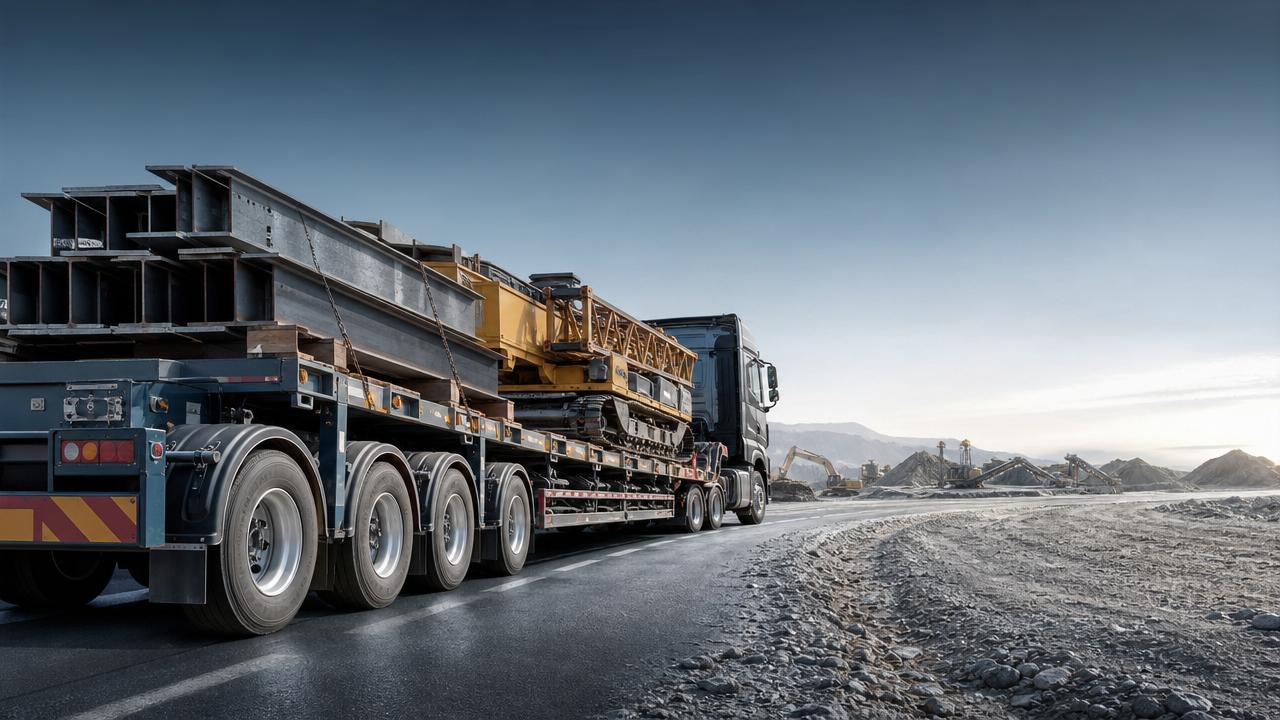
Why Flatbed Semi-Trailer Cost Decisions Depend on Operating Scenarios
When evaluating a Flatbed Semi-Trailer, load capacity is only one side of the investment equation.
In engineering vehicle transport, trailer choice affects fuel burn, axle stress, tire life, maintenance intervals and delivery reliability.
A higher payload rating may look attractive at first.
Yet an oversized setup can increase empty-run cost, reduce maneuverability and create avoidable wear in daily operations.
The better decision starts with transport reality.
Road quality, trip distance, cargo shape, loading frequency and compliance limits all influence the best Flatbed Semi-Trailer specification.
For engineering vehicle applications, profitable transport comes from matching capacity to route conditions and operating intensity.
That is where long-term savings are created.
How Different Engineering Transport Scenarios Change Trailer Priorities
Not every Flatbed Semi-Trailer works equally well across every job.
A trailer moving steel structures on highways faces different demands than one carrying excavator attachments to rough project sites.
In some scenarios, maximum payload matters most.
In others, chassis durability, suspension protection and easier loading can reduce total operating cost more effectively.
This is why capacity should never be judged in isolation.
A balanced Flatbed Semi-Trailer selection considers useful load, tare weight, structural design and lifecycle service needs together.
Scenario 1: Highway Transport of Standard Construction Materials
For long highway routes, stable payload efficiency usually drives returns.
Common cargo includes steel beams, precast components, pipes and machinery frames with predictable dimensions.
In this case, a Flatbed Semi-Trailer with optimized dead weight can support higher legal payload without unnecessary fuel penalties.
Lightweight design matters, but not at the expense of frame integrity.
If the chassis is too light for repetitive loading cycles, cracks and alignment issues may appear early.
The better balance includes strong main beams, quality cross-members and dependable axle distribution.
For highway use, cost control often comes from reduced rolling resistance, lower tare weight and fewer unplanned maintenance stops.
Core judgment points for highway operations
- Legal payload versus empty trailer weight
- Fuel use across long-distance cycles
- Brake and tire wear under high mileage
- Cargo securing efficiency for repeated dispatch
Scenario 2: Mixed Road Delivery to Construction and Mining Sites
Mixed road conditions change the decision significantly.
Here, a Flatbed Semi-Trailer often travels on paved roads first, then enters uneven, muddy or stone-covered access routes.
In this environment, extreme load capacity alone can increase operating cost.
Overloading a trailer on poor roads amplifies suspension fatigue, tire damage and frame twisting.
A stronger suspension setup, higher ground adaptability and reinforced critical stress points may create better value than chasing maximum tonnage.
Engineering cargo in these routes is also less uniform.
Heavy parts, generators, formwork systems and project equipment can shift center of gravity if not loaded correctly.
That raises risk and increases component wear.
For these jobs, a Flatbed Semi-Trailer should be judged by durability per trip, not by headline payload only.
What matters most on rough access routes
- Suspension resilience under repeated shock
- Frame reinforcement at high-stress zones
- Tire specification for puncture and abrasion resistance
- Axle reliability under uneven weight transfer
Scenario 3: Frequent Short-Haul Transport with High Loading Turnover
Some engineering vehicle operations involve many short trips each day.
These runs may move pallets of building materials, compact equipment or fabricated structures between yards and project zones.
In this scenario, time efficiency often outweighs absolute load rating.
A Flatbed Semi-Trailer that supports faster loading, easier securing and smoother maneuvering can lower labor time and idle fuel use.
Repeated stop-start cycles also increase brake wear and fuel consumption.
Choosing a trailer that is too large for the actual cargo volume may reduce turnaround performance and increase hidden operating cost.
For short-haul work, a practical Flatbed Semi-Trailer delivers stable loading convenience and lower downtime rather than oversized capacity.
Scenario 4: Oversized or Irregular Engineering Equipment Moves
Irregular cargo introduces another decision model.
Large equipment modules, abnormal steel sections and wide project components can create uneven pressure distribution.
In these moves, a Flatbed Semi-Trailer must support safe load placement and secure lashing positions.
A trailer with sufficient deck length, anchor points and structural confidence can reduce cargo movement risk.
Operating cost here is shaped by route approvals, escort needs, loading time and damage prevention.
Choosing the wrong platform can create delays that cost more than a higher initial trailer price.
Where Load Capacity and Operating Cost Differ by Scenario
Practical Flatbed Semi-Trailer Selection Suggestions
A useful decision process should compare real operation data, not catalog numbers alone.
- Review average payload, not rare peak loads only.
- Check route surface quality and seasonal road changes.
- Estimate annual tire, suspension and brake replacement frequency.
- Match deck dimensions to actual cargo shape and securing method.
- Consider local axle regulations and bridge limits.
- Compare lifecycle service access and parts support availability.
This approach helps identify the Flatbed Semi-Trailer that delivers the lowest total cost across its working life.
Common Misjudgments That Increase Operating Cost
Several purchasing mistakes appear repeatedly in engineering transport.
One is assuming the highest load capacity always produces the best return.
Another is ignoring empty-run efficiency.
A heavier Flatbed Semi-Trailer consumes cost even when not fully loaded.
Some decisions also overlook maintenance conditions.
If spare parts, service knowledge or repair response are weak, downtime can erase any purchase-price advantage.
Cargo compatibility is another blind spot.
If the trailer deck or lashing layout does not fit real loads, daily operations become slower and less secure.
A More Reliable Next Step for Cost-Efficient Trailer Planning
The best Flatbed Semi-Trailer choice begins with a route-and-cargo review.
List average trip distance, road type, typical payload, loading frequency and maintenance expectations.
Then compare trailer specifications against those working conditions, rather than against theoretical maximums.
Shandong Livol Truck International Trade Co., Ltd. provides integrated commercial vehicle export support for practical transport planning.
As an authorized dealer for FOTON, SHACMAN and SINOTRUK, the company offers stable supply, customization and coordinated export service.
With professional documentation, logistics coordination and after-sales support, trailer selection can align more closely with actual engineering vehicle operating demands.
A carefully matched Flatbed Semi-Trailer does more than carry weight.
It protects uptime, controls cost and supports reliable project transport over the long term.
Search Starts Here