
News
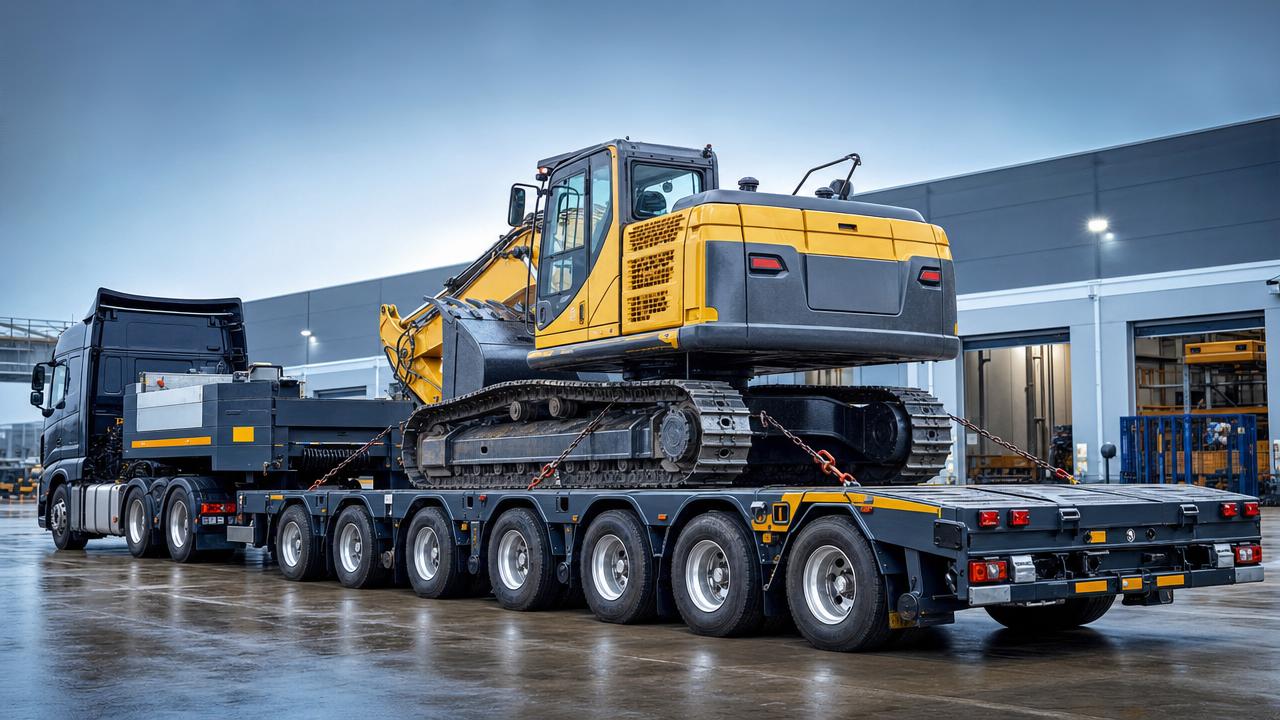
Why does the quoted price rarely equal the real Flatbed Semi-Trailer budget?
A low quote can look attractive, but transport cost is rarely decided by purchase price alone.
For a Flatbed Semi-Trailer, the total budget usually grows through configuration choices, shipping terms, compliance work, downtime risk and service access.
That is why many buyers compare numbers twice.
The first comparison is the ex-factory or FOB trailer price.
The second is the full landed and operating cost over several years.
In engineering vehicle transport, this difference matters even more.
Loads are heavier, routes are harsher, and failure costs can be far higher than the original savings.
A more useful question is not, “Which Flatbed Semi-Trailer is cheapest?”
It is, “Which option protects the transport budget best over time?”
In practice, experienced exporters such as Shandong Livol Truck International Trade Co., Ltd. help reduce cost uncertainty by aligning trailer selection, documentation, logistics and delivery timing from the beginning.
Which specifications change Flatbed Semi-Trailer cost the most?
Not every parameter affects cost equally.
The biggest budget drivers are usually payload requirement, deck size, steel grade, suspension type, axle count and tire specification.
A Flatbed Semi-Trailer built for stable highway cargo is different from one used for machinery, steel coils or construction equipment.
If the load profile is understated, the initial quote may look better, but reinforcement costs appear later.
Higher tensile steel can reduce tare weight and improve payload efficiency.
At the same time, it may raise manufacturing cost depending on design and welding quality.
Axle configuration also changes the numbers quickly.
A 2-axle trailer may reduce upfront spending, but a 3-axle or 4-axle arrangement may be necessary for legal payload, road stability and tire life.
Suspension is another common turning point.
Mechanical suspension often costs less at purchase.
Air suspension may improve cargo protection and reduce long-term wear in some applications.
The right answer depends on route conditions and cargo sensitivity, not just the catalog price.
A quick budget check helps separate necessary cost from optional cost
This kind of table is useful because it shifts the discussion from price alone to budget sensitivity.
How do material quality and manufacturing details affect long-term spending?
This is where many hidden costs begin.
Two Flatbed Semi-Trailer units may look similar on paper, yet perform very differently after a year of work.
The gap often comes from welding consistency, beam design, anti-rust treatment and component sourcing.
If the main beam is poorly processed, fatigue cracks may appear sooner under repeated heavy loading.
If coating quality is weak, corrosion can shorten service life and reduce resale value.
Cheap landing gear, pins, brake chambers or electrical harnesses also raise maintenance frequency.
These are not dramatic costs on day one.
They become expensive through workshop visits, replacement parts, delayed loading and unplanned downtime.
A better way to evaluate a Flatbed Semi-Trailer is to request a component list, manufacturing details and inspection standards together.
When supply is handled by a company with stable inventory, authorized channels and export experience, specification consistency is usually easier to verify.
That matters when replacement planning depends on repeatability across batches.
What transport, compliance and delivery terms should be checked before approving the budget?
This question is often underestimated.
A Flatbed Semi-Trailer can fit the technical need and still exceed budget because delivery scope was not clearly defined.
The main checks usually include Incoterms, port charges, customs documents, homologation needs, local road regulations and lead time assumptions.
For example, a lower FOB price does not include ocean freight, destination fees or inland delivery.
A CIF offer may simplify comparison, but it still needs review for insurance scope and destination exclusions.
Compliance can add another layer.
Lighting standards, reflective markings, braking requirements, dimensions and axle load rules vary by market.
If these items are adjusted after shipment, the correction cost can be disproportionate.
More careful buyers ask for a delivered specification sheet linked to the target country before the order is confirmed.
This is one reason full-process export support matters.
When vehicle selection, documentation, customs clearance and logistics are coordinated by one experienced team, cost leakage is easier to control.
Questions worth clarifying before shipment
- Is the Flatbed Semi-Trailer dimensionally compliant in the destination market?
- Are tire brand, axle brand and brake parts confirmed in writing?
- Which certificates, chassis data and export documents are included?
- What does the delivery term exclude at origin and destination?
- What is the realistic production and vessel booking timeline?
Is a lower-cost Flatbed Semi-Trailer always the wrong choice?
Not necessarily.
The better question is whether the lower-cost unit matches the operating profile without creating downstream risk.
If routes are short, road conditions are stable and payloads are moderate, a simpler configuration may be fully reasonable.
In that case, overspecification can lock unnecessary capital into the asset.
But where machinery transport, rough roads or cross-border operations are common, chasing the lowest price often becomes expensive later.
A practical comparison method is to estimate cost in three layers.
- Acquisition cost, including trailer price and freight.
- Activation cost, including registration, compliance adjustment and spare support.
- Operating cost, including maintenance, tire wear, downtime and resale value.
This layered view usually reveals whether a cheap Flatbed Semi-Trailer is truly economical or only inexpensive at the invoice stage.
What mistakes most often distort the total transport budget?
Some errors are common because they happen before technical and financial details are connected.
One mistake is buying by reference photo instead of by confirmed specification.
Another is using a generic trailer for a specialized engineering transport task.
There is also the assumption that spare parts will be easy to source later, even when component brands were never documented.
Lead time is another hidden trap.
If supply is unstable, a delayed Flatbed Semi-Trailer can affect project schedules and contract commitments.
That is why supplier stability matters almost as much as price.
Companies with authorized channels, nationwide 4S resources, sufficient inventory and established export workflow usually create fewer surprises during execution.
The final mistake is evaluating the trailer in isolation.
The tractor match, route conditions, maintenance capability and loading method should all be reviewed together.
A simple decision guide for cost control
How should the next step be approached when comparing suppliers?
Start with the transport task, not the brochure.
Define payload range, route type, legal limits, expected annual mileage and service conditions.
Then ask each supplier to quote the same Flatbed Semi-Trailer baseline with the same delivery term.
That single step makes price comparison much more reliable.
It also helps reveal where one quote is lower because scope is thinner.
A useful supplier discussion should cover specification detail, component origin, inspection process, spare support, export documents and lead time discipline.
For cross-border orders, integrated coordination is often a financial advantage, not just an operational convenience.
Shandong Livol Truck International Trade Co., Ltd. operates within that model, combining commercial vehicle supply strength, authorized brand resources, customization support and export execution under one workflow.
That kind of structure can simplify evaluation when the goal is a dependable Flatbed Semi-Trailer budget rather than a narrow invoice comparison.
In the end, the best decision usually comes from matching configuration, compliance and delivery realities before the order is placed.
If those points are clarified early, the total transport budget becomes far easier to defend and manage.
Search Starts Here