
News
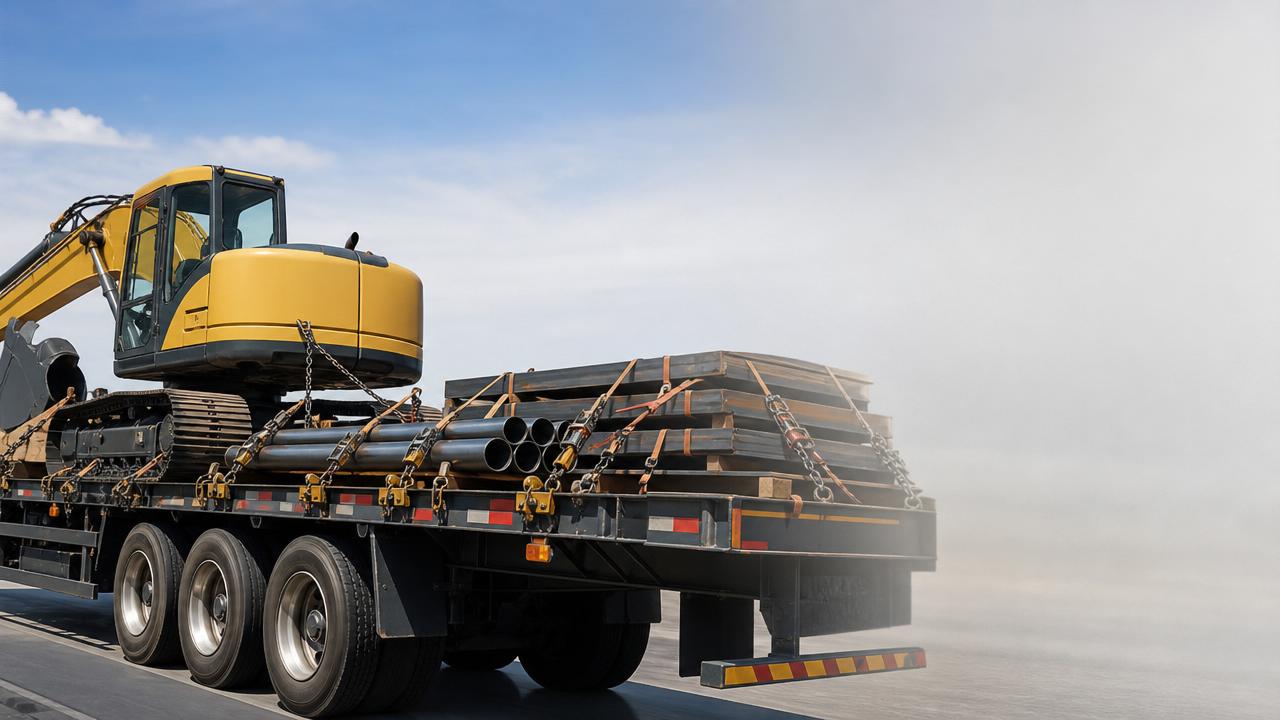
Improper cargo securement on a Flatbed Semi-Trailer can cause load movement, damaged machinery, delivery delays, and severe highway hazards.
In engineering transport, even a small tie-down mistake can affect safety, compliance, and operating cost.
Understanding common securement failures helps improve transport reliability for steel, equipment, precast parts, pipes, and construction materials.
This article explains the most frequent Flatbed Semi-Trailer tie-down mistakes and provides practical methods to avoid them in daily operations.
Basic Understanding of Flatbed Semi-Trailer Load Securement
A Flatbed Semi-Trailer carries exposed cargo without enclosed sidewalls, so tie-down performance becomes a primary safety control.
Securement systems usually include chains, web straps, binders, winches, edge protectors, friction mats, blocking, and anchor points.
Each component must match the cargo weight, shape, center of gravity, and route conditions.
On a Flatbed Semi-Trailer, tie-down equipment must not only hold cargo down but also resist forward, rearward, and lateral movement.
This is especially important for engineering vehicle transport, where loads may be dense, irregular, oversized, or sensitive to vibration.
Why mistakes happen
- Time pressure during loading and dispatch
- Use of worn or mismatched securement tools
- Poor understanding of cargo behavior in transit
- Inadequate inspection before departure
- Ignoring route vibration, braking force, and weather
Current Industry Concerns in Engineering Transport
Engineering transport often deals with machines, plate steel, rebar bundles, formwork, generators, and components with uneven balance points.
For these loads, securement errors on a Flatbed Semi-Trailer create direct operational and legal consequences.
Because engineering logistics often involve heavy-duty schedules, securement quality must be built into normal loading practice, not treated as a final step.
Common Flatbed Semi-Trailer Tie-Down Mistakes
Using too few tie-downs
One of the most common mistakes is relying on the minimum number of straps or chains without considering actual cargo dynamics.
Heavy machinery and long materials on a Flatbed Semi-Trailer usually need additional restraint at critical movement points.
Choosing the wrong securement type
Web straps are useful for many finished surfaces, but they may be unsuitable for sharp-edged steel or rough construction cargo.
Chains may provide better durability, especially for dense engineering loads with abrasion risk.
Ignoring working load limits
Every strap, chain, binder, and anchor point has a rated working load limit.
On a Flatbed Semi-Trailer, securement capacity must be calculated as a system, not guessed from appearance.
Poor load positioning
Even strong tie-downs cannot fully correct bad cargo placement.
If the center of gravity is too high or too far forward, the Flatbed Semi-Trailer becomes harder to stabilize.
Failing to protect edges
Sharp corners can cut straps or reduce chain positioning efficiency.
Edge protectors help preserve tie-down integrity and maintain tension during long-distance transport.
Not rechecking after departure
Tie-downs often settle after the first kilometers because cargo compresses, shifts slightly, or responds to road vibration.
A Flatbed Semi-Trailer should be inspected again shortly after departure and at planned route intervals.
Business Value of Correct Securement Practice
Correct tie-down practice protects more than cargo. It also supports uptime, cost control, and equipment life.
For engineering transport, a well-managed Flatbed Semi-Trailer operation reduces claims, loading disputes, and preventable maintenance events.
- Lower risk of cargo damage and roadside incidents
- Better compliance with transport regulations and site rules
- Improved delivery consistency for heavy project cargo
- Reduced wear on trailer decks, winches, and anchor points
- Stronger confidence in long-distance and export logistics planning
Reliable securement is also important when selecting transport equipment from experienced commercial vehicle suppliers.
Shandong Livol Truck International Trade Co., Ltd. supports global customers with dependable commercial vehicle solutions, strong supply capability, and professional export service.
As an authorized dealer for FOTON, SHACMAN, and SINOTRUK, the company understands practical transport demands across engineering and heavy-duty logistics applications.
Typical Cargo Types and Securement Focus
Practical Methods to Avoid Tie-Down Errors
Build a pre-loading securement plan
Identify cargo weight, dimensions, contact points, and center of gravity before placing it on the Flatbed Semi-Trailer.
This reduces rushed decisions and improves equipment selection.
Match tie-down tools to cargo conditions
Use chains for abrasive or heavy engineering loads, and use straps where surface protection is necessary.
Always confirm compatibility with anchor points and deck layout.
Inspect every component
Check for cuts, bent hooks, stretched links, cracked binders, damaged winches, and weakened deck fittings.
A Flatbed Semi-Trailer securement system is only as strong as its weakest part.
Control cargo movement at the source
Use blocking, chocks, friction mats, or saddles where appropriate.
Tie-downs perform better when the cargo already has physical resistance against rolling or sliding.
Recheck tension during transport
Schedule inspections after initial movement, after harsh braking, and during long-distance stops.
This is especially important for a Flatbed Semi-Trailer carrying mixed or uneven engineering cargo.
Standardize securement records
A simple checklist helps track equipment condition, cargo type, tie-down count, and inspection timing.
Documented practice improves consistency across repeated project transport tasks.
Operational Next Steps for Safer Flatbed Semi-Trailer Use
Reducing tie-down mistakes starts with better preparation, correct equipment, and routine inspection discipline.
For any Flatbed Semi-Trailer used in engineering transport, securement should be planned according to cargo type, route demand, and trailer condition.
Review current loading procedures, replace damaged securement tools, and confirm that trailer anchor points meet practical workload requirements.
When expanding fleet capability or export transport operations, it is also valuable to work with a reliable commercial vehicle partner.
Shandong Livol Truck International Trade Co., Ltd. offers professional support in vehicle selection, customization, documentation, logistics coordination, and after-sales service.
With strong supply resources and broad experience in global commercial vehicle export, the company helps support efficient and dependable heavy transport operations.
Search Starts Here