
News
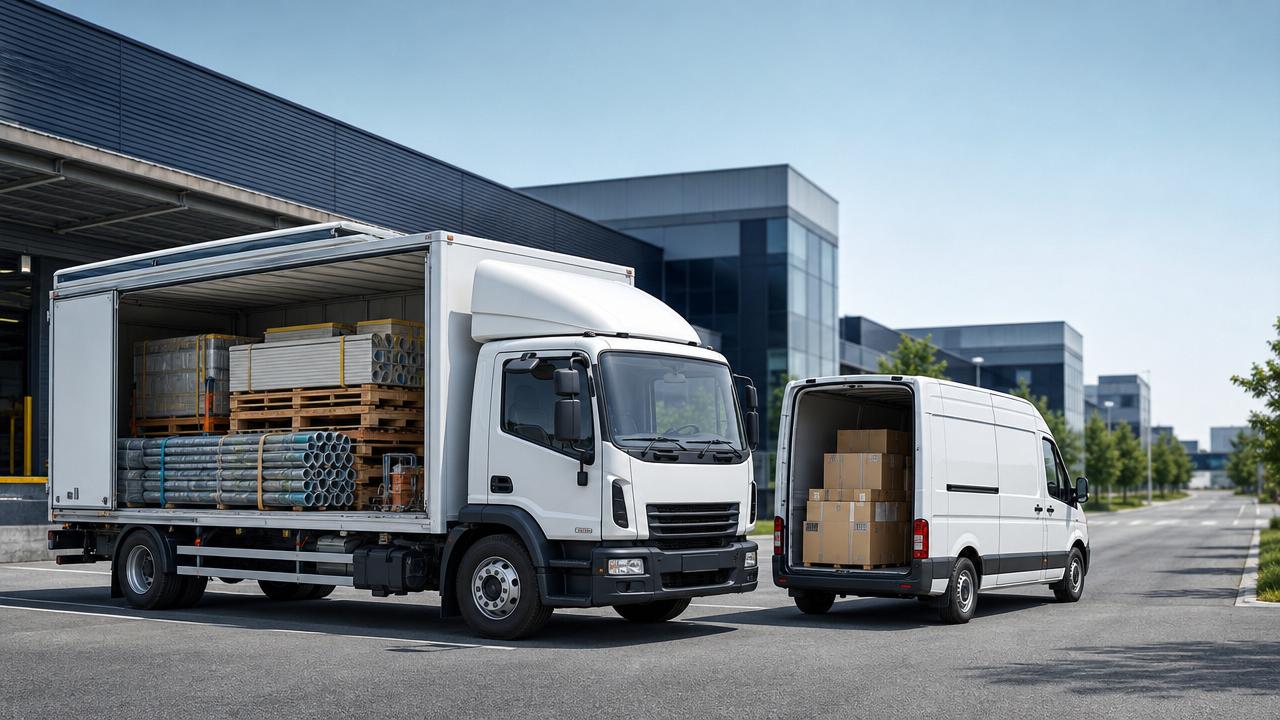
When planning efficient last-mile operations, choosing between a light van and a 4_2 Cargo Truck can directly affect delivery capacity, operating cost, and route flexibility.
For engineering vehicle evaluation, this decision shapes loading efficiency, urban compliance, service speed, and long-term fleet value.
A light van works well for compact loads and dense city streets.
A 4_2 Cargo Truck usually offers greater payload, stronger chassis durability, and broader body customization.
The better option depends on cargo volume, delivery radius, road conditions, and how often demand peaks during daily operations.
What is the real difference between a light van and a 4_2 Cargo Truck?
The first difference is structure.
A light van is usually built for enclosed transport with a smaller body, lighter frame, and easier city maneuvering.
A 4_2 Cargo Truck uses a truck chassis with two axles and one driven rear axle.
That layout supports stronger carrying capacity and more stable performance under repeated loading cycles.
The second difference is body flexibility.
A light van often has fixed cargo space.
A 4_2 Cargo Truck can be configured as a box truck, stake truck, refrigerated body, wing van, or special engineering transport unit.
The third difference is loading behavior.
Vans are efficient for parcels, small tools, and low-weight cargo.
A 4_2 Cargo Truck is better for pallets, construction materials, equipment parts, and mixed deliveries with larger cubic demand.
Quick comparison points
- Light van: compact, agile, lower capacity, better for narrow urban lanes.
- 4_2 Cargo Truck: larger body, higher payload, stronger frame, better for diverse cargo tasks.
- Van: easier parking and loading in curbside delivery settings.
- 4_2 Cargo Truck: better for route consolidation and fewer trips per day.
Which vehicle fits common last-mile delivery scenarios better?
The answer changes by delivery pattern.
For high-frequency parcel routes in crowded downtown zones, a light van often performs better.
It moves faster through traffic, parks more easily, and reduces delays at small unloading points.
For suburb distribution, industrial park supply, or mixed retail replenishment, a 4_2 Cargo Truck usually has the advantage.
It can carry more units in one trip, reducing dispatch frequency and labor repetition.
In engineering vehicle applications, many last-mile tasks involve bulky items rather than simple parcels.
These can include spare parts, packaged components, maintenance materials, small machinery accessories, and site support goods.
In those cases, a 4_2 Cargo Truck tends to match the operational reality better.
Best-fit scenarios for each option
- Light van: e-commerce parcels, pharmacy delivery, documents, small appliance transport.
- 4_2 Cargo Truck: building supply distribution, equipment support, municipal material delivery, cold-chain expansion.
- Light van: routes with height restrictions and very limited unloading zones.
- 4_2 Cargo Truck: routes needing pallet handling, liftgate support, or larger daily throughput.
How do payload, cargo volume, and route efficiency compare?
This is often the deciding question.
A light van may appear economical at first.
However, limited volume can force extra trips, especially during seasonal peaks or multi-stop replenishment routes.
A 4_2 Cargo Truck can reduce those repeated runs.
That improves delivery density and may lower total cost per delivered unit.
Payload matters even more when cargo is dense.
Engineering-related goods often include metal parts, repair kits, cable drums, pumps, or packaged hardware.
A 4_2 Cargo Truck handles these loads with better suspension support and safer weight distribution.
Route efficiency also depends on loading method.
If operations use forklifts, pallets, or standardized cargo cages, truck-based loading is usually faster and more organized.
That creates time savings beyond pure capacity figures.
Practical rule
If one vehicle frequently reaches its space limit before route completion, the fleet likely needs a 4_2 Cargo Truck.
If the route ends with unused cargo room but difficult parking, a light van may remain the better fit.
What about operating cost, compliance, and long-term value?
Purchase price alone does not tell the whole story.
A light van often costs less upfront and may consume less fuel on short urban loops.
Yet cost per trip can become less favorable when cargo demand grows.
A 4_2 Cargo Truck may involve higher initial investment.
Still, it can deliver stronger asset utilization when routes require larger loads or body specialization.
Compliance is another key factor.
Some city centers restrict truck access by size, time window, or emission category.
A light van may gain easier entry in those zones.
However, many outer-city and industrial routes impose fewer constraints, allowing a 4_2 Cargo Truck to work efficiently.
Maintenance should also be considered carefully.
A well-built 4_2 Cargo Truck from established brands can provide durable service under tougher work intensity.
That matters for engineering vehicle operations where uptime affects project schedules and service commitments.
What mistakes should be avoided when choosing a 4_2 Cargo Truck or van?
One common mistake is buying only for today’s route size.
Delivery networks often expand, and cargo mix can become heavier or more diverse within one year.
Another mistake is ignoring loading infrastructure.
If warehouses use forklifts and dock loading, a 4_2 Cargo Truck usually integrates more smoothly.
A third mistake is overlooking body customization needs.
Some goods require insulation, temperature control, side opening access, or reinforced floors.
In these cases, a 4_2 Cargo Truck offers more practical conversion possibilities.
A final mistake is evaluating fuel alone.
True logistics efficiency comes from matching payload, route structure, service speed, maintenance support, and compliance together.
Risk checklist
- Do not choose a van if frequent overloading is likely.
- Do not choose a 4_2 Cargo Truck without checking urban access rules.
- Do not ignore spare parts availability and after-sales service.
- Do not forget future customization and export documentation needs.
How can you decide which option fits better before ordering?
Start with route mapping.
Measure average daily stops, cargo weight, cargo cube, road width, and unloading method.
Then review peak-season demand, not only standard weekdays.
If deliveries include engineering materials or larger replenishment loads, a 4_2 Cargo Truck often gives more operational room.
Also compare whole-life support.
Stable inventory, documented export handling, customization ability, and after-sales response can influence value more than list price.
Shandong Livol Truck International Trade Co., Ltd. offers commercial vehicle export solutions backed by authorized access to FOTON, SHACMAN, and SINOTRUK resources.
With authorized 4S store networks, available inventory, and full-process export support, vehicle selection becomes more practical and predictable.
FAQ comparison table
Choosing between a light van and a 4_2 Cargo Truck should be based on route facts, cargo behavior, and future operating plans.
If deliveries are small, frequent, and restricted by city access, a van may be enough.
If the operation needs higher volume, stronger payload, or specialized body options, a 4_2 Cargo Truck is often the smarter last-mile asset.
Review your routes, loading method, and compliance limits first.
Then compare vehicle configurations with reliable export and after-sales support to ensure long-term delivery performance.
Search Starts Here