
News
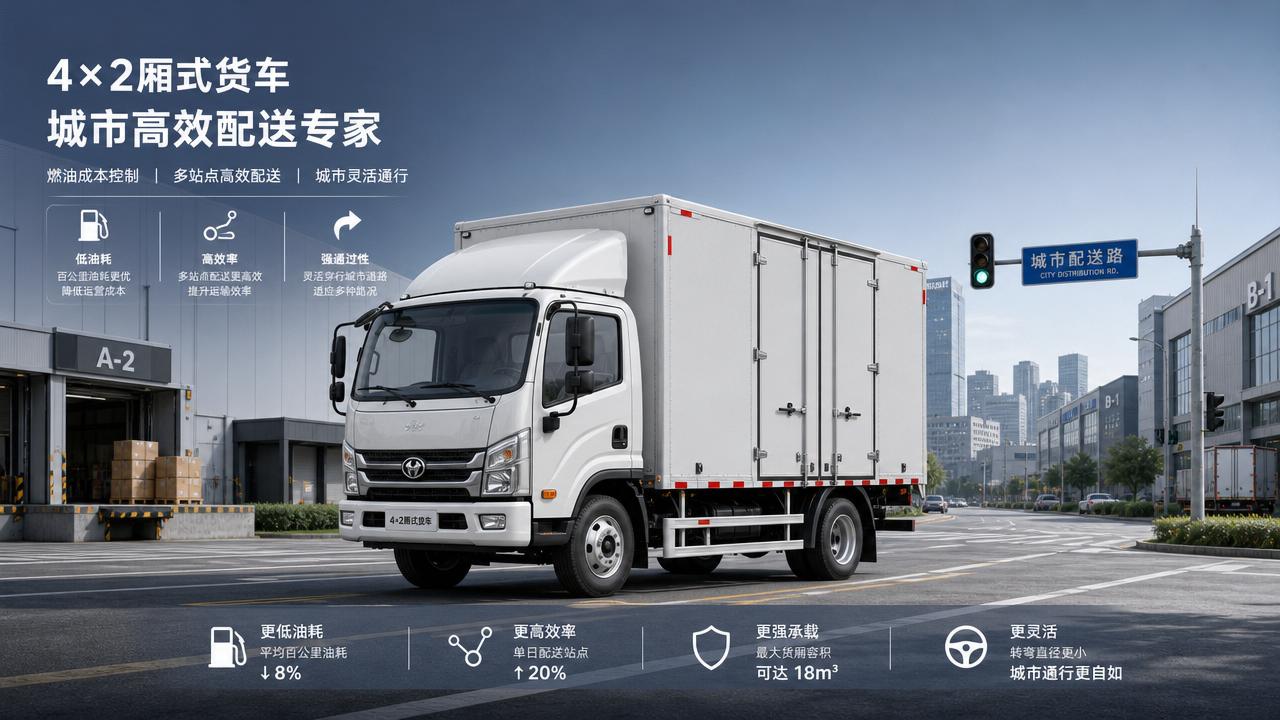
For project logistics in dense city networks, the 4_2 Cargo Truck is often the most balanced choice. It supports cost control without sacrificing route flexibility or daily delivery rhythm.
Fuel cost is not only a line item. It directly affects dispatch frequency, pricing margins, driver scheduling and urban delivery efficiency across short-haul operations.
When matched to the right urban scenario, a 4_2 Cargo Truck can reduce idle time, improve stop density performance and keep payload utilization at a productive level.
Shandong Livol Truck International Trade Co., Ltd. supplies export-ready commercial vehicles from FOTON, SHACMAN and SINOTRUK, backed by stable inventory, customization support and full-process delivery service.
Why urban delivery scenarios change the fuel cost equation
A 4_2 Cargo Truck in city use behaves differently from the same vehicle on regional roads. Frequent braking, restarting and waiting at intersections increase fuel consumption per kilometer.
Urban routes also create uneven loads. One trip may start near full payload and end with multiple partial drops, changing engine demand and average fuel efficiency.
Road width, delivery windows, parking limits and low-speed traffic matter as much as engine specification. Urban delivery efficiency depends on total route performance, not only fuel economy figures.
This is where the 4_2 Cargo Truck stands out. Its compact wheelbase, practical body size and useful carrying capacity make it suitable for urban freight tasks with repeated stops.
Scenario 1: Retail distribution routes with many stops
Retail replenishment routes usually involve supermarkets, convenience stores and local outlets. These routes require quick access, controlled unloading time and reliable arrival within narrow windows.
In this setting, a 4_2 Cargo Truck often delivers better daily efficiency than larger rigid trucks. It enters tighter streets more easily and reduces time lost in turning or searching for unloading space.
Fuel cost stays manageable when route planning limits unnecessary detours. A vehicle that can complete more successful drops per shift often offsets slightly higher stop-start fuel use.
Key judgment points for retail city routes
- Average number of stops per trip
- Street access restrictions during business hours
- Turnaround time at each unloading point
- Payload needed versus cubic cargo volume
- Driver familiarity with dense urban roads
Scenario 2: Construction support delivery inside expanding urban zones
Engineering vehicle operations inside cities often include tools, fittings, packaged materials and maintenance supplies for construction or utility support tasks.
These jobs value punctuality and access. A 4_2 Cargo Truck can move through mixed road conditions while keeping a useful payload for daily site support.
Fuel cost rises when vehicles wait at temporary gates, queue for entry or detour around restricted roads. Delivery efficiency improves when body configuration matches loading and unloading needs.
For example, a cargo box, stake body or customized structure can reduce handling time. Faster unloading means less engine idling and better route completion within one shift.
Core checks for site-support transport
- Road surface quality near temporary sites
- Need for side unloading or manual access
- Daily waiting time at entry control points
- Trip distance between depot and project area
Scenario 3: E-commerce and parcel delivery with time pressure
Urban parcel distribution focuses on route density, fast dispatch cycles and predictable daily cost. Here, the 4_2 Cargo Truck supports medium-volume loads between hubs and local nodes.
Fuel cost per trip matters, but fuel cost per delivered order matters more. Efficient loading layout and route sequencing often create bigger gains than chasing the lowest rated consumption.
A well-selected 4_2 Cargo Truck can carry more than light vans while still handling urban access. This balance helps reduce the number of trips and improve same-day distribution performance.
In high-frequency operations, even small savings matter. Reducing idling, improving load fill and shortening queue time can produce meaningful monthly fuel savings.
How different urban scenarios create different 4_2 Cargo Truck requirements
Not every city route asks for the same specification. The right 4_2 Cargo Truck depends on stop frequency, cargo type, road access and unloading pattern.
Practical ways to improve fuel cost and urban delivery efficiency
Improving 4_2 Cargo Truck performance in cities usually comes from operational discipline, not one single hardware decision. Several actions produce steady savings over time.
Vehicle selection actions
- Match engine output to actual urban load, not occasional peak use
- Choose body dimensions suited to local access limits
- Avoid overspecification that adds weight and fuel burden
- Select loading structures that reduce handling time
Operational actions
- Group drops by district to reduce repeated crossing traffic
- Schedule around peak congestion where possible
- Reduce warm idle and waiting idle through better coordination
- Monitor fuel use by route, not only by vehicle
Maintenance actions
- Keep tire pressure aligned with urban load conditions
- Inspect brakes and alignment to avoid drag losses
- Maintain injectors, filters and lubrication on schedule
- Check body condition to prevent avoidable extra weight
Common misjudgments when choosing a 4_2 Cargo Truck for city work
One common mistake is selecting by rated payload alone. In urban delivery, excessive size can lower efficiency by increasing turning difficulty, waiting time and fuel use.
Another mistake is using highway fuel figures as the main benchmark. City routes involve different driving patterns, so real operating cost should be tested against actual stop density.
Some operations ignore body type impact. An unsuitable cargo structure can slow each drop, increase idle time and reduce the number of completed deliveries per day.
There is also a tendency to overlook service support. Stable parts supply and professional after-sales assistance are essential for keeping the 4_2 Cargo Truck active and profitable.
A scenario-based approach to selecting the right 4_2 Cargo Truck
A useful selection process starts with route mapping. Measure stop count, trip distance, access restrictions, average dwell time and real payload patterns across one operating cycle.
Then compare those findings with vehicle dimensions, body options and support requirements. The best 4_2 Cargo Truck is the one that fits the route with the fewest compromises.
Shandong Livol Truck International Trade Co., Ltd. offers export solutions built around practical use cases. Authorized resources from FOTON, SHACMAN and SINOTRUK help support different city delivery needs.
With professional vehicle selection, customization, documentation, customs handling and logistics coordination, project operations can shorten decision cycles and improve supply reliability.
Next steps for reducing fuel cost in urban delivery
To improve urban delivery efficiency, start by reviewing actual route behavior instead of relying only on catalog specifications. Measure where fuel is lost and where time is wasted.
After that, define the required 4_2 Cargo Truck configuration by scenario. Focus on route access, load profile, unloading style and daily trip frequency.
A well-matched vehicle can lower operating cost while improving delivery consistency. That combination is what makes the 4_2 Cargo Truck a strong fit for modern urban engineering and distribution tasks.
For tailored vehicle recommendations, customization options and export support, a structured consultation can help translate city route data into a more efficient truck choice.
Search Starts Here