
News
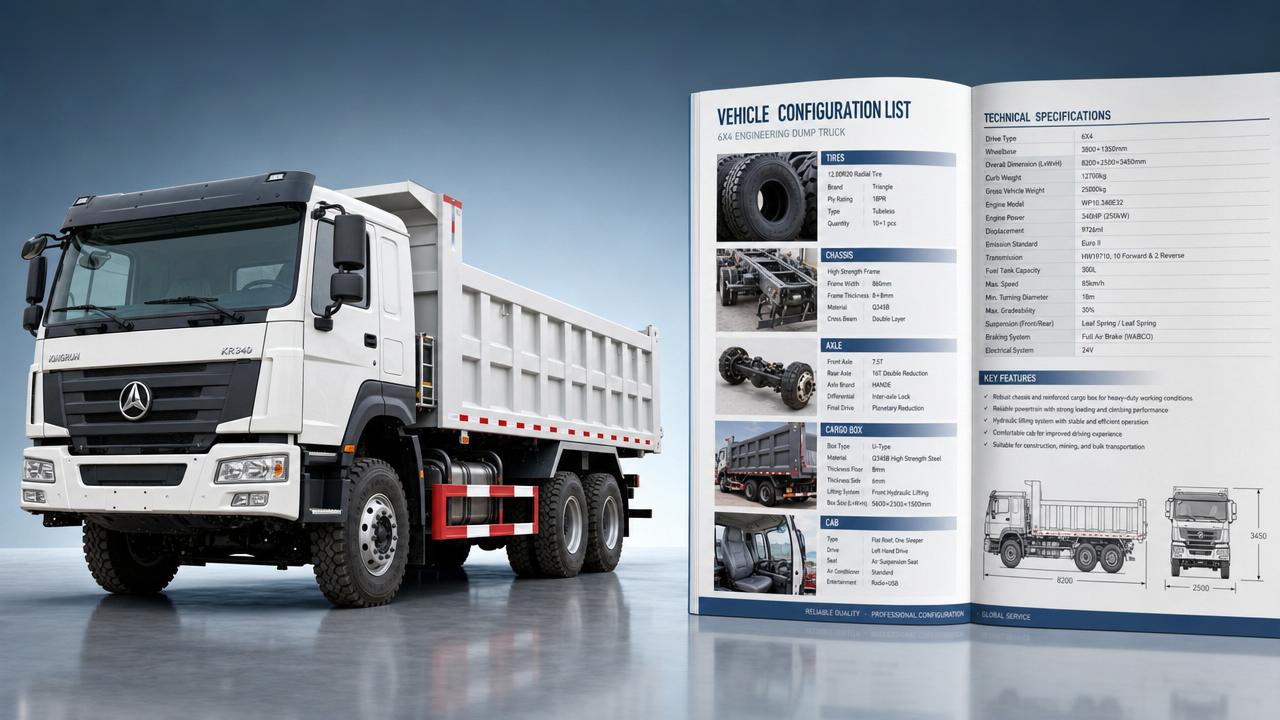
Why does the Cangshan Vehicle Configuration List matter so much?
When comparing engineering vehicles, the Cangshan Vehicle Configuration List is not just a technical sheet.
It is the document that shows whether a truck fits duty cycles, legal limits, operating roads, and total ownership cost.
Many decisions look correct at first glance, then fail later because one small specification was overlooked.
That missing item may be axle ratio, suspension type, emission level, tire size, or PTO compatibility.
In practice, the Cangshan Vehicle Configuration List helps separate a visually similar vehicle from one that truly matches the project.
This is especially important in engineering transport, where payload, terrain, and uptime directly affect project cost.
A complete reading also supports cleaner communication with exporters, body builders, logistics teams, and end users.
For companies handling Chinese commercial vehicles, this document is often the starting point for a serious evaluation.
Shandong Livol Truck International Trade works with FOTON, SHACMAN, and SINOTRUK models across export projects.
In that setting, reading the Cangshan Vehicle Configuration List accurately helps avoid mismatch before customization, shipping, and customs paperwork begin.
What exactly should you look at first on the Cangshan Vehicle Configuration List?
A good reading order prevents costly confusion.
Instead of starting with brand names or horsepower alone, begin with the vehicle identity block.
This usually includes model code, vehicle type, drive form, cab version, wheelbase, and intended application.
If this first block is wrong, every later comparison becomes unreliable.
After that, move to the core operating specifications.
- Engine model, rated power, torque band, and emission standard
- Transmission model, gear count, and PTO availability
- Axle capacity, axle ratio, and differential lock details
- GVW, curb weight, payload estimate, and body allowance
- Tire specification, suspension, braking, and fuel tank volume
These items explain how the truck will behave under load, on grade, and across long working hours.
More common mistakes happen when readers focus on a single line, such as engine output, and ignore ratio matching.
A strong engine with the wrong axle ratio can still produce poor climbing, fuel use, or top speed.
The table below gives a practical reading sequence for the Cangshan Vehicle Configuration List.
How do you judge whether the listed specs match real operating needs?
This is where the Cangshan Vehicle Configuration List becomes more than a reading exercise.
The key is to translate each specification into site conditions and workload patterns.
A vehicle used on paved regional roads needs different tuning from one entering mines, muddy access roads, or steep construction zones.
For example, a longer wheelbase may improve cargo layout and ride comfort.
Yet on tight sites, it can reduce turning convenience and chassis flexibility.
The same applies to tire selection.
A road-biased tire may lower fuel use, but wear faster under stone, mud, or repeated overload stress.
A practical approach is to test each major line against five questions.
- Does this spec support the actual payload, not only the advertised one?
- Can it handle route slope, surface condition, and climate?
- Will it pass local emission, axle load, and size rules?
- Does it fit the planned body, such as dump, mixer, or crane use?
- Are service parts and maintenance skills available after delivery?
In export trade, this last point is often underestimated.
A suitable vehicle on paper can become expensive if filters, clutch parts, or electronic components are hard to source locally.
That is why experienced suppliers usually connect configuration review with delivery planning and after-sales support.
Which lines on the Cangshan Vehicle Configuration List are most often misunderstood?
Several items look simple but create confusion during comparison.
Horsepower is the most obvious example.
Higher power does not automatically mean better site performance.
Torque curve, gearbox matching, and rear axle ratio decide whether that power is usable in low-speed heavy work.
Curb weight is another common trap.
Some readers treat a lower curb weight as always better.
In reality, lower weight may come with a lighter frame or different suspension package.
That may not be ideal for repeated heavy engineering duty.
Another area is dimensions.
Overall length, rear overhang, and frame height affect body installation, turning space, and compliance.
Even small differences matter when the vehicle must fit a local dump body standard or port shipping limit.
More subtle misunderstandings include these points.
- Assuming every 6x4 configuration performs the same under heavy haul conditions
- Ignoring PTO interface details for hydraulic or auxiliary equipment
- Treating emission level as paperwork only, not an operating restriction
- Missing whether the listed tires are radial, bias, tubeless, or tube type
A careful reading of the Cangshan Vehicle Configuration List should therefore connect each line to a real use consequence.
Can the Cangshan Vehicle Configuration List help compare brands and export options fairly?
Yes, but only if the comparison basis is controlled.
Engineering vehicles from FOTON, SHACMAN, and SINOTRUK may appear close in headline specifications.
The useful comparison starts when the Cangshan Vehicle Configuration List is lined up item by item.
That means matching wheelbase to wheelbase, axle to axle, tire to tire, and compliance level to compliance level.
Without that discipline, one vehicle may seem cheaper simply because essential equipment is missing.
In actual export work, vehicle selection is linked to stock availability, delivery time, body customization, and document readiness.
A technically suitable truck still needs a realistic export path.
This is where an experienced exporter can add value without turning the process into a sales pitch.
With authorized channels, sufficient inventory, and full-process coordination, configuration review becomes faster and more reliable.
The goal is not only choosing a vehicle, but choosing one that can be delivered, cleared, and supported correctly.
A short comparison checklist often works better than a long general discussion.
What risks appear when the Cangshan Vehicle Configuration List is read too quickly?
The biggest risk is false equivalence.
Two vehicles may share the same drive form and engine family, but still differ in operating value.
One may be prepared for construction transport, while the other is closer to general cargo duty.
Another risk is hidden cost migration.
A lower purchase price can later become higher fuel use, tire wear, driveline stress, or body modification expense.
There is also timing risk.
If a configuration issue is discovered after contract confirmation, changes may affect factory scheduling, export documents, and vessel booking.
To reduce these problems, it helps to pause before approval and confirm a few sensitive points.
- Optional items versus standard equipment
- Body installation requirements and PTO matching
- Legal payload under local road regulations
- Parts support for the selected engine and gearbox family
- Delivery lead time for the exact listed configuration
In other words, the Cangshan Vehicle Configuration List should be treated as a decision document, not a brochure attachment.
So what is the best next step after reading the Cangshan Vehicle Configuration List?
A useful next step is to convert the list into a short approval matrix.
Mark each item as suitable, uncertain, or not aligned with the intended job.
That keeps the review practical and prevents attention from drifting to only price or brand familiarity.
Where questions remain, ask for confirmation in writing on model code, drivetrain, axle ratio, payload basis, and optional equipment.
For export transactions, it is also wise to connect configuration review with documentation, shipping method, and after-sales planning early.
That is often where experienced suppliers stand out.
Teams with authorized brand access, stable inventory, and end-to-end export handling can help clarify whether the listed truck is truly order-ready.
The Cangshan Vehicle Configuration List becomes far more useful when read against operating reality, compliance demands, and delivery feasibility together.
If the goal is a sound comparison, start with the list, verify the critical lines, and build decisions around facts that will still matter after the vehicle arrives.
Search Starts Here