
News
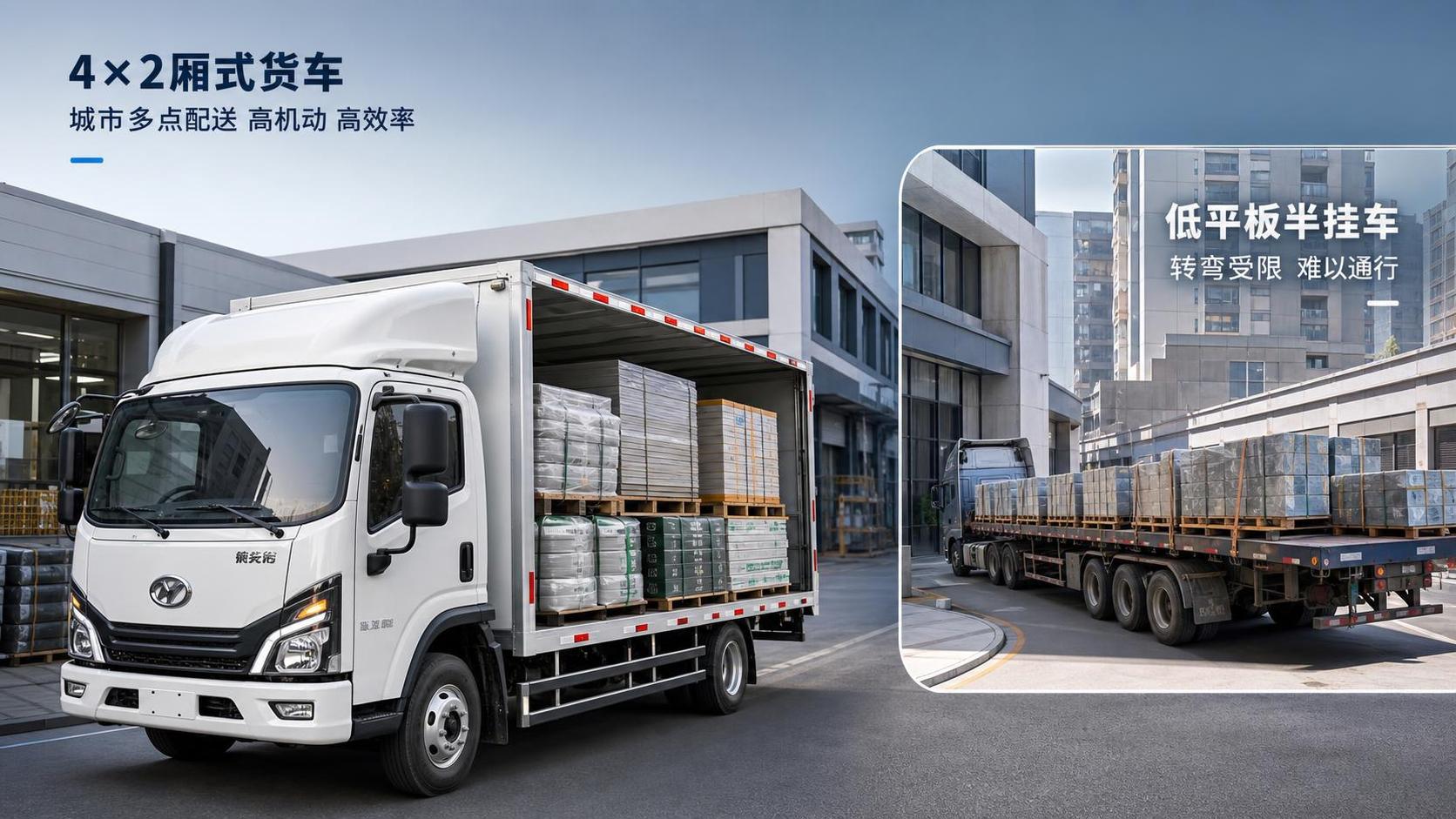
When the City Route Decides the Vehicle
For urban delivery projects, the real question is rarely whether a low plate can carry the load. The harder question is whether it can complete the route without wasting half the day in access delays, turning restrictions, unloading complications or permit issues. That is where a 4_2 Cargo Truck often becomes the better tool. In dense city work, transport efficiency is not defined only by payload. It is defined by how often the vehicle can enter, stop, unload, leave and repeat the cycle without disrupting the schedule.
A low plate trailer has a clear place in engineering logistics. It is useful when cargo is oversized, unusually heavy, or difficult to load onto a standard truck body. But many urban delivery jobs are not oversized transport jobs in the strict sense. They involve packaged building materials, maintenance equipment, municipal components, palletized parts, generators, small machinery, steel accessories, cable drums, pumps or spare assemblies that still need disciplined logistics, just not a trailer-based solution. On those routes, a 4_2 Cargo Truck usually performs better because the operating environment is tight, repetitive and time-sensitive.
Project managers sometimes focus too early on cargo dimensions and too late on route behavior. In city deliveries, route behavior decides more than people expect: basement loading bays with short approach angles, warehouse alleys with parked vehicles on both sides, temporary road works, market-area congestion, compound gates that open only partway, and delivery windows measured in minutes rather than hours. A vehicle that looks acceptable on paper can become inefficient once it starts making repeated stops inside a live urban network.
Why a 4_2 Cargo Truck Often Wins the Daily Cycle
The main advantage is maneuverability, but that word is often used too loosely. In practice, maneuverability means a driver can enter narrower streets, negotiate intersections with less lane occupation, reverse into shopfront or warehouse positions with fewer corrections, and clear loading points faster. Over one trip the gain may look small. Over six or eight drops in one shift, it becomes operationally meaningful.
A 4_2 Cargo Truck also simplifies the loading and delivery rhythm. Because the cargo body and tractor are one unit, dispatch control is more predictable. There is no articulation penalty when repositioning in cramped urban zones. At sites where unloading space is shared with other vehicles, security staff or municipal workers, that matters. The truck occupies less working space during stopping, and the driver generally has more flexibility when adjusting position to match forklift reach, hand unloading zones or side access conditions.
This becomes especially relevant when the route includes mixed stops. A low plate may be acceptable for a single direct trip from depot to site. It becomes inefficient when one vehicle is expected to serve a chain of locations: a contractor yard in the morning, a maintenance corridor in the central district, then an afternoon drop to a commercial renovation project. The more fragmented the route, the more valuable a compact rigid truck becomes.
Typical Urban Conditions That Favor This Configuration
A 4_2 Cargo Truck is usually the stronger option when cargo is within standard vehicle dimensions and the route includes frequent access changes. That covers a wide range of engineering-support deliveries: electrical infrastructure materials, HVAC replacement units, scaffold components, packaged construction supplies, waterworks fittings, tool containers and municipal repair stock.
It is also a practical choice where unloading conditions are only partly controlled. Many city jobs do not have a clean logistics zone waiting at arrival. Deliveries may happen beside an occupied sidewalk, inside a service lane, at the edge of a plant room entrance, or through a rear gate shared with waste removal and other contractors. In those conditions, a low plate can create unnecessary complexity because the vehicle footprint and turning behavior demand more coordination than the site can comfortably support.
Another recurring factor is turnaround discipline. Urban delivery projects often succeed or fail on whether each vehicle can finish enough cycles per day. If the operation depends on short-haul replenishment from a regional yard to downtown work fronts, the smaller time losses start to dominate cost. A longer vehicle may still move the goods, but it may lose productive hours in queuing, staging and repositioning.
Where Buyers Misjudge the Decision
One common mistake is assuming that lower deck height automatically means better delivery practicality. That is true for some equipment transport tasks, but not for ordinary urban engineering distribution. Low deck height helps when loading a machine with particular clearance or center-of-gravity concerns. It does not automatically solve street access, curbside unloading or route speed.
Another misjudgment is treating all urban deliveries as light logistics. Some are physically demanding even when they are not oversized. Repeated palletized cargo, dense hardware loads or mixed-material shipments can create weight distribution and body configuration questions that need proper vehicle matching. This does not mean the low plate becomes the default choice. It means body type, axle layout, suspension suitability and loading method should be assessed together. A 4_2 Cargo Truck can be highly effective, but only when the body and load plan match the actual job.
There is also a planning error that shows up in export projects and fleet expansion: selecting around occasional exceptional loads instead of the daily transport profile. If one route in twenty requires unusual dimensions, it is usually better to solve that one route with a special dispatch arrangement than to run the entire daily city fleet on a less efficient format.
What Operations Teams Usually Check Before They Commit
In practice, the best selection discussions are not centered on catalog claims. They revolve around a few grounded questions. How many stops per trip? What is the narrowest access point? Is unloading done by forklift, crane, tail lift or manual crew? Are there fixed delivery time windows? Does the route enter older urban districts, basement ramps or mixed commercial streets? Is the cargo regular enough to standardize loading, or does every shipment change?
Those questions matter because the cost structure of city distribution is rarely driven by fuel alone. Driver hours, waiting time, failed first delivery attempts, extra escort coordination, and off-route repositioning can quietly exceed the savings expected from choosing a trailer-based format. A 4_2 Cargo Truck often reduces these hidden costs simply by making the job easier to execute repeatedly.
For export buyers and project fleets, after-sales practicality also enters the picture. A vehicle used in dense urban service needs stable uptime, straightforward maintenance access and parts support that matches the operating schedule. Shandong Livol Truck International Trade Co., Ltd. works with authorized channels for FOTON, SHACMAN and SINOTRUK and supports customers through vehicle selection, customization, documentation, customs clearance and logistics. In city-delivery projects, that kind of support matters less as a marketing point than as an operating safeguard: the wrong body or configuration ordered at the beginning is expensive to correct after the fleet is in service.
The Jobs Where a Low Plate Still Makes More Sense
A low plate remains the better answer when the load itself creates the constraint. That includes machines with non-standard height, equipment that benefits from lower loading geometry, or cargo whose shape makes standard cargo-body transport impractical. If the transport task is fundamentally an equipment move rather than an urban delivery cycle, the comparison changes. In that case, route flexibility may become secondary to loading safety and dimensional compliance.
This distinction is worth keeping clear. Some engineering contractors use the words delivery and transport interchangeably, but the vehicle decision changes when the cargo moves from “materials and parts” to “special equipment.” Once abnormal dimensions, loading angle sensitivity or machine handling issues enter the job, a low plate may be justified even if the route passes through the city.
A More Reliable Way to Choose
If the cargo fits a standard truck body, the route includes frequent stops, and delivery points are constrained by urban access, a 4_2 Cargo Truck is often the more efficient and less troublesome choice. It matches the realities of city logistics better: tighter turns, shorter stopping footprints, cleaner dispatch rhythm and quicker daily recovery between jobs.
The decision becomes clearer when buyers stop asking which vehicle looks more capable and start asking which one wastes less time on the actual route. For urban engineering deliveries, that usually points toward the rigid truck. Before finalizing a fleet or a single-project purchase, it is worth checking the route map, gate widths, unloading method, stop frequency and cargo form together. That is usually where the right answer shows up.
Search Starts Here