
News
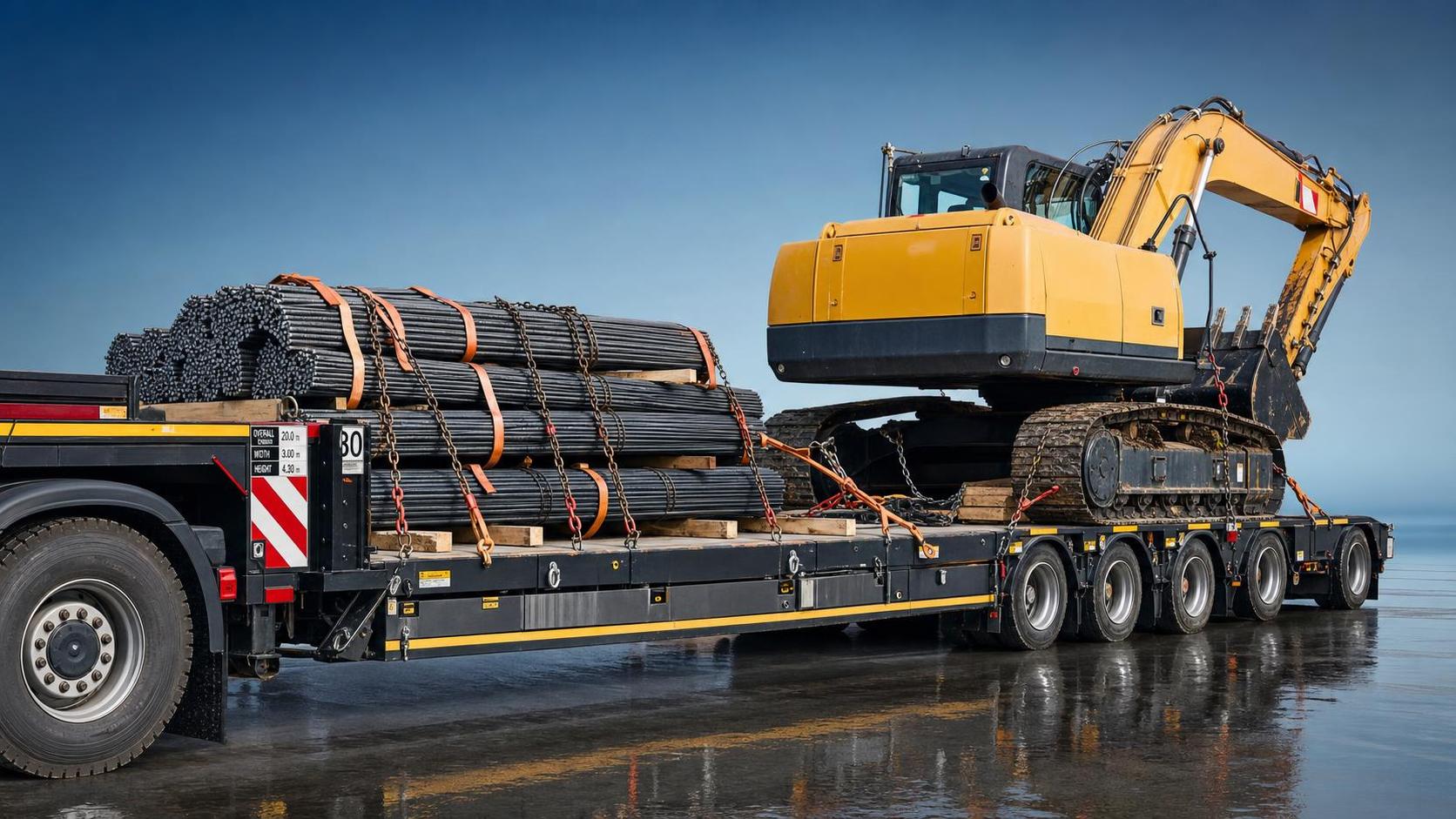
Flatbed Semi-Trailer Load Limits: What Affects Stability and Cargo Safety
The load limit of a Flatbed Semi-Trailer is often misunderstood as a single number printed on a plate or in a specification sheet. In practice, that number only describes part of the safety envelope. A trailer may be legally rated to carry a certain payload and still become unstable if the cargo is positioned too high, too far forward, too far back, or secured in a way that allows small shifts during braking and cornering. For quality control and safety management, that distinction matters more than the headline capacity. Cargo safety failures rarely come from one dramatic mistake alone. They usually begin with ordinary decisions that looked acceptable in isolation.
A flatbed platform is inherently versatile. It can carry machinery, steel products, precast elements, timber, containers in some configurations, and oversized cargo that would not fit inside enclosed bodies. That same flexibility creates a wider range of loading conditions. Unlike a box trailer, a flatbed gives less passive restraint from the body structure. Stability depends much more heavily on weight distribution, center of gravity, deck condition, suspension behavior, tire condition, and the quality of lashing. This is why two loads with the same mass can present very different risk levels.
The real meaning of a load limit
In engineering and transport operations, load limit should be read through at least three lenses: structural capacity, legal compliance, and dynamic stability. Structural capacity is about what the chassis, cross-members, axles, tires, kingpin area, suspension and wheels can support without damage or accelerated fatigue. Legal compliance depends on local axle weight limits, gross vehicle weight rules, road authority restrictions, and permit conditions for abnormal loads. Dynamic stability is the part that is easiest to underestimate. It asks a different question: can the combination remain predictable under braking, lane changes, uneven pavement, crosswinds, slopes and emergency maneuvers?
A trailer can be within its nominal payload rating and still fail the dynamic test. This is common when dense cargo is concentrated over a short section of deck, or when a tall load raises the center of gravity beyond what is comfortable for the route and speed involved. Safety managers usually see the consequences after the fact: tire overload on one axle group, poor steering response at the tractor, excessive roll, broken lashings, deck damage, or cargo movement that did not show up during loading.
Axle distribution changes everything
The most important technical point is that payload does not act on the trailer as a uniform block unless it is actually loaded that way. Every item creates a load path. Where the cargo sits relative to the kingpin and axle group directly affects the load seen by the tractor drive axles, trailer axles and frame. If cargo is too far forward, kingpin load rises and the tractor may carry more than intended. If it is too far rearward, steering axle unloading or trailer axle overload can appear even when gross mass remains unchanged.
For quality control teams, this means pre-shipment inspection should never stop at counting total weight. The loading plan needs to reflect actual dimensions, support points and the likely center of gravity of the cargo. Machinery with asymmetric internal mass, bundled steel with uneven stacking, and fabricated structures with offset lifting points are frequent sources of false assumptions. A load can look centered visually and still be mechanically unbalanced.
This is also where trailer design matters. Flatbed semi-trailers are not all equivalent. Axle spacing, deck length, gooseneck structure, suspension type, tire specification, and frame reinforcement influence how the trailer handles concentrated loads. Some configurations are better suited to general cargo, while others cope more safely with heavy point loads or longer pieces that create bending stress across the deck.
Stability is driven by height, not only weight
A common loading error is to focus on whether the trailer can “carry” the cargo while paying too little attention to how high the mass sits above the deck. The higher the center of gravity, the greater the overturning moment during cornering or sudden evasive action. This is one reason why light but bulky industrial equipment can feel less stable in transport than denser cargo with a lower profile. The trailer may not be overloaded in the usual sense, yet the rollover margin becomes smaller.
Road conditions amplify that effect. Cambered roads, potholes, unpaved access routes, terminal ramps and uneven loading yards generate transient forces that do not appear in static calculations. For overseas deliveries and mixed-route operations, this matters even more because cargo may pass through ports, depots and regional roads with very different surface quality. A load that remains calm on a highway can begin to work against its restraints after repeated vibration and twisting in lower-speed sections.
Cargo securing is part of the load limit, not a separate topic
Many incidents described as securing failures actually begin as load limit misjudgments. When a trailer is loaded in a way that creates high forward force under braking, or side force during cornering, the lashing system is being asked to compensate for a poor loading condition. Chains, web lashings, blocking, friction mats and edge protectors all have their place, but they are not substitutes for sound weight distribution. Securement should control movement, not rescue an unstable arrangement.
In practical inspection work, it helps to evaluate the load in this order:
That sequence reflects operational reality. You do not start by tightening straps and hope the rest works out.
Trailer condition is part of cargo safety control
Safety managers sometimes inherit a hidden problem: the loading method is acceptable on paper, but the trailer entering service is not in the same condition as the trailer assumed in the plan. Worn suspension components, tire pressure variation, damaged deck surfaces, corroded lashing points, and unauthorized repairs can all change how forces are transmitted. A flatbed with uneven deck friction or weakened anchorage points should not be treated as equivalent to a well-maintained unit of the same nominal specification.
This is particularly relevant for export and cross-border operations, where fleet utilization is high and turnaround pressure can be strong. Companies with stronger vehicle control usually reduce risk by aligning procurement, pre-delivery inspection, and loading procedures rather than treating them as separate functions. In commercial vehicle export practice, that alignment often decides whether a buyer receives equipment that is merely compliant on paper or operationally dependable in daily transport.
For exporters and fleet suppliers with broad brand coverage, such as organizations handling FOTON, SHACMAN and SINOTRUK commercial vehicle channels, the practical advantage is not only inventory availability. It is the ability to match trailer and tractor configurations more precisely to route profile, cargo type and service intensity. That matters because load safety is a system issue. Tractor capacity, brake performance and fifth-wheel compatibility influence the same transport outcome as the trailer deck and axle group.
Common misunderstandings that lead to avoidable risk
One misunderstanding is that a lower-speed route is automatically safer for a marginal load. In reality, rougher roads, tighter turns and more frequent braking at lower speeds may place more repeated stress on the cargo and restraints than a steady highway section. Another is that dense cargo is always easier to manage than light cargo. Dense cargo can create severe point loading on the deck and axles, especially when its footprint is small.
There is also a tendency to separate legal compliance from physical safety. Operators may assume that if axle limits and gross weight are within local rules, the risk is controlled. Those rules are necessary, but they are not a route-specific dynamic assessment. They do not account for every variable that quality personnel deal with: packaging integrity, moisture exposure, timber blocking quality, trailer maintenance level, or repeated transloading during international logistics.
A final mistake is relying too heavily on experience without documentation. Veteran loaders often develop good instincts, but safety systems become fragile when critical judgments are not translated into repeatable checks. The best transport operations usually turn practical knowledge into loading diagrams, inspection points, weigh verification, lashing standards and release procedures that newer staff can follow consistently.
What a sound decision process looks like
When reviewing a Flatbed Semi-Trailer loading plan, the useful question is not “Is this trailer big enough?” but “Does this trailer-cargo-route combination stay within a stable operating window?” That requires checking rated capacities, yes, but also the less visible details: cargo geometry, support spacing, center-of-gravity height, axle distribution, securement method, deck condition, and route characteristics. If one of those variables changes, the acceptable payload may change with it.
For quality control teams, a disciplined approach often means stopping short of easy assumptions. Verify actual cargo weight where possible. Review whether the load is uniform or concentrated. Check if securing points are rated and in serviceable condition. Consider how the load behaves after several hours of vibration, not only at the loading bay. And when specifications from different suppliers are being compared, look beyond the nominal tonnage. Trailer suitability is determined by the whole structure and the operating context around it.
That is the practical meaning of load limits in real transport work. They are not fixed promises detached from conditions. They are operating boundaries shaped by structure, regulation and motion. The teams that manage flatbed safety well are the ones that treat those boundaries as something to interpret carefully, not merely something to read off a plate.
Search Starts Here