
News
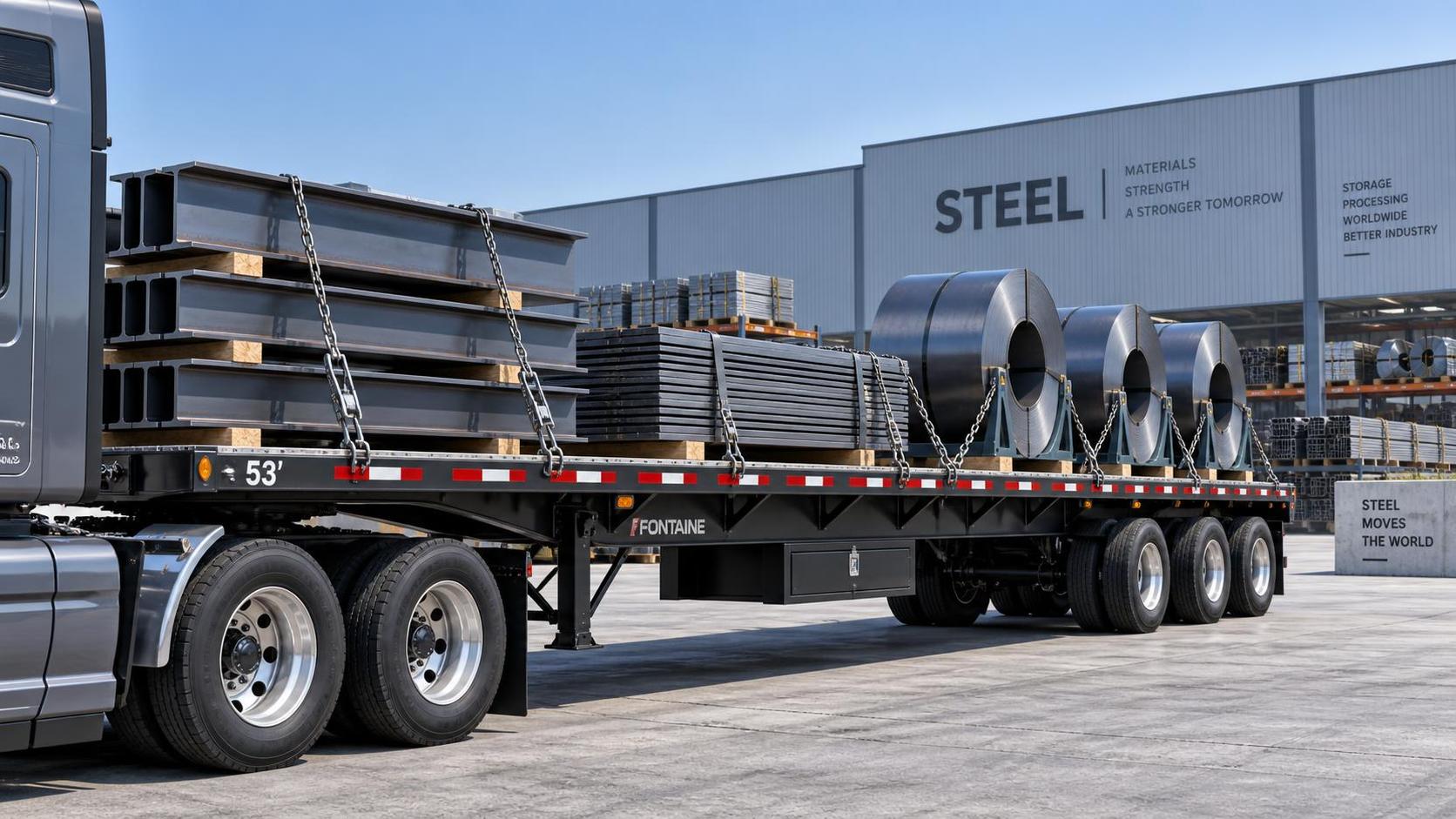
A steel shipment can appear straightforward on a loading plan: the product length is known, the gross weight is known, and a standard Flatbed Semi-Trailer is available. The difficulty often emerges when the load is positioned. A trailer may be long enough to contain the steel, yet still place too much weight on one axle group, leave inadequate room for blocking and tie-downs, or create an overhang problem at the rear.
For most general steel loads, a 48-foot or 53-foot deck is the practical starting point. A 48-foot flatbed commonly suits steel coils, plate bundles, fabricated components, and many beam loads. A 53-foot deck is more appropriate when the shipment includes long structural sections, multiple separated bundles, or cargo that needs additional space for dunnage, securement hardware, and weight distribution. However, deck length should not be selected from cargo length alone. The correct specification depends on the steel product, its mass concentration, the axle layout, legal dimensions on the intended route, and how the load will be secured.
Start with the load’s usable footprint, not its nominal length
The usable deck length is always less than the advertised trailer length. Headboard clearance, rear clearance, stake pockets, winch locations, coil wells, bulkhead structure, and the space needed to position chains or straps all affect where steel can actually sit. A load that is technically 48 feet long may not be safely or legally carried on a 48-foot deck without overhang, depending on its shape and the required end clearance.
For technical evaluation, separate the cargo into three dimensions:
- Physical length: the end-to-end dimension of a beam, pipe bundle, plate pack, or fabricated steel assembly.
- Supported length: the length that must rest on dunnage, saddles, coil racks, or deck contact points.
- Securement envelope: the extra space required for chains, straps, edge protection, blocking, anti-slip material, and access to anchor points.
A long bundle of steel sections may require only a few support locations, but its full length governs overhang and overall vehicle dimensions. A dense coil may occupy a short section of deck, but its support and securement arrangement has much greater influence on trailer selection than its diameter. This distinction prevents a common mistake: choosing a long deck for a compact but extremely heavy steel load when the more important requirement is axle placement and concentrated-load capacity.
Typical deck-length choices by steel product
These are selection directions rather than legal limits. A trailer that works for one 48-foot beam bundle may not work for another bundle of the same length if the center of gravity, bundle rigidity, or loading arrangement differs. The deck must provide enough room to place the load where its mass can be shared appropriately between tractor and trailer axles.
Steel coils: deck length is rarely the first constraint
Coils demonstrate why trailer length alone can be misleading. A coil may take up only a small portion of a flatbed deck, yet it can impose a very high load on a limited deck area. The evaluator should first determine the coil’s gross weight, width, outside diameter, eye orientation, and required loading method. Only then should deck length be finalized.
A standard 48-foot flatbed is often suitable for coil transport because it provides enough longitudinal room to position one or several coils while retaining space for coil racks, timber, chocks, chains, and separation between units. The decisive issue is whether the coil positions can be adjusted to keep axle groups within allowable limits. A 53-foot deck may give more flexibility for multiple coils or mixed coil sizes, but the additional deck length does not automatically increase legal payload or concentrated-load capability.
For coils loaded eye-to-the-side, the trailer needs an appropriate cradle arrangement and effective lateral restraint. For eye-to-the-rear loading, the securement forces and blocking layout change. In either case, the trailer deck should have suitable anchor points and a deck structure rated for the expected point loading. A longer trailer with insufficient anchor capacity or weak deck support is not a safer coil carrier than a properly specified shorter unit.
Long steel products require a length and overhang calculation
Beams, channels, rails, pipe bundles, and reinforcing bar are more directly affected by deck length. Here, the first calculation is simple: compare cargo length with the usable supported deck length, then assess any permitted front or rear projection. The second calculation is more important: establish where the load center will sit after dunnage, end clearance, and securement access are included.
A 48-foot deck is commonly workable for steel members that fit within the deck or can be carried with allowable overhang. It remains a widely used baseline because it provides a practical balance between maneuverability, loading space, and compatibility with common transport operations. A 53-foot deck becomes more attractive when the load approaches the usable length of a 48-foot platform, when several bundles must be separated to prevent damage, or when moving the cargo rearward or forward is needed to obtain acceptable axle loads.
Do not use trailer length to compensate for an undefined overhang plan. The allowable projection, required marking, lighting, and route restrictions vary by jurisdiction. A technical specification should identify the operating country or region and confirm the permitted overall combination length before assigning a trailer deck. This is especially important for structural steel, where a few additional feet of cargo length can change the route and permitting requirements.
Why a longer deck may not solve a weight-distribution problem
Steel creates a particular challenge because it is heavy relative to its occupied deck area. Adding five feet of deck can create more placement options, but it does not change the position of the trailer’s axle group, kingpin, or tractor drive axles. If a concentrated load is placed too far forward, the tractor may become overloaded. If it is placed too far rearward, the trailer axle group may exceed its allowable loading or steering performance can be affected.
Before choosing between 48 and 53 feet, calculate the load center of gravity and compare it with the axle geometry. This requires more than total shipment weight. The calculation should account for:
- Kingpin-to-axle distance and axle-group location;
- Trailer tare weight and its own center of gravity;
- Tractor configuration and axle ratings;
- Number, weight, and spacing of individual steel bundles or coils;
- Dunnage height and support position, which can shift the effective load placement;
- Fuel, equipment, and other operational weight carried by the tractor.
For a load with a compact center of gravity, the operator may need to position it within a narrow deck zone. In that situation, a 53-foot flatbed can be useful only if it provides usable adjustment range around that zone. If the cargo must still sit near the same location to satisfy axle loads, most of the additional deck remains unused. Conversely, for several coil units or separated plate bundles, the longer platform can provide meaningful flexibility because the individual masses can be distributed along the deck.
Deck configuration matters as much as deck length
The phrase Flatbed Semi-Trailer covers several configurations that behave differently with steel. A standard flatbed provides open side access and is often suitable for general steel products. A step deck may be needed where load height is the limiting issue, but its upper and lower deck sections complicate long-load support and weight placement. Extendable trailers support long structural members but require careful evaluation of reduced capacity, altered axle geometry, and permitted operating dimensions.
For dense steel loads, assess the deck’s rated concentrated-load capacity rather than relying only on the published gross payload. A trailer may have sufficient total capacity while still requiring load-spreading timber, steel plates, or a specified support arrangement to prevent localized deck damage. This is particularly relevant for coils, narrow slab supports, and small-footprint fabricated parts.
Anchor layout deserves equal attention. Long products need tie-down points at practical intervals along the deck. Coil transport may require chain positions that align with coil cradles and allow proper angles without rubbing against sharp edges. Steel bundles can also require stake pockets, removable stakes, headboards, or side restraints depending on their tendency to roll, slide, or separate under braking.
A practical specification process
Instead of asking only, “How long is the steel?” prepare a load sheet before requesting a trailer quotation or approving a fleet specification. The sheet should identify each product’s dimensions, unit weight, bundle count, loading orientation, expected dunnage, and unloading method. Include whether forklifts, cranes, magnets, coil loaders, or side loading will be used, since handling equipment affects available deck space and acceptable trailer construction.
- Measure the longest transportable unit. Use the actual shipping length, not a nominal product category length. Include end fittings, packaging, protective frames, and bundle protrusions.
- Map the support points. Determine where dunnage, coil saddles, or blocking must sit. Steel should not be supported at locations that permit bending, rolling, or bundle deformation.
- Allow space for securement. Confirm that chains, straps, binders, edge protectors, and blocking can be installed without unsafe angles or inaccessible anchor points.
- Model axle loading. Place the load according to its individual mass centers, not merely by its overall outline. Check both empty and loaded tractor-trailer axle conditions.
- Check transport dimensions. Review overall vehicle length, cargo projection, height, width, route limits, and any required permits in the operating territory.
- Confirm deck and securement ratings. Verify concentrated-load capability, anchor capacity, flooring condition, and the suitability of any coil well, stakes, or other specialized equipment.
This process often leads to a clearer conclusion than selecting a deck by habit. A fleet carrying mostly coils and plate bundles may standardize on 48-foot units with suitable coil and securement provisions. An operation handling varying structural sections, pipe bundles, and fabricated steel may gain enough loading flexibility from 53-foot decks to justify the added length. Extremely long products should trigger an assessment of extendable equipment and route permissions rather than forcing the load onto a conventional platform.
Common sizing errors during steel trailer evaluation
Using cargo length as the only selection rule
A load can fit on the deck and still be unsafe to haul. This error is most visible with coils and short, dense bundles. Their cargo length is small, but their placement determines axle loading and securement performance.
Ignoring the loading method
Crane loading, forklift loading, and coil-loader handling do not create the same deck requirements. Forklift tines may need clear access under a bundle. Crane loading may require dunnage locations that prevent sling damage. A trailer selected only for road dimensions can become inefficient or unsafe at the loading point.
Assuming a 53-foot deck always carries more steel
A longer deck may carry longer or more widely spaced cargo, but legal payload is governed by axle ratings, gross vehicle limits, trailer design, and local regulations. The extra deck can improve distribution; it does not remove the need for weight calculations.
Leaving no margin for bundle movement or securement access
Steel should not be packed so tightly against the front or rear of the deck that load restraint cannot be inspected or adjusted. Space for chain angles, blocking, end protection, and post-loading checks is part of the required deck length.
Questions that usually affect the final choice
Is a 48-foot flatbed enough for most steel loads?
Yes, it is often enough for common coils, plate bundles, pipe bundles, and many structural products. It should be treated as a baseline, not an automatic answer. Confirm usable deck length, concentrated-load rating, anchor layout, and axle loading for the actual cargo mix.
When does a 53-foot deck make more sense?
Choose a 53-foot deck when the steel is close to the usable length of a 48-foot trailer, when multiple bundles need separation, or when longer deck space allows the load to be positioned correctly over the axle groups. It is particularly helpful for variable structural-steel work, but only after checking local dimensional limits.
Can a shorter deck be used for steel coils?
A shorter deck can be suitable for dedicated coil operations where the coil count, axle arrangement, and route requirements are well defined. The trailer must still provide enough adjustment range for axle loading and enough deck area for cradles, blocking, and securement. Shorter length should not reduce the ability to inspect or restrain the load properly.
Should overhang be used to avoid buying a longer trailer?
Only when the cargo, route, and applicable rules allow it. Overhang affects overall vehicle length, marking requirements, turning clearance, and route suitability. It should be an engineered transport condition, not an informal workaround for insufficient deck length.
Search Starts Here