
News
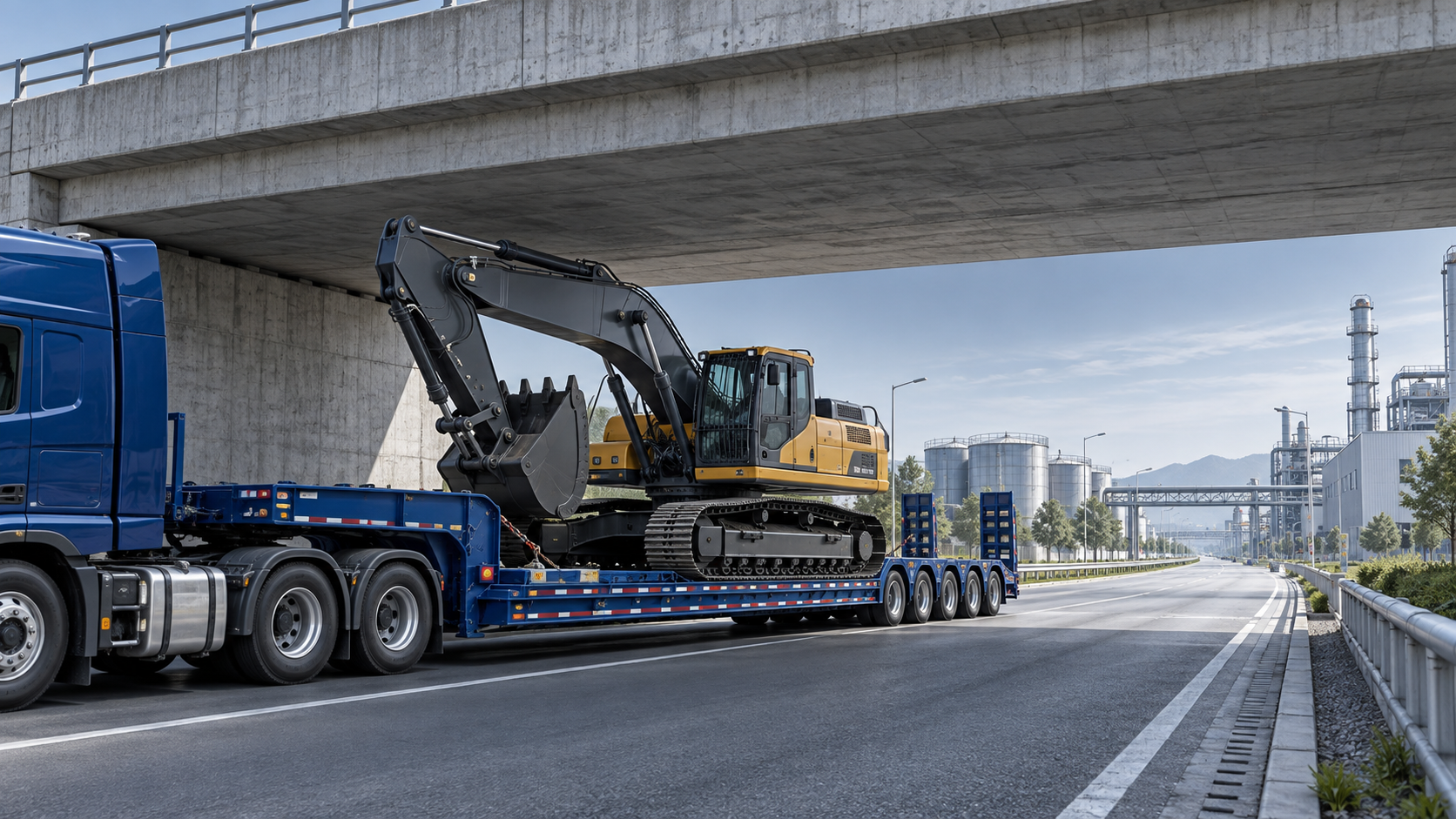
When Does a Low Plate Trailer Improve Clearance for Tall Equipment?
When a machine is too tall for a planned transport route, the problem is rarely limited to the machine itself. Overall loaded height affects bridge clearance, overhead utilities, tunnel access, toll-road eligibility, permit requirements, escort planning, and the practical availability of alternative routes. For procurement teams moving excavators, drilling rigs, cranes, industrial modules, or mining equipment, choosing the right trailer configuration can be the difference between a manageable shipment and a transport plan that becomes expensive before the vehicle even leaves the yard.
A Low Plate trailer improves clearance when its loading deck places the equipment meaningfully lower than a conventional flatbed or standard semi-trailer. This sounds straightforward, but the decision requires more than comparing deck heights in a brochure. The relevant question is whether the reduction in loaded height solves a real route constraint without creating new issues involving ramp angles, axle loading, turning radius, ground clearance, cargo support, or local transport rules.
In heavy-equipment logistics, lower is not automatically better. It is better only when the trailer geometry matches the machine, the route, and the operating conditions at both ends of the journey.
The clearance advantage comes from the loaded-height calculation
The basic calculation is simple: overall transport height equals the trailer’s effective deck height plus the height of the equipment above its support points. A conventional trailer may leave a tall machine sitting high above the road surface. A Low Plate arrangement uses a lowered loading area—often referred to in the market as a low-bed or low-deck configuration—to reduce that starting point.
That reduction can be decisive for machines with fixed upper structures. Examples include crawler excavators with booms that cannot be lowered enough, piling and drilling rigs, large wheel loaders, elevated work platforms, and industrial machinery mounted on tall skids. It is especially valuable where the transported unit cannot be economically dismantled or where dismantling would create technical, labor, and reassembly risks.
Procurement teams should not rely on the published machine height alone. The transport height may change because of removable attachments, tire pressure, suspension position, timber blocking, securing hardware, protective covers, or the way tracks and outriggers sit on the deck. For some loads, a few centimeters determine whether a route is workable. The shipping drawing should therefore show the actual transport configuration, not only the equipment’s standard operating dimensions.
Situations where a Low Plate trailer is usually worth considering
The strongest case for a Low Plate trailer arises when route clearance is the dominant constraint. If the machine can be loaded on a standard deck but exceeds the lowest verified overhead restriction on the planned route, lowering the deck may avoid a route redesign. This can matter on routes that include older bridges, low industrial gates, underpasses, site entrances, or temporary overhead services around construction zones.
It also becomes relevant when the project has repeated movements rather than a single exceptional shipment. A contractor relocating equipment between sites may accept special routing once, but repeated detours, escorts, and permit administration can become a recurring operational burden. A properly specified low-deck trailer can make the transport plan more repeatable, provided the equipment mix is consistent enough to justify the configuration.
Another common situation is cross-border delivery. Clearance rules, permit thresholds, road enforcement practices, and accepted vehicle configurations can vary substantially between markets. A trailer that works efficiently in one country may be difficult to register, operate, or permit elsewhere. For export purchases, the decision should begin with the destination market’s dimensional requirements and the expected road network, rather than the trailer specification commonly used at the factory or port of origin.
Low loading height can also improve stability. Lowering the machine’s center of gravity generally reduces the tendency of the load to sway or roll during cornering and uneven-road travel. However, this benefit does not replace load distribution analysis. A low-mounted load can still overload an axle group, impose too much kingpin load on the tractor, or create unstable behavior if it is positioned incorrectly.
A lower deck does not solve every transport problem
A frequent purchasing mistake is to treat clearance as the only selection criterion. The lower central section of a trailer may create a reduced breakover angle. That can become a problem at steep site entrances, rough quarry roads, temporary ramps, ferry ramps, or loading yards with abrupt grade changes. A trailer that clears a low bridge may bottom out before it reaches the worksite.
Loading method deserves the same attention. Equipment that can drive onto a trailer needs suitable ramp length, ramp capacity, traction, and approach angle. Machines with low ground clearance or long wheelbases may require specialized ramps or a different loading method. Where loading is performed by crane, the trailer still needs adequate access around the deck and sufficient structural suitability for the intended concentrated load points.
The machine’s contact geometry matters as well. Crawler tracks, wheeled axles, outriggers, and skid-mounted equipment distribute weight differently. A deck may have sufficient nominal payload while still requiring reinforced areas, track guides, hardwood packing, or a different axle layout. The procurement review should identify where the cargo actually bears on the trailer, not merely how much it weighs in total.
There is also a practical maintenance consideration. Lower configurations may be exposed to rough-road impacts, debris, water, and more demanding ramp contact. For equipment moving on paved intercity routes, this may be manageable. For frequent use on construction, mining, or poorly maintained access roads, suspension type, chassis protection, spare-parts access, and workshop capability become part of the selection decision.
Compare the trailer against the route, not against another brochure
A useful procurement review starts with a route-and-load sheet. It does not need to be complicated, but it should turn general requirements into checkable points before a purchase order is issued.
- Actual transport height, length, width, mass, and center-of-gravity position of the equipment.
- The lowest confirmed overhead clearance on the intended route, including site access roads where information is available.
- Required deck length, usable loading width, loading method, and approach or departure angles.
- Permitted axle loads, gross combination limits, and dimensional rules in the operating market.
- Tractor compatibility, including fifth-wheel height, coupling requirements, traction needs, and electrical or braking interfaces.
- The condition of loading yards, jobsite access roads, border crossings, ports, and maintenance facilities.
This exercise often reveals that the right answer is not simply “the lowest possible deck.” Sometimes a standard low-bed is adequate. In other cases, a detachable gooseneck, extendable deck, multi-axle design, or a configuration with a recessed loading area may be more suitable. The correct option depends on whether the challenge is height, length, weight distribution, access angle, or a combination of these factors.
Three comparisons that affect the decision
Procurement risks often appear at the interfaces
The trailer itself may be correctly built yet still be unsuitable for the complete transport system. The coupling height of the tractor changes the trailer attitude. Suspension behavior changes clearance while driving. The selected tires affect deck height and service availability. Brake and electrical connections must match the tractor specification and destination-market requirements. These interfaces are often more consequential than cosmetic differences between trailer models.
Documentation should be treated as part of the technical package, especially for international supply. Buyers typically need accurate dimensional drawings, axle and suspension information, weight data, component specifications, and documentation appropriate for customs, registration, or project approval. The exact requirements depend on the destination and intended use, so they should be clarified early rather than after shipment has been booked.
It is also sensible to distinguish between a trailer designed for occasional abnormal-load work and one intended for daily fleet operation. Frequent operation places greater value on parts availability, brake and suspension serviceability, tire commonality, and a realistic maintenance plan. A theoretically suitable low-deck design becomes a costly asset if local technicians cannot maintain its key components or obtain replacements within a workable timeframe.
How an export-oriented supplier can support a better specification
For buyers sourcing tractors and trailers across borders, the most useful supplier support is not a generic recommendation. It is the ability to coordinate the trailer selection with the prime mover, cargo profile, export documentation, and delivery plan. Shandong Livol Truck International Trade Co., Ltd., based in Shandong, China, works in commercial vehicle export and is an authorized domestic and overseas dealer for FOTON, SHACMAN, and SINOTRUK. Its authorized 4S store network and available vehicle inventory can be relevant where a project requires the tractor and transport equipment to be reviewed as one operating combination rather than purchased in isolation.
For a Low Plate trailer inquiry, the useful starting materials are the machine drawing, expected payload, destination country, route type, preferred loading method, and tractor requirements. With that information, the discussion can focus on usable deck height, axle arrangement, coupling compatibility, required options, documentation, shipping preparation, customs handling, and after-sales expectations. This is a more reliable basis for procurement than choosing a configuration solely from a nominal capacity label.
The practical decision point
A Low Plate trailer improves clearance when lowering the equipment resolves a verified height constraint and does so without compromising loading access, legal axle distribution, route clearance beneath the trailer, or fleet usability. It is most compelling for tall machinery that cannot be reduced in height easily and must move repeatedly through routes with restrictive overhead infrastructure.
Before committing, confirm the loaded height in its real transport position, identify the route’s limiting points, and review the complete tractor-trailer-equipment combination. If those checks show that a lower deck removes a recurring obstacle rather than merely offering an attractive specification, the Low Plate configuration is likely to be a practical transport solution rather than an unnecessary specialization.
Search Starts Here