
News
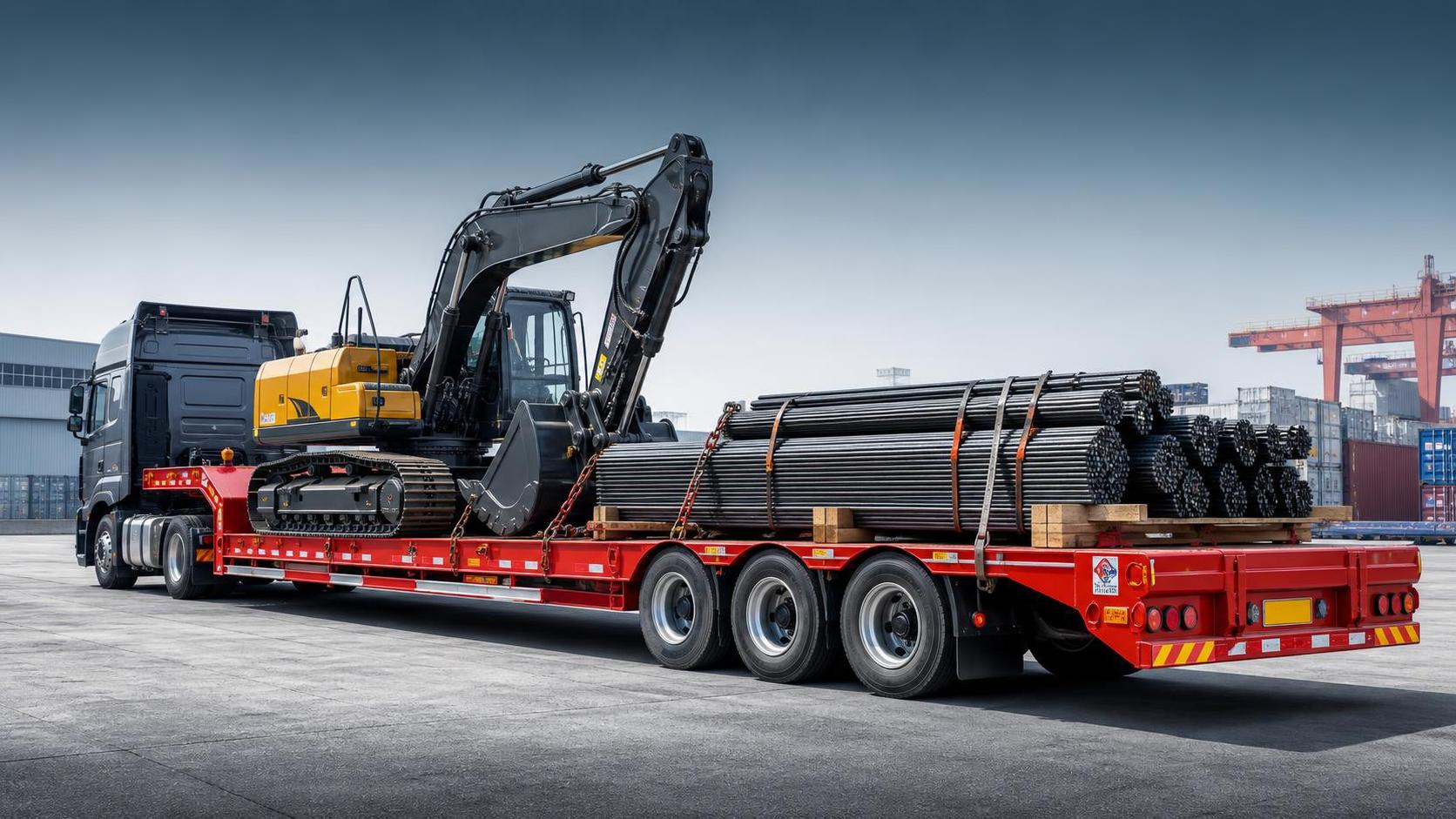
What Really Determines Flatbed Semi-Trailer Payload and Loading Efficiency?
A flatbed semi-trailer is often judged too quickly by its deck length or quoted tonnage. In practice, payload and loading efficiency are shaped by a combination of structural design, legal limits, cargo characteristics, and how the trailer fits the transport task. That is why two trailers with similar dimensions can perform very differently once they enter real engineering, construction, or equipment-haul operations.
The first misunderstanding is simple: payload is not just “how much weight the trailer can carry.” In transport work, payload is the usable cargo weight after the trailer’s own tare weight, axle arrangement, and compliance requirements are taken into account. A trailer built with heavier steel sections may appear stronger, but if its self-weight rises too much, the operator loses available cargo capacity. On the other hand, a lighter trailer is not automatically better if the structure cannot handle concentrated loads from machinery, steel coils, pipes, or precast materials. The useful question is not maximum weight in isolation, but how much real cargo can be carried repeatedly, safely, and legally.
This is where structural design matters more than many buyers expect. Main beam design, cross-member spacing, suspension type, axle capacity, landing gear quality, and deck configuration all influence how load is distributed. Flatbeds used for palletized building materials face a different stress pattern from trailers carrying excavators, wheel loaders, or long steel products. Uniformly distributed cargo is easier on the frame. Concentrated point loads are not. A trailer that looks adequate on paper may deform earlier if the design does not match the actual load pattern.
Material selection also changes the equation. High-strength steel is often discussed as a way to reduce tare weight while maintaining structural integrity, but the benefit depends on design quality and manufacturing control. Steel grade alone does not tell the whole story. Weld consistency, reinforcement at high-stress zones, anti-corrosion treatment, and production tolerances all affect long-term performance. In engineering transport, fatigue resistance is not an abstract concept. Trailers see repeated loading cycles, rough roads, off-yard handling, and occasional over-concentrated cargo. A trailer may survive one difficult job and still develop problems later if the structure was not designed with that duty cycle in mind.
Axle configuration is another factor that buyers often reduce to a number. More axles can improve weight distribution and regulatory compliance in many markets, but they also add tare weight, tire cost, and maintenance points. Fewer axles may improve efficiency for lighter or volume-driven cargo, yet become unsuitable when the cargo density is high or road rules restrict axle load. This is why selecting a 2-axle, 3-axle, or multi-axle flatbed should start with the transport profile: typical cargo weight, cargo footprint, route quality, local bridge and road regulations, and whether the operation is domestic, cross-border, or project-based.
Deck dimensions matter too, but not only in the obvious sense of “more length means more cargo.” In many cases, loading efficiency is won or lost by how well the deck supports cargo placement and securing. A longer deck may allow more units per trip, but it can also create wasted space if the transported goods do not match the deck layout. Stake pockets, lashing points, side protection arrangement, deck height, and access for forklifts or cranes all affect turnaround time. For operators handling mixed loads, a well-configured standard flatbed can outperform a theoretically larger trailer that is awkward to load or difficult to secure properly.
Deck height deserves more attention than it usually gets. A lower deck can improve loading convenience and, in some markets, help control overall transport height. That becomes important when carrying construction machinery, containers, fabricated structures, or oversized components. But lowering deck height may involve tradeoffs in frame layout, ground clearance, or suspension design. If routes include uneven site access or temporary roads, too little clearance can reduce practical efficiency even if loading at the warehouse becomes easier.
Why Cargo Type Changes Everything
In engineering vehicle transport, “cargo” is not one category. Bulk packaged cement, rebar bundles, scaffolding, stone-cut slabs, generator sets, road rollers, and agricultural or construction equipment place very different demands on the trailer. Some loads are dense and compact. Some are oversized but relatively light. Some need side loading by crane. Others need rear access for driving on and off. Payload efficiency is therefore not only about carrying the highest tonnage, but about reducing dead space, minimizing loading time, and keeping the cargo stable throughout the route.
For example, dense cargo can make axle load the limiting factor before deck space is fully used. Large but lighter cargo can do the opposite: the deck is full while legal weight remains unused. In that sense, loading efficiency is a balance between cubic use, surface use, and weight use. Good trailer matching means understanding which of these constraints appears first in actual work.
This is also why operators sometimes feel disappointed after buying a trailer that looked competitive on specification sheets. Paper specifications tend to present ideal values. Real operations expose the details: whether the lashing points are placed where the cargo actually needs them, whether the deck surface provides proper friction, whether cross-members support forklift traffic, and whether repeated loading damages the floor or side components. Efficiency is operational, not theoretical.
A Useful Way to Evaluate a Flatbed Semi-Trailer
When comparing options, it helps to separate four questions that are often mixed together:
That framework is more useful than asking for “the best flatbed semi-trailer” in general terms. There is no universal best configuration. A trailer that works well for regional building-material delivery may be a poor choice for machinery export haulage or cross-border project cargo.
Where Efficiency Is Often Lost
One common loss comes from mismatched specifications. Buyers sometimes request the highest-rated trailer available, assuming extra capacity automatically reduces risk. In reality, over-specification can increase self-weight and cost without improving actual revenue per trip. Another loss comes from underestimating the loading process itself. If a trailer needs frequent repositioning of cargo, extra timber blocking, or complicated tie-down arrangements, it consumes labor and time on every cycle.
Road conditions matter as well. Engineering transport often involves a mix of highways, industrial yards, quarry access roads, and temporary project entrances. Suspension and chassis robustness affect not only ride quality but also how well the trailer preserves alignment and tire life. That has an indirect effect on payload efficiency, because downtime, uneven tire wear, and structural repairs all reduce usable productivity over time.
There is also the question of standardization. Fleets that carry varied loads across different routes often benefit from standardized deck dimensions and spare parts compatibility, even if a specialized trailer could perform slightly better on one narrow task. A trailer is part of a transport system, not an isolated asset. Serviceability, parts availability, and repair turnaround influence lifetime efficiency as much as the original specification.
Why Supplier Experience Matters in Specification Matching
For international buyers, trailer selection is rarely just a factory configuration decision. It usually involves adaptation to operating country requirements, preferred axle brands or brake systems, cargo habits, and delivery timelines. This is where an experienced commercial vehicle exporter can add practical value. A supplier with strong manufacturer access, stable inventory, and export handling capability is better positioned to align trailer configuration with application instead of simply quoting a standard unit.
Shandong Livol Truck International Trade Co., Ltd. operates in this space as an authorized commercial vehicle dealer and exporter with access to major Chinese truck brands including FOTON, SHACMAN and SINOTRUK, along with a nationwide authorized sales and service network. For flatbed and related transport equipment, that kind of operating background matters because specification advice is more credible when it comes from teams that understand vehicle supply, customization, documentation, logistics, and after-sales coordination together. Especially in engineering transport, the wrong trailer is not just an inconvenience; it can affect route planning, compliance, loading safety, and total operating cost for years.
A capable supplier should be able to discuss more than price and dimensions. They should ask what cargo is being moved, how it is loaded, how often axle loads approach regulatory limits, whether the route includes rough access roads, and what maintenance support is available locally. Those questions are not sales formalities. They are how payload and efficiency are actually protected in service.
What Buyers Should Keep in Mind
A flatbed semi-trailer performs well when its structure, tare weight, axle arrangement, and deck layout are matched to the cargo and route it will really face. Payload is partly a design issue, partly a legal issue, and partly a loading-discipline issue. Efficiency comes from reducing wasted weight, wasted space, wasted motion, and wasted downtime at the same time.
That is the more useful way to understand this category. Instead of asking only how many tons a trailer can carry, ask how it carries them, under what conditions, and with what compromise. Once those questions are clear, the specification starts to make sense, and the trailer becomes easier to judge as a working transport tool rather than a list of dimensions and claims.
Search Starts Here