
News
What People Usually Miss in a Cangshan Vehicle Configuration List
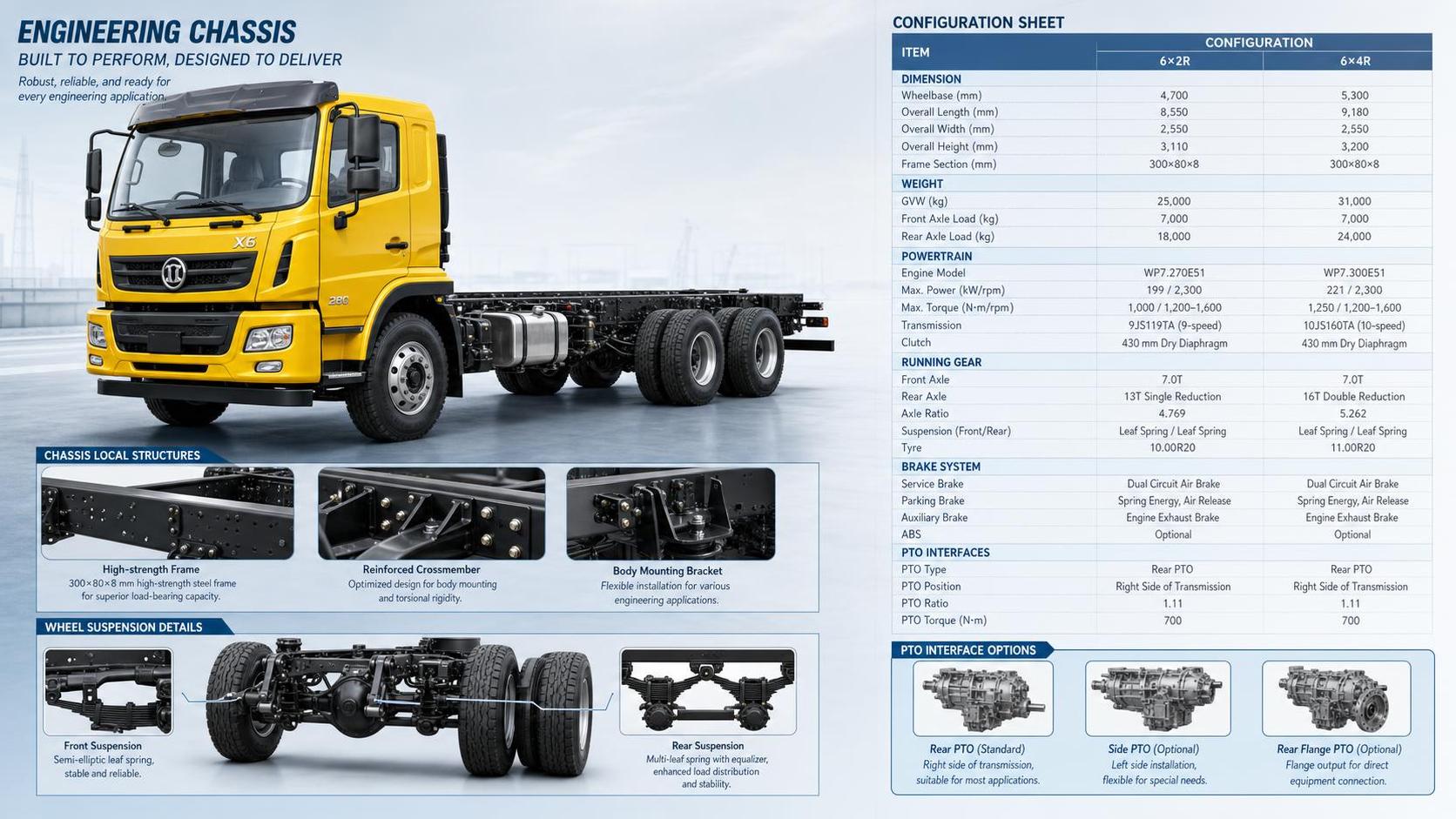
A Cangshan Vehicle Configuration List is not just a price attachment or a model summary. In engineering vehicle procurement, it is the document that tells you what the truck actually is, not what the model name suggests it should be. Technical evaluators often lose time on the wrong questions because they start with the headline model, axle count, or engine power figure. The real risks usually sit lower in the sheet: wheelbase, axle ratio, suspension type, legal mass limits, PTO readiness, tire specification, emission configuration, brake system details, and cabin electrical provisions.
That is why reading a configuration list properly matters. Two vehicles that look almost identical in a quotation can behave very differently once they are loaded, operated on poor roads, sent across borders, or adapted for mixers, cranes, tank bodies, hook lifts, or municipal equipment. If you are reviewing a Cangshan Vehicle Configuration List for technical approval, the job is not to confirm that the list is complete. The job is to see whether the configuration logic matches the intended operating scenario.
Read It as a System, Not as a Catalog
The biggest mistake is to treat each line item independently. A vehicle configuration list only becomes meaningful when the specs are read as a linked system. Engine output, gearbox ratios, rear axle ratio, tire size, and gross vehicle weight rating must be read together. The same applies to frame section, suspension design, braking format, and body interface requirements.
For example, a higher horsepower number may look favorable in isolation, but that tells you very little about gradeability, low-speed site operation, or fuel behavior if the transmission and axle reduction do not support the working load. A dump truck used in quarry access conditions may need a different gearing logic from a cargo truck that spends most of its life on paved regional routes. On paper, both can carry similar power ratings. In operation, they are not equivalent.
This is where experienced exporters and dealers add value. Companies working daily with FOTON, SHACMAN and SINOTRUK platforms often see that overseas buyers focus first on brand and payload class, while the actual fitness for duty depends on whether the base chassis was configured for construction haulage, general freight, municipal service, or special upper-body adaptation. A configuration list is where that distinction becomes visible.
Start with the Use Case, Then Check the Chassis Logic
Before comparing specifications, define the vehicle’s real operating context. Engineering vehicles are not evaluated the same way as long-haul tractors or urban delivery trucks. The key questions are practical:
- Will the vehicle carry bulk material, liquid, equipment, or a mounted working body?
- Will it operate mostly on public roads, mixed surfaces, mine roads, or confined sites?
- Does it need low-speed torque, body power output, ground clearance, or legal road compliance across multiple jurisdictions?
- Will local maintenance teams support electronic systems, emissions hardware, and specific driveline brands?
Once those conditions are clear, the configuration sheet becomes easier to interpret. Wheelbase is no longer just a dimension; it affects turning radius, body length compatibility, and axle load distribution. Suspension is no longer a comfort feature; it affects durability, stability under shifting loads, and serviceability in rough-use conditions. Fuel tank size is not simply a range indicator; on some applications, it affects mounting space and body integration.
The Specs That Deserve Closer Attention
Not every line in the Cangshan Vehicle Configuration List carries equal decision weight. Some are descriptive. Some are decisive.
One detail that gets overlooked frequently is the relationship between nominal payload expectation and legal axle capacity. Buyers sometimes assume that a stronger engine or a heavier rear suspension automatically means the truck is suitable for a more demanding body. That is not a sound conclusion. If the front and rear axle ratings, frame reinforcement, and wheelbase-body pairing do not support the intended installation, the configuration may still be wrong even if the truck looks robust.
Why Compliance Details Matter More Than They First Appear
A technical review should always separate performance suitability from market-entry suitability. A vehicle may be operationally capable yet still create problems because of emissions configuration, braking standard differences, lighting requirements, left-hand or right-hand drive needs, or documentation alignment with import procedures. The configuration list often contains the first clues.
For cross-border engineering vehicle supply, this point matters even more. The truck must fit the target country’s operating and registration environment, not only the project site. In practice, evaluators should check whether the listed configuration clearly identifies emission level, safety equipment, and key system specifications in a way that can be matched with import and homologation requirements. The exact acceptance framework depends on the destination market, so the list is not a substitute for local compliance review. But it is where mismatches often reveal themselves early.
Common Misreadings in Technical Comparison
A configuration list can mislead even experienced buyers if they compare trucks by a few headline numbers. Several patterns come up repeatedly.
One is treating engine horsepower as a proxy for total capability. It is useful, but incomplete. Torque curve, transmission matching, and final drive ratio often matter more for loaded startability and site movement.
Another is assuming that a larger cab or more comfort-oriented trim means a better overall vehicle. For engineering use, cabin options should be judged against duty cycle, safety, driver retention, climate conditions, and electrical complexity. More equipment is not always better if field service support is limited.
A third is overlooking body compatibility. Vehicles intended for special applications need more than enough chassis length. They may require PTO position compatibility, reinforced mounting areas, battery and air tank layout coordination, and spare electrical channels. If these are absent or ambiguous in the configuration sheet, the conversion stage becomes more uncertain and more expensive.
How Experienced Reviewers Compare Two Similar Configurations
When two Cangshan Vehicle Configuration List versions appear close, good reviewers do not ask which one has more features. They ask which one leaves fewer technical contradictions.
A practical comparison usually follows this order: confirm the duty type, verify legal and structural capacity, test the driveline logic against route and load, check body interface conditions, then review service and parts implications. That final point is easy to underestimate. An engineering vehicle is purchased as a working asset, so the configuration should also be read through the lens of maintenance access, parts commonality, and after-sales response. This is especially relevant in export business, where delivery speed is only one part of reliability. Stable supply, correct documentation, and the ability to align configuration with the destination market can save more cost than negotiating a lower unit price.
This is one reason established exporters with authorized brand channels tend to be preferred on complex commercial vehicle orders. They are usually in a better position to verify model availability, factory-backed configuration options, and whether a quoted chassis truly corresponds to the body and operating requirement. That matters for technical evaluation because the cleanest configuration sheet is still only useful if the delivered truck matches it.
What a Good Technical Reading Looks Like
A strong reading of the Cangshan Vehicle Configuration List is not about memorizing terms. It is about spotting where a specification affects real-world use: whether the truck can carry the intended body without overloading an axle, whether the driveline is matched to site conditions, whether the braking and suspension setup suits the terrain, and whether the configuration can pass through the target market’s operational and documentation process without friction.
If a line item seems minor, test it against three questions: does it affect legality, durability, or integration? If the answer is yes to any of them, it deserves attention. That approach is usually more reliable than comparing sales descriptions or model names. In engineering vehicle procurement, the configuration list is where assumptions stop and technical reality begins.
Search Starts Here