
News
Start with the cost line that actually hurts
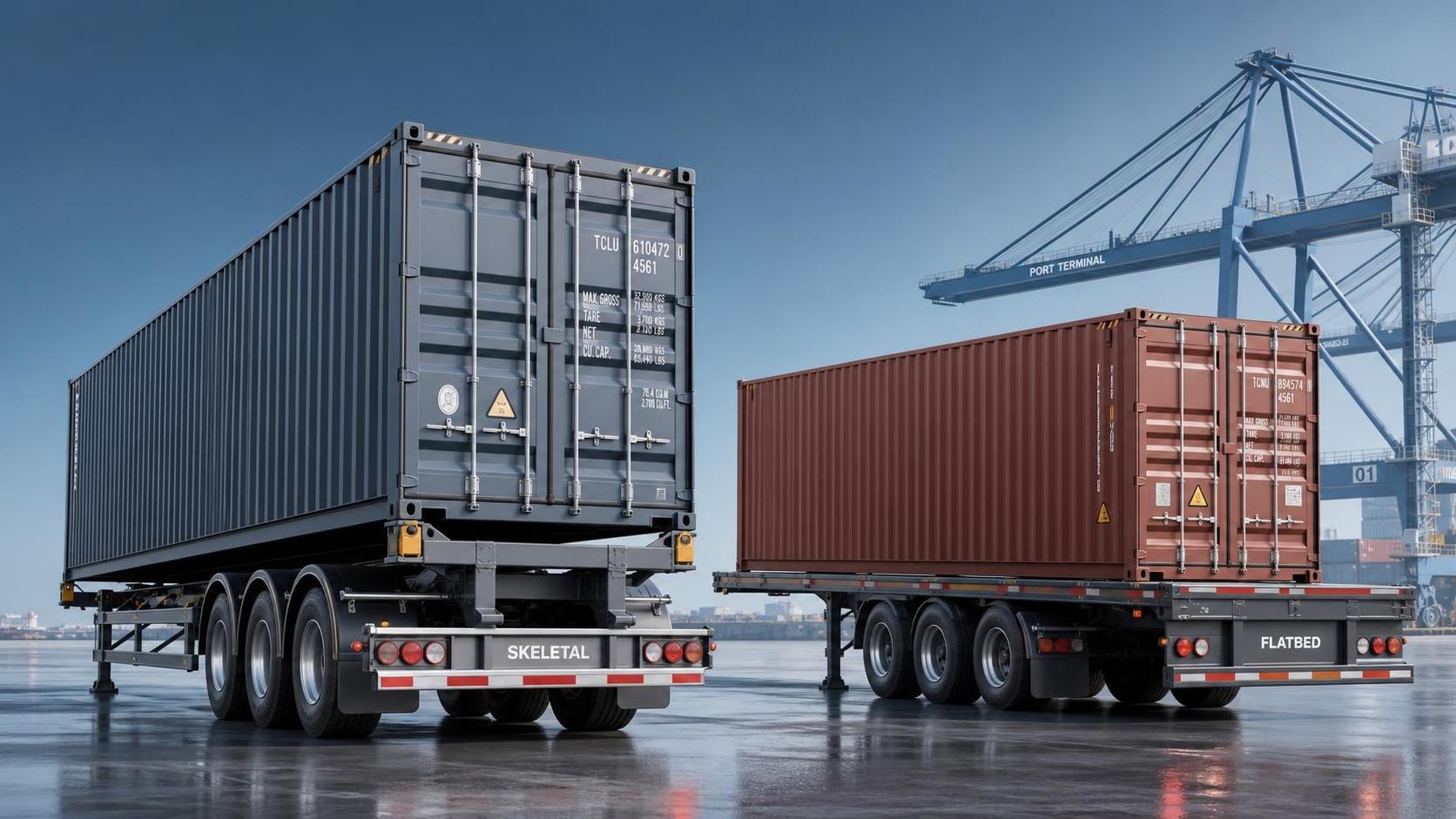
When port haul costs start climbing, many buyers compare trailer prices first and stop there. That is usually the wrong place to begin. For container moves, the bigger cost swing often comes from how fast the unit can enter, pick up, drop, and return inside the port cycle. In that comparison, a flatbed and a Skeleton (Container) Semi-Trailer are not interchangeable just because both can carry a box.
If your team is buying for regular port drayage, the practical question is simple: which trailer reduces total cost per completed move, not just purchase cost per unit. That means looking at loading method, terminal handling, driver waiting time, compliance with the containers you actually move, and how often the trailer will be used outside pure container work.
In most dedicated container operations, the Skeleton (Container) Semi-Trailer has the cost advantage. But that conclusion only holds when your route, cargo pattern, and yard process match it. Procurement mistakes happen when buyers assume “container transport” is one single scenario. It is not.
Check whether you are moving containers or moving cargo inside containers
This sounds obvious, but it is the first place teams mix up equipment selection.
- Choose a Skeleton (Container) Semi-Trailer when the container itself is the transport unit from port to yard, factory, warehouse, or inland point.
- Choose a flatbed when the box may be stripped, side-loaded, top-loaded, or when the same trailer must regularly carry steel, machinery, pallets, timber, or irregular freight.
A skeleton trailer is built around the container’s corner castings and locking points. That usually shortens handling time because the terminal can place the container directly onto the trailer and secure it through twist locks. A flatbed can carry a container, but it adds a deck you may not need and may create extra steps depending on site practice. If your operation is mostly port box pickup and delivery, paying for that extra deck structure rarely lowers your cost.
Map the turnaround time before you compare purchase prices
A cheaper trailer can still be the more expensive decision if it slows the daily cycle. Ask your operations side to walk through one full move:
- Gate entry and terminal assignment
- Container positioning onto trailer
- Securing and release
- Port exit and road transport
- Unloading, return, or chassis reuse
In a dedicated container flow, the skeleton trailer usually wins because the loading interface is purpose-built. Less wasted motion matters. Every extra ten or twenty minutes in a congested port environment can turn into fewer completed trips per day, more driver hours, and more tractor underutilization.
Buyers often underestimate this because the delay does not show up on the trailer quotation. It shows up later in dispatch complaints, lower daily output, and arguments about why transport cost per container is not falling.
Compare the two on the cost drivers that matter in procurement
That is the core tradeoff. Skeleton trailers usually reduce cost through operational efficiency. Flatbeds justify themselves through flexibility.
Do not buy before checking your container mix
This is one of the easiest procurement errors to avoid. Ask for the actual container profile from your operations records or from the forwarder handling your typical lanes:
- 20ft only, 40ft only, or mixed
- Standard dry containers or special equipment
- How often repositioning is needed between container sizes
- Whether empty and laden containers follow the same route pattern
A Skeleton (Container) Semi-Trailer can be the right answer and still create avoidable cost if the trailer configuration does not match your real box mix. The point is not to ask “Can it carry a container?” The point is “Can it carry the containers we move every week without slowing dispatch or forcing awkward repositioning?”
The right document to check here is the equipment specification sheet against your internal move history. Procurement should not sign off based on a generic assumption that all port containers are operationally the same.
Look at yard and terminal handling, not only road transport
A trailer may perform well on the road and still lose money inside the yard. Port haul cost is shaped by interfaces: terminal cranes, reach stackers, yard teams, factory unloading points, and return-container handling.
If the container is dropped on and off frequently with standard container handling equipment, skeleton trailers usually fit the workflow better. If the receiving site often unloads cargo from the trailer body itself, or lacks efficient container-lifting conditions, a flatbed may avoid operational bottlenecks.
One useful internal question: where do delays happen now? At the gate, under the crane, at unloading, or during trailer reassignment? Buy for that bottleneck. Too many fleets buy based on the highway portion while the real time loss sits at the handoff points.
Check compliance items early, because they can erase any savings
There is no value in choosing the lower-cost operating concept if the trailer later misses a legal or operational requirement in the destination market. The exact rules vary by country and route, so procurement needs to review the documents for the target market before final selection. The practical checklist is straightforward:
- Confirm allowable overall dimensions and axle layout for the operating route.
- Check the registration and roadworthiness requirements that apply to container chassis or flatbeds in that market.
- Review the transport contract or customer requirement sheet for any equipment-specific restrictions.
- Match the trailer specification with the container securing method required by local enforcement or operator policy.
The documents to pull are the local vehicle registration requirements, route or port access rules, and the supplier’s technical specification sheet. That is the level where costly mistakes show up. A low quote means little if the trailer needs rework, cannot be dispatched on a core route, or causes avoidable delays at inspection points.
Do not ignore utilization outside peak season
This is where flatbeds often make their strongest case. If your fleet cannot keep a container chassis busy year-round, versatility has financial value. A flatbed can cover more job types when port volume softens or dispatch priorities change.
That does not automatically make it the better buy. It only means you should calculate cost across the whole utilization pattern:
- How many monthly trips are true port container moves?
- How often would the trailer be reassigned to non-container cargo?
- What revenue or avoided rental cost comes from that extra flexibility?
If container drayage is your core business and trailer reassignment is rare, a flatbed’s extra flexibility may look useful on paper and add little in practice. If your transport mix shifts week to week, that same flexibility can protect utilization better than a specialized trailer.
Ask the supplier questions that expose real operating fit
A procurement conversation should go beyond price, lead time, and basic dimensions. Ask for the technical details that affect your daily work. For example:
- What container sizes is this trailer built to handle in its standard configuration?
- What securing points and locking arrangement are included?
- What changes are required if the operating market has different axle or lighting requirements?
- What spare parts and after-sales support are available in the destination region?
For buyers sourcing through an exporter with established vehicle supply channels and support capability, this is where the process can get smoother: specification matching, customization, shipping documents, customs handling, and logistics coordination all affect the real delivered cost. A trailer is not cost-effective if it arrives late, arrives mismatched, or creates paperwork friction before it even starts working.
Common buying mistakes that push port haul costs back up
- Buying flatbeds because they feel safer, even though 80 percent of the work is standard container pickup and delivery.
- Buying skeleton trailers without checking the actual container size mix and dispatch pattern.
- Comparing only purchase price and ignoring cycle time, driver hours, and tractor utilization.
- Leaving route and registration review until after the order is placed.
- Treating yard handling as someone else’s problem when it is often where the cost difference is created.
None of these are technical mysteries. They are process mistakes, which means procurement can prevent them.
The practical decision rule
If your operation is mainly port-to-yard or port-to-factory container movement, and the trailer will spend most of its life carrying containers rather than general cargo, a Skeleton (Container) Semi-Trailer usually lowers port haul costs through faster handling and a better fit for the job.
If your fleet needs one trailer type to cover mixed cargo, changing assignments, and non-container work with decent frequency, a flatbed may produce the better whole-fleet result even if it is not the fastest container tool.
For procurement teams, the right order of work is: check your container mix, map one real operating cycle, review route and market requirements, then compare utilization across the full month. Once those four points are clear, the trailer choice usually stops being a debate and becomes a straightforward cost decision.
Search Starts Here