
News
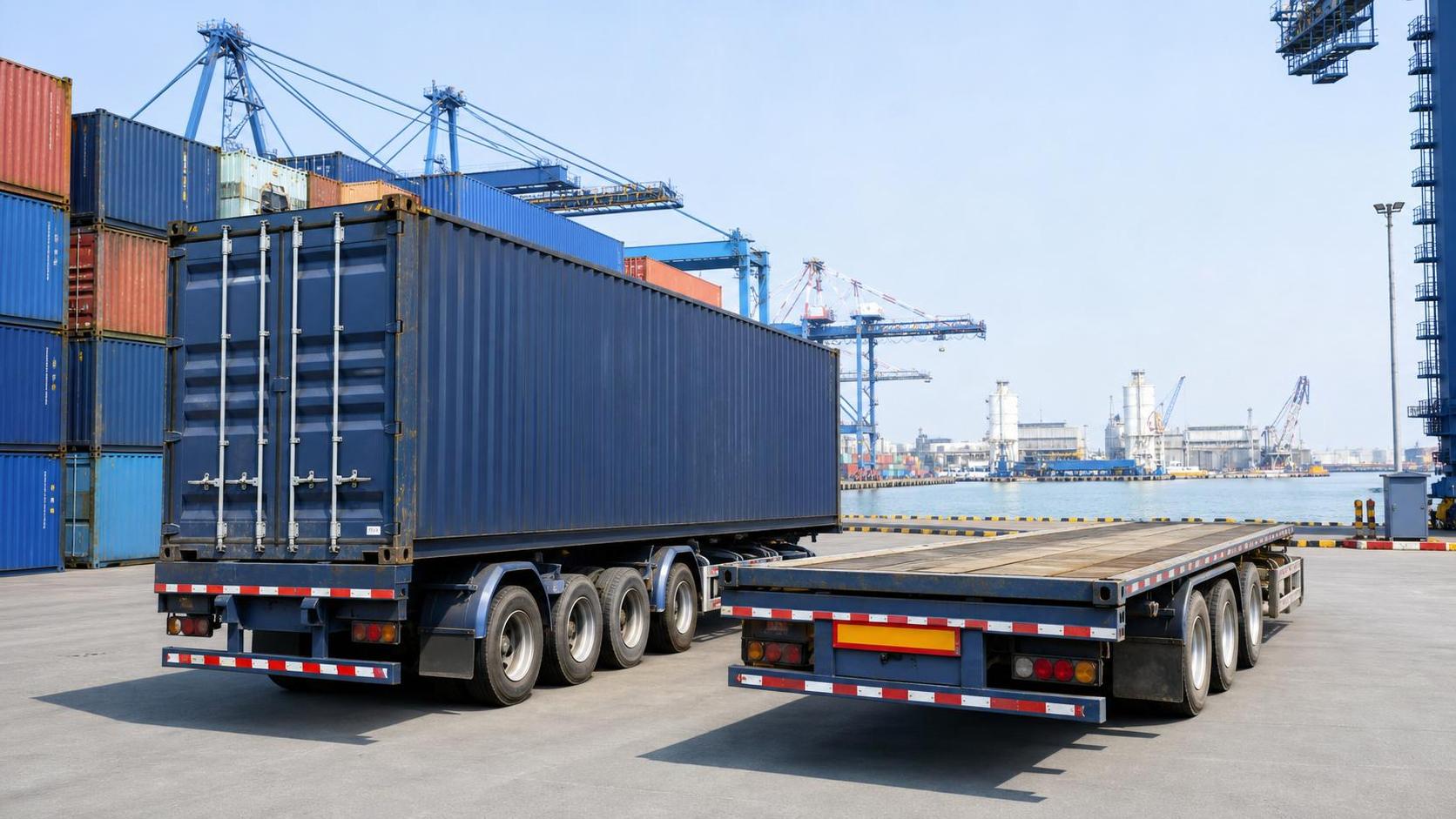
Port haulage leaves little room for the wrong trailer choice. In container transport, a few extra minutes at the terminal can ripple into missed slots, higher detention fees, and weaker fleet utilization.
That is why the comparison between a flatbed and a Skeleton (Container) Semi-Trailer matters far beyond equipment preference. It affects loading logic, legal compliance, route flexibility, and how smoothly cargo moves from port gate to yard, factory, or inland depot.
In practical engineering vehicle operations, both trailer types still have value. The better option depends on whether the job centers on containerized throughput, mixed cargo handling, or a combination of both across changing project schedules.
Why this comparison has become more important
Port transport is under pressure from tighter delivery windows, rising inland freight costs, and stronger safety expectations. At the same time, container volumes remain uneven, which makes asset efficiency more important than simple trailer availability.
A flatbed can look attractive because it is familiar and versatile. Yet in port haulage, the workflow is built around ISO containers, twist locks, chassis compatibility, and fast turnaround. That is where a Skeleton (Container) Semi-Trailer often gains a clear operational edge.
More attention is also going to tractor-trailer matching. Fleets running FOTON, SHACMAN, or SINOTRUK prime movers usually need trailer specifications that fit real axle loads, terminal conditions, and local road rules instead of generic procurement assumptions.
Understanding the two trailer types in port work
A flatbed is a broad platform trailer designed to carry many load types. It can transport palletized cargo, steel, machinery, timber, or containers, usually with lashing, blocking, or extra securing devices.
A Skeleton (Container) Semi-Trailer is different. It is built specifically for containers, using a lighter frame, container corner support, and locking mechanisms that secure 20ft, 40ft, or other approved container formats.
Simple differences in structure create major differences in use. A flatbed carries many things adequately. A Skeleton (Container) Semi-Trailer is optimized for one transport task and usually performs that task faster and with less handling complexity.
Core design difference
Where a Skeleton (Container) Semi-Trailer fits better
In most dedicated port container operations, a Skeleton (Container) Semi-Trailer is the more natural fit. The reason is not only speed. It is also consistency across loading, securing, inspection, and unloading stages.
Terminal operators handle containers with repeatable processes. When the trailer is purpose-built for the same process, coordination improves. The container aligns faster, locking is clearer, and the chance of improper securing is reduced.
This matters even more on short-haul shuttle work between port and nearby yard. High-frequency trips reward faster cycle times. A Skeleton (Container) Semi-Trailer often supports more trips per shift than a flatbed used for the same container route.
Weight efficiency is another advantage. Because the frame is designed around container support rather than a full deck, the trailer can reduce dead weight and preserve more legal payload margin, depending on local axle regulations.
Typical strengths in daily port haulage
- Faster loading and release at container terminals
- Lower risk of cargo shift from poor manual securing
- Better alignment with 20ft and 40ft container operations
- Improved payload efficiency in regulated road transport
- Simpler inspection of lock points and frame condition
When a flatbed still makes sense
A flatbed should not be treated as outdated. It remains useful where transport demand is mixed and containers are only part of the weekly workload. In such cases, flexibility can outweigh pure container efficiency.
This is common in engineering projects that receive machinery, fabricated steel, temporary structures, and occasional containerized parts through the same logistics chain. A flatbed can support a wider cargo mix without adding separate trailer assets.
It can also help in regions where terminal handling standards vary and the operation needs ad hoc loading solutions. Still, once containers become the dominant cargo unit, flatbed convenience usually starts to create hidden inefficiencies.
Those inefficiencies often appear as longer loading time, more manual securing, higher labor dependence, and greater variation between drivers or loading crews. Over time, these small differences influence total operating cost.
Operational issues that decide the better choice
The right trailer is not chosen by brochure language alone. It should be judged against the actual transport loop, from booking and gate entry to final drop-off.
Turnaround time
If the route depends on quick entry and exit from the port, a Skeleton (Container) Semi-Trailer usually delivers better cycle performance. Less cargo preparation means less idle time and fewer process interruptions.
Cargo profile
If more than half of the transport volume is standard container traffic, dedicated container equipment becomes easier to justify. If cargo types change daily, the flatbed may still serve as a balancing asset.
Road and yard conditions
Some port access roads, depot ramps, and project yards place stress on trailer suspension and frame geometry. Trailer selection should reflect turning radius, ground clearance, load distribution, and maintenance access.
Compliance and safety
A Skeleton (Container) Semi-Trailer supports clearer compliance for container securing. That does not remove inspection responsibility, but it can reduce the variability that comes with manually securing containers on a general-purpose deck.
Cost should be measured beyond purchase price
Procurement decisions often focus first on unit price. In port haulage, however, the more useful measure is cost per completed container movement over time.
A lower-priced flatbed can become more expensive if it causes slower loading, lower trip frequency, or higher labor input. A Skeleton (Container) Semi-Trailer may cost more initially in some configurations, yet recover value through faster operations.
Maintenance planning also matters. Dedicated container trailers are easier to standardize in fleets with repetitive routes. Standardized lock systems, known wear points, and predictable service intervals can simplify lifecycle management.
Useful evaluation points
- Average loading and unloading minutes per trip
- Trips completed per tractor per day
- Labor needed for securing and checking loads
- Detention, waiting, and scheduling penalties
- Maintenance frequency under actual route conditions
A practical sourcing view for international projects
For cross-border fleet planning, trailer choice is also linked to supplier capability. Reliable delivery, configuration accuracy, and documentation support can be as important as the equipment itself.
Shandong Livol Truck International Trade Co., Ltd. operates in this broader context. As an authorized dealer for FOTON, SHACMAN, and SINOTRUK, the company works with commercial vehicle combinations that need to perform in real freight environments, not only in product catalogs.
That matters when selecting a Skeleton (Container) Semi-Trailer for export projects. Tractor matching, trailer specification, spare parts readiness, and customs documentation can all affect how quickly a fleet becomes productive after arrival.
A supplier with stable inventory, 4S network support, and full-process export service can reduce delays between decision, shipment, and deployment. For port-focused operations, that planning discipline often protects project schedules better than a narrow price comparison.
How to make the final decision
If the operation is mainly container-in and container-out, the answer is usually straightforward. A Skeleton (Container) Semi-Trailer fits port haulage better because it follows the same logic as the cargo system it serves.
If the operation mixes containers with oversized or non-containerized cargo, a flatbed may still deserve a place in the fleet. In many cases, the most effective solution is not choosing one trailer for everything, but assigning each trailer to the work it handles best.
A useful next step is to review recent trip data, container share, loading delays, and route constraints. Once those numbers are clear, the difference between a flatbed and a Skeleton (Container) Semi-Trailer becomes much easier to judge in operational terms.
The strongest decision usually comes from matching trailer design to cargo rhythm, terminal practice, and fleet structure. In port haulage, that alignment is often what turns transport capacity into dependable delivery performance.
Search Starts Here