
News
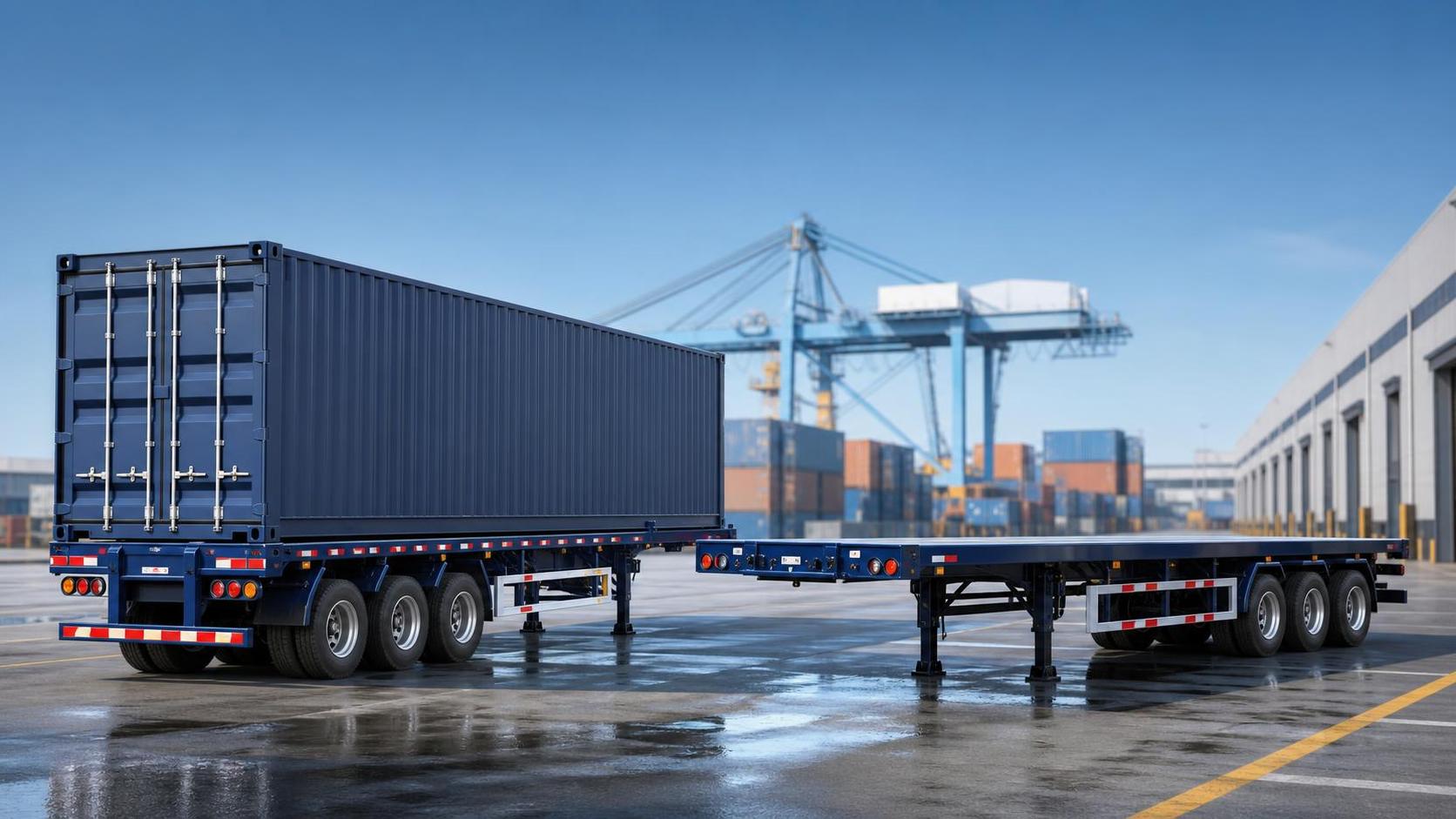
Skeleton (Container) Semi-Trailer vs Flatbed Semi-Trailer: Which Fits Port-to-Warehouse Hauls Better?
For port-to-warehouse work, the key question is not which trailer is more versatile in general. It is which trailer matches the cargo unit, the loading method, and the transfer rhythm of the route. That is where many buying decisions go wrong. A flatbed semi-trailer is often treated as the practical default because it can carry many cargo forms. A Skeleton (Container) Semi-Trailer, by contrast, is sometimes seen as a narrowly specialized tool. In real container logistics, especially between terminals, bonded yards, distribution centers, and project warehouses, that “specialization” is often exactly what makes it the better operational fit.
The difference starts with structure. A skeleton trailer is built around the geometry and locking points of ISO containers. It does not need a full deck because the container itself is the cargo body. The trailer supports the container at designed points and secures it through twist locks. A flatbed uses a continuous platform and normally depends on lashing, blocking, or other cargo restraint measures. That makes the flatbed more flexible for steel, timber, machinery, bagged cargo, or mixed freight. But once the job is specifically moving loaded or empty containers from port to warehouse, the flatbed begins to introduce extra handling logic that the skeleton trailer avoids.
This is why operators who handle repetitive container drayage usually separate the two categories very clearly. They are not comparing two trailers that happen to look different. They are comparing two loading systems.
Where the Skeleton Trailer Gains Its Advantage
In a port environment, speed and predictability matter more than broad adaptability. Container yards, quay cranes, reach stackers, and warehouse receiving areas are all organized around standardized containers. A Skeleton (Container) Semi-Trailer fits directly into that chain. The container can be lifted on and off without the trailer deck getting in the way, and the locking arrangement is aligned with how terminals expect containers to be carried. That means fewer intermediate steps, less need for improvised securing methods, and a lower chance of disputes over whether the load was restrained correctly.
For port-to-warehouse hauls, this usually translates into three practical benefits. One is faster turnaround during loading and unloading. Another is cleaner compliance with container transport practice, because the trailer is designed for the container rather than merely capable of carrying it. The third is weight efficiency. Since there is no full cargo deck, the trailer’s own structure is often lighter than a flatbed built for equivalent heavy-duty service, although exact tare weight depends on axle configuration, steel specification, reinforcement, and intended container size.
That last point matters more than it seems. On routes where legal gross vehicle weight is tight, every unnecessary kilogram in trailer tare weight eats into payload margin. Project managers do not always control the regulation side, but they do feel the effect when a route that should have moved in one cycle ends up needing a different loading plan.
Why Flatbeds Still Enter the Discussion
Flatbeds stay in the conversation because port-related cargo is not always a sealed container job from start to finish. Some warehouses strip containers immediately and combine the inbound flow with palletized cargo, oversized equipment, or site materials on the outbound side. If a trailer must perform multiple roles in the same fleet, a flatbed can look more economical on paper. It can move a container one day, fabricated steel the next, and machinery after that.
But that flexibility should be judged carefully. A flatbed can carry a container, yet “can carry” is not the same as “is optimized for.” If the main task is repeated short- to medium-distance port drayage with standard 20-foot or 40-foot containers, a flatbed often adds compromise rather than capability. Loading height, securing procedure, and terminal handling compatibility may all be less direct. In some operations, that is manageable. In high-frequency container transfer, it becomes friction.
What Project Managers Should Actually Evaluate
When this choice is made at procurement stage, discussion often gets stuck on acquisition cost. That is too narrow. For a project manager or engineering logistics lead, the better frame is operational fit over the full haul cycle. Start with the container mix. Are you mainly moving 20-foot, 40-foot, or a combination? Do you need a fixed configuration or a multi-lock arrangement? Are the containers mostly loaded import boxes from port, or is there a high share of empty repositioning?
Then look at route conditions. A skeleton trailer that performs well in organized terminal-to-warehouse corridors may need different attention if warehouse access roads are uneven, turning radius is restricted, or loading areas are not set up for container handling equipment. Flatbeds sometimes survive these imperfect conditions better simply because more sites know how to work around them. That said, if the receiving warehouse is already handling containers with forklifts, stackers, or dock-side unloading plans, the skeleton trailer keeps the process more disciplined.
Axle layout, suspension choice, and chassis strength matter more than many buyers expect. A trailer described as “for container transport” is not automatically right for every container duty. Road condition, expected payload, local axle load rules, and the frequency of rough yard operation all influence what specification makes sense. This is where experienced exporters and authorized commercial vehicle dealers add value: not by selling the broadest catalog, but by matching the trailer structure to the transport pattern and destination market requirements.
Shandong Livol Truck International Trade Co., Ltd. works in that part of the decision chain. With experience in commercial vehicle export and supply support linked to major Chinese truck brands including FOTON, SHACMAN, and SINOTRUK, the company’s practical role is not limited to supplying units. For overseas buyers, the more useful contribution is often in configuration confirmation, documentation coordination, and making sure the vehicle selected for export actually fits the local duty cycle rather than only the purchase budget.
Common Misunderstandings That Distort the Choice
One common misunderstanding is that a flatbed is automatically safer because it has a full platform. In container transport, safety comes from correct load interface and secure restraint, not from deck area alone. A container sitting on a trailer designed with proper locking positions is usually in a more controlled state than one being adapted onto a platform that was designed for general cargo.
Another mistake is assuming that all port-to-warehouse hauls are short and therefore forgiving. Short distance does not remove the cost of delay. In many projects, the issue is not fuel burn over long mileage but queue time, crane coordination, warehouse slot timing, and demurrage-related pressure. A trailer that shortens each handover step can be the better financial choice even if its use case is narrower.
There is also a habit of treating container transport as a simple trailer purchase independent of tractor matching. That is risky. Fifth-wheel height, braking system compatibility, powertrain suitability for yard exits and urban approaches, and local compliance requirements all affect the final result. Trailer selection should be part of a transport unit decision, not an isolated line item.
So Which One Fits Better?
If the haul is genuinely port to warehouse, the cargo is primarily standard containers, and loading and unloading are built around container-handling equipment, a Skeleton (Container) Semi-Trailer is usually the cleaner fit. It aligns with the infrastructure, reduces unnecessary structure, and supports faster container turnover. In repetitive drayage work, those advantages are not theoretical. They show up in dispatch discipline, yard efficiency, and fewer avoidable loading compromises.
A flatbed semi-trailer becomes the better choice when container movement is only one part of a broader logistics role, when the receiving points are not consistently container-ready, or when the fleet must absorb varied cargo types without dedicating assets to one loading system. In that case, the decision is less about ideal container handling and more about preserving fleet versatility.
The practical rule is straightforward: if your operation is container-centric, choose a trailer designed around the container. If your operation is cargo-diverse and only occasionally containerized, the flatbed may justify its compromises. The wrong decision usually comes from buying for hypothetical flexibility instead of the actual transport pattern you run every week.
That is the real comparison. A Skeleton (Container) Semi-Trailer is not simply a stripped-down flatbed. It is a purpose-built answer to a specific logistics task. For port-to-warehouse hauls, that purpose often matters more than versatility.
Search Starts Here