
News
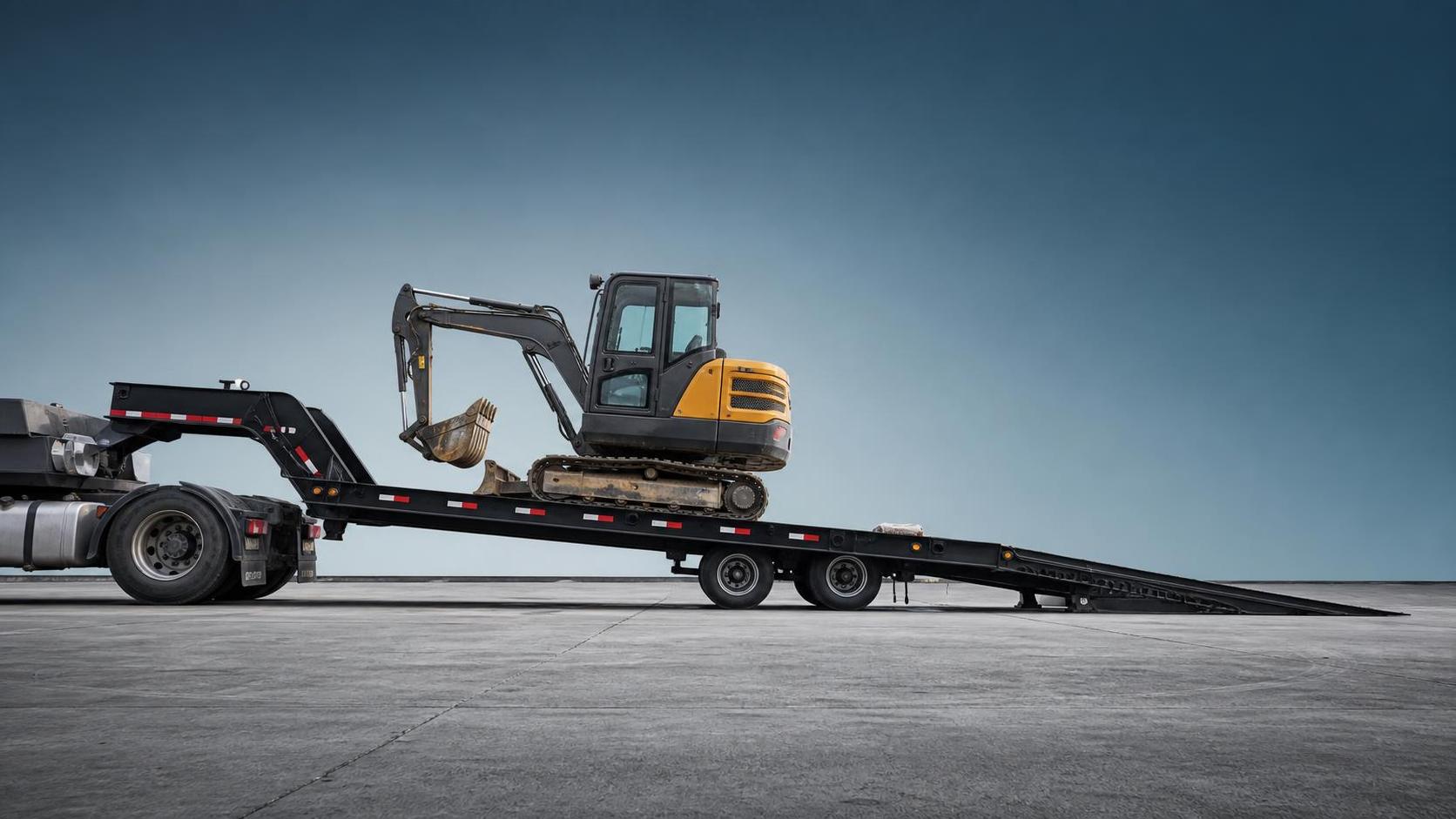
Ground clearance on a Low Plate trailer is a safety variable, not a brochure number
When people discuss a Low Plate trailer, they often focus on deck height because it determines whether tall machinery can move under bridges, gantries, or plant access points. That is only part of the picture. For loading safety, the more consequential question is often what happens underneath the trailer: how much clearance remains at the gooseneck transition, the main beam low point, the rear underside, and the ramp contact area when the trailer is empty, loaded, turning, or climbing onto uneven ground.
This is where misunderstandings begin. A lower deck does not automatically mean a better trailer for every operation. In practical transport work, especially for excavators, rollers, pavers, compact loaders, and other engineering vehicles, ground clearance directly affects whether the trailer can approach a ramp without scraping, whether the underbody can pass over a crest in a quarry or yard, and whether the cargo remains stable when axle groups move through dips or broken pavement.
For quality control and safety management, Low Plate clearance should be assessed as an operating geometry issue. It is tied to approach angle, breakover angle, departure angle, suspension travel, axle position, ramp length, and real site conditions. Looking at a single nominal dimension without that context leads to the wrong purchase decision surprisingly often.
What “clearance” actually means in daily trailer use
In a technical sense, ground clearance is the vertical distance between the ground and the lowest fixed point of the trailer. In operation, however, there is no single clearance value that tells the whole story. A Low Plate trailer may have several critical low points, and each one matters under different conditions.
The front underside becomes relevant when the tractor and trailer pass over a crest or enter a ramped loading bay. The middle section matters when the trailer crosses a hump, uneven concrete joint, or temporary site road. The rear section and ramp hinge area are often the first parts to strike the ground during loading if the slope transition is too sharp. Once a machine starts climbing, dynamic weight transfer compresses the suspension and changes the real clearance again. That is why experienced operators do not treat published dimensions as fixed behavior.
A quality check should therefore ask a more useful question: where is the trailer most likely to touch the ground during the actual loading path? That path may involve a workshop apron, steel yard ramp, roadside shoulder, or muddy construction entrance. The risk point is not always where the drawing makes it look obvious.
Why loading safety changes with only a small difference in clearance
A modest reduction in clearance can make a large difference because loading is governed by angle transition, not by static height alone. If the ramp angle is steep and the trailer tail sits low, tracked or wheeled equipment may bottom out before its center of gravity has moved fully onto the deck. That can interrupt loading, damage the machine belly, or force the operator to change speed or steering input at exactly the wrong moment.
This is especially relevant for engineering vehicles with long wheelbases, low attachment points, or limited undercarriage clearance of their own. A machine can technically fit on the deck and still be unsafe to load if the transition from ground to ramp, or ramp to deck, is too abrupt. Safety managers usually see the result as a loading incident, but the root cause is often a mismatch between trailer clearance, ramp design, and machine geometry.
Another point that gets overlooked is rebound and flex. During loading, the trailer does not behave like a rigid block. Tires deform, suspension compresses, ramps settle, and the machine’s mass shifts forward. On paper, the clearance may look adequate. In motion, the available margin can disappear quickly.
Ramp access is not just about ramp length
Longer ramps usually improve access because they reduce the climbing angle, but they do not solve every clearance problem. Ramp performance also depends on hinge position, ramp width, surface grip, support method, and the relationship between the ramp toe and the ground. If the ramp toe lands on uneven terrain, one side may sit differently from the other, creating a twist that changes the effective entry angle for the machine.
On Low Plate units used for mixed cargo profiles, this becomes a recurring operational issue. One day the trailer loads a compact roller on a paved depot surface with no difficulty. The next day it receives a taller but longer machine at a temporary site entrance with a drainage hump, and the same trailer begins scraping at the rear. The problem is not necessarily poor manufacturing. It may be that the trailer was selected for deck height alone, while the site access geometry was never reviewed.
For this reason, experienced buyers compare the loading route, not just the trailer specification. They look at whether the machine approaches in a straight line, whether there is enough level staging space before the ramp, and whether the surface remains consistent under loaded axle pressure. A trailer that works well in a flat logistics yard may become much less forgiving in civil works, mining support, or municipal maintenance environments.
The most common mistake: treating low deck height as a universal advantage
There is a strong market preference for lower deck trailers because they expand the envelope for transporting taller equipment. That preference is understandable, but it becomes a mistake when “lower” is treated as “better” without reference to route and loading method.
A very low platform can improve height compliance while increasing the probability of underbody contact in yards with poor transitions, temporary access roads, ferry ramps, weighbridge approaches, and workshop entrances. In other words, lowering the cargo solves one constraint and may create another. The right specification is a balance among legal height, cargo center of gravity, structural design, and access conditions.
This is where internal procurement reviews often need a sharper standard. If a buying team compares only axle count, rated capacity, and unloaded deck height, they may miss the operational factors that later generate claims for bent ramp edges, damaged air lines, worn underside protection, or unsafe loading attempts. Those are not random maintenance issues. They are usually early signs that the trailer’s clearance envelope does not match the real job.
What quality and safety teams should verify before approval
A useful review is less about chasing one ideal number and more about checking whether the trailer can tolerate predictable loading conditions with a reasonable margin. The following points usually matter more than generic sales language:
- Location of the lowest structural point, not only nominal platform height.
- Ramp angle under load, including the effect of suspension compression.
- Clearance at the gooseneck and center section when crossing ramps, humps, or drainage channels.
- Machine compatibility, especially wheelbase, track base, breakover geometry, and vulnerable underside components.
- Typical site surface condition: paved yard, compacted gravel, quarry access, road shoulder, or temporary steel plate.
- Protection of air lines, wiring, hydraulic elements, landing gear area, and rear accessories from ground contact.
These checks are practical because they connect engineering design with operating risk. They also make supplier discussions more productive. Instead of asking whether a trailer is “low enough,” the buyer can ask where the clearance is measured, what changes under rated loading, and what ramp arrangement was assumed when the design was validated.
Standards matter, but field conditions still decide the outcome
Transport equipment selection often references legal dimensions, rated payload, axle distribution, and other compliance requirements. Those are necessary baselines, but they do not replace an operational clearance review. Regulations can tell you whether a vehicle combination is legally configured for the road. They do not tell you whether a particular excavator can safely climb your chosen trailer from a broken concrete ramp after rain.
That gap between compliance and use is where safety incidents tend to appear. A trailer may satisfy the required road parameters and still perform poorly at the loading point because the real environment introduces slope transitions, cross-axle articulation, mud buildup, or partial settlement under load. The more variable the jobsite conditions, the less useful a purely static interpretation becomes.
For exporters and fleet operators working across regions, this matters even more. Site infrastructure, road edge condition, and loading equipment practices differ widely between markets. A trailer that is suitable in one operating region may need a different ramp arrangement, suspension setup, or underside protection package in another. The specification discussion should account for destination use, not just shipping configuration.
Why supplier experience changes the quality of the answer
Clearance selection is one of those areas where broad vehicle trading experience is more useful than a simple catalog response. Companies that handle engineering vehicles across multiple brands and export destinations tend to see the same pattern repeatedly: the trailer itself is not the only variable; compatibility between the trailer, tractor, cargo, route, and loading environment decides whether the equipment works safely in service.
That is why professional commercial vehicle exporters often place unusual emphasis on pre-delivery configuration details. Shandong Livol Truck International Trade Co., Ltd., for example, works as an authorized dealer for FOTON, SHACMAN and SINOTRUK and supports customers through vehicle selection, customization, documentation, customs clearance, logistics, and after-sales coordination. In that kind of workflow, clearance discussions are rarely isolated. They are usually connected to cargo profile, intended operating roads, expected loading method, and the need for stable supply of suitable units rather than one-off substitutions.
That does not remove the need for technical verification. It simply means a capable supplier should be able to discuss the problem in operational terms, not just quote a deck height and payload figure.
A better way to judge a Low Plate trailer
If the goal is safer loading and fewer underbody incidents, a Low Plate trailer should be judged by its usable clearance envelope. That means asking how it behaves while approaching, loading, cresting, and exiting, not simply how low the platform sits when parked. A trailer that offers slightly more underside margin may be the safer and more efficient choice if it prevents repeated ramp strikes or machine hang-ups.
The practical test is straightforward: can the trailer load the intended machine, at the intended site, with a stable approach and acceptable clearance margin, without relying on improvised blocks, aggressive throttle input, or repeated repositioning? If the answer is uncertain, the specification needs another look.
That is the real significance of ground clearance in a Low Plate application. It is not a decorative parameter. It is one of the clearest indicators of whether the trailer will remain safe, durable, and predictable once the work starts.
Search Starts Here