
News
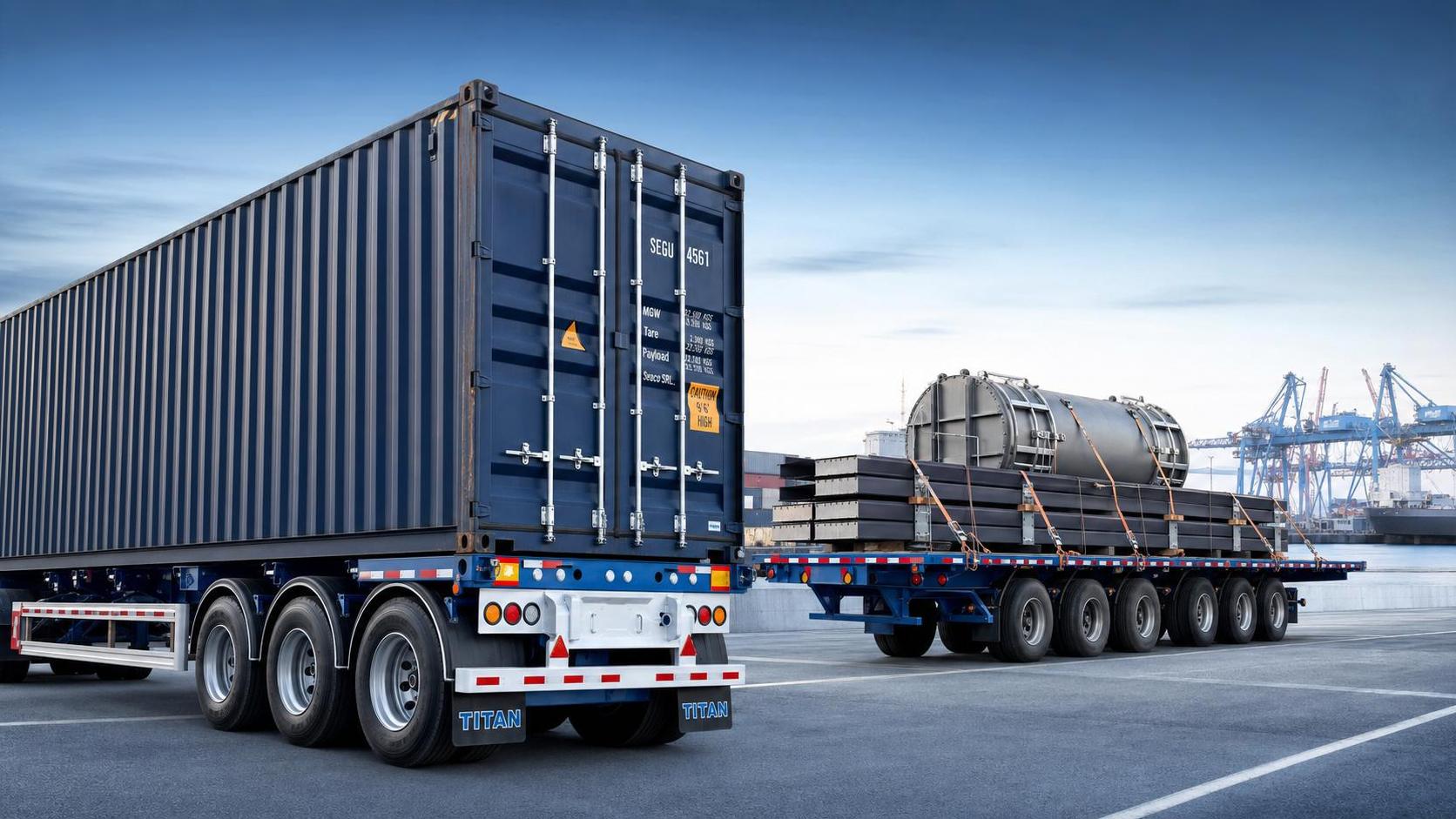
Skeleton Container Semi-Trailer vs Flatbed: Key Differences in Cargo Use
When comparing a Skeleton (Container) Semi-Trailer with a flatbed, the right choice depends on cargo type, loading method, and transport efficiency.
Both trailer types are common in engineering transport, port logistics, and heavy-duty delivery.
Still, they solve different problems.
A Skeleton (Container) Semi-Trailer is built for container handling.
A flatbed is designed for open cargo with flexible loading from multiple sides.
That structural difference affects cost, speed, compliance, and daily operating efficiency.
In real transport planning, choosing the wrong trailer often creates loading delays, safety issues, or wasted payload capacity.
This guide breaks down the practical differences, so decision-making becomes easier and more grounded.
What a Skeleton (Container) Semi-Trailer Really Does
A Skeleton (Container) Semi-Trailer uses a reinforced chassis instead of a full cargo deck.
Its frame holds ISO containers through twist locks placed at fixed positions.
This means the trailer works as a dedicated container transport solution.
It is commonly used in ports, freight terminals, inland depots, and cross-border container routes.
Because there is no full platform, tare weight is often lower than many flatbed configurations.
That can improve payload efficiency when the cargo is already containerized.
A Skeleton (Container) Semi-Trailer also speeds up standardized handover between ships, rail yards, and trucks.
From an operations angle, this is one of its biggest advantages.
How a Flatbed Differs in Daily Use
A flatbed has a full loading deck and open sides.
That makes it suitable for machines, steel, timber, pipes, pallets, and oversized materials.
Forklifts, cranes, and side loaders can access cargo more freely.
In practical terms, a flatbed offers broader cargo compatibility.
However, it usually needs more attention to cargo securing, weight balance, and weather protection.
That extra flexibility can be valuable, but it also creates more loading variables.
So while a flatbed can sometimes carry containers, it is not as purpose-built as a Skeleton (Container) Semi-Trailer.
Core Structural Differences That Affect Performance
The first difference is deck design.
A Skeleton (Container) Semi-Trailer has an open frame.
A flatbed has a continuous platform.
The second difference is cargo restraint.
A Skeleton (Container) Semi-Trailer secures containers with twist locks.
A flatbed depends on chains, belts, corner protectors, blocks, and operator skill.
The third difference is loading process.
Container lifting systems match the geometry of a Skeleton (Container) Semi-Trailer.
Flatbeds suit non-standard goods better, especially when side access matters.
The fourth difference is transport specialization.
A dedicated Skeleton (Container) Semi-Trailer improves repeatability on container lanes.
A flatbed supports mixed cargo operations but with less standardization.
Best Cargo Types for Each Trailer
This is where the decision becomes straightforward.
Choose a Skeleton (Container) Semi-Trailer when your cargo moves inside 20ft, 40ft, or similar standard containers.
It is especially suitable for port drayage, bonded transport, factory-to-port delivery, and multimodal freight transfer.
Choose a flatbed when the cargo cannot fit into a container, or loading needs open access.
- Skeleton (Container) Semi-Trailer: dry containers, reefer containers, tank containers, and standardized shipping boxes.
- Flatbed: excavators, loaders, transformers, construction steel, stone slabs, and irregular long cargo.
In short, containerized cargo favors specialization.
Non-containerized cargo favors flexibility.
Loading Efficiency, Safety, and Operating Cost
Efficiency is not only about driving.
It starts at the yard.
A Skeleton (Container) Semi-Trailer often reduces loading time because container cranes and reach stackers can position cargo quickly.
Twist-lock fixing is also faster than building a custom tie-down plan for every load.
That saves labor and lowers the risk of cargo movement.
A flatbed may require more time for checking load height, center of gravity, and lashing points.
For oversized equipment, escorts or permit planning may also become part of the job.
Cost follows the same pattern.
A Skeleton (Container) Semi-Trailer usually performs better on high-frequency container routes.
A flatbed performs better when cargo variety is wide enough to justify its flexibility.
Selection Factors Buyers Should Check First
Before comparing price, check the route and cargo pattern.
- Cargo form: containerized, palletized, oversized, or irregular.
- Loading equipment: crane, forklift, side loader, or terminal gantry.
- Route type: port shuttle, highway long-haul, mining zone, or construction supply line.
- Frequency: fixed container cycles or mixed dispatching.
- Compliance needs: axle load limits, container standards, and local road regulations.
- Maintenance conditions: parts availability, workshop support, and turnaround expectations.
These points usually reveal the right trailer faster than a simple price comparison.
A lower purchase cost can easily become a higher operating cost later.
When a Skeleton (Container) Semi-Trailer Is the Better Choice
A Skeleton (Container) Semi-Trailer is usually the better option in three situations.
- Your business handles containers every day and needs faster turnaround.
- Your route connects ports, rail terminals, warehouses, and customs yards.
- Your cargo safety relies on standardized container locking rather than manual securing.
It is also a strong fit where fleet utilization depends on schedule consistency.
More importantly, a Skeleton (Container) Semi-Trailer aligns with global container transport systems.
That creates fewer handling interruptions across different logistics nodes.
Supplier Support Matters More Than Many Buyers Expect
Trailer selection is not only about the chassis itself.
It also depends on supply reliability, documentation accuracy, and after-sales coordination.
Shandong Livol Truck International Trade Co., Ltd., based in Shandong, China, supports customers with integrated export service.
The company is an official authorized domestic and overseas dealer for FOTON, SHACMAN, and SINOTRUK.
Its nationwide authorized 4S store network and sufficient inventory help maintain stable supply and fast delivery.
That matters when fleet expansion must stay on schedule.
With a professional export team, the company also supports customization, documentation, customs clearance, logistics, and after-sales service.
For buyers comparing a Skeleton (Container) Semi-Trailer with other transport solutions, this full-process support reduces purchasing friction.
Final Decision: Specialization or Flexibility
The decision comes down to cargo reality.
If your loads are standardized containers, a Skeleton (Container) Semi-Trailer is usually the smarter and more efficient choice.
If your loads vary in shape, size, and handling method, a flatbed offers broader flexibility.
The key is to match trailer structure with loading workflow, cargo form, and route demands.
That is where long-term transport efficiency is really decided.
A careful review of cargo mix, handling equipment, and operational targets will point to the right answer faster than assumptions.
For fleets focused on container transport, starting with a well-matched Skeleton (Container) Semi-Trailer specification is the most practical next step.
Search Starts Here