News
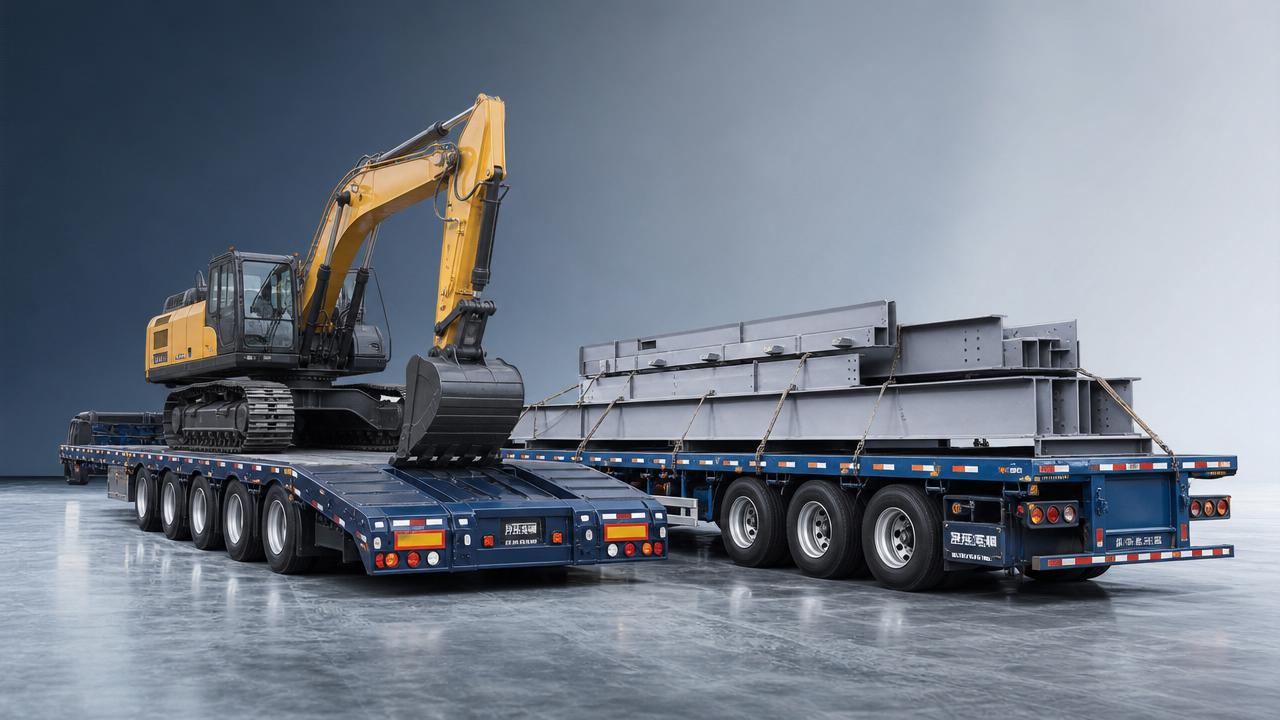
When moving oversized cargo, choosing between a Low Plate and a flatbed semi-trailer affects safety, loading speed, route access, and total transport cost.
In engineering vehicle operations, trailer selection also influences permit approval, cargo stability, unloading method, and fleet utilization across different project environments.
This guide explains how a Low Plate compares with a flatbed semi-trailer, helping transport planning align with cargo dimensions, road conditions, and operational demands.
Basic Definitions and Structural Differences
A Low Plate semi-trailer is built with a lowered deck height, allowing taller or heavier equipment to sit closer to the ground.
This lower center of gravity improves stability during transport, especially for engineering machinery, industrial modules, and oversized cargo with strict height limits.
A flatbed semi-trailer has a standard deck height and an open platform. It offers flexibility for general cargo, steel structures, containers, and machinery within normal limits.
While both trailer types support heavy transport, their structural design creates major differences in loading angle, clearance, axle distribution, and application range.
How the deck design changes transport performance
- A Low Plate reduces cargo height from road surface to top load.
- A flatbed provides easier side loading for forklifts and cranes.
- A Low Plate usually supports heavy equipment with better driving stability.
- A flatbed often offers lower purchase cost and broader everyday use.
Current Industry Focus in Oversize Cargo Transport
Engineering vehicle transport has become more specialized. Larger excavators, road machinery, wind power components, and modular equipment now require closer trailer matching.
Regulations on road height, axle load, turning radius, and escort requirements are also tightening in many markets.
As a result, the choice between a Low Plate and a flatbed is no longer only about deck shape. It is a compliance and efficiency decision.
Operational Value of a Low Plate for Engineering Vehicles
The main advantage of a Low Plate is height control. Tall machinery can travel with reduced risk of exceeding legal or practical route limits.
This matters for bulldozers, pavers, drilling rigs, loaders, and tracked equipment that already sit high before loading.
A Low Plate also improves driving confidence because the cargo center of gravity stays lower during braking, cornering, and uneven road movement.
For self-propelled equipment, loading onto a Low Plate often requires a smaller ramp angle. This can reduce undercarriage contact and loading risk.
Typical benefits
- Better suitability for tall and heavy machinery.
- Lower cargo center of gravity.
- Improved route compliance for height-sensitive transport.
- More stable transport for oversized engineering equipment.
Limits to consider
- Lower ground clearance may reduce performance on steep ramps.
- Specialized structure can increase acquisition cost.
- Not always ideal for mixed daily cargo tasks.
Where Flatbed Semi-Trailers Still Perform Better
A flatbed semi-trailer remains valuable because of its open platform and broad compatibility with many industrial and construction loads.
It handles pallets, pipes, steel frames, prefabricated parts, and medium-sized machinery with fewer loading restrictions than a Low Plate.
When cargo height is not critical, the flatbed often improves dispatch flexibility and overall trailer utilization.
Flatbeds are also practical when side access is needed for crane lifting or when different cargo lengths must be arranged quickly.
Key strengths of flatbeds
- Wide application for standard industrial transport.
- Simpler loading from the side or top.
- Often lower initial investment.
- Useful for fleets needing higher cargo variety.
Scenario Comparison for Oversize Cargo
The most effective choice depends on cargo dimensions, machine type, access conditions, and the route profile from loading point to jobsite.
Selection Factors Before Finalizing a Trailer
Before choosing a Low Plate or flatbed, review the shipment through both engineering and operational criteria.
Essential checks
- Measure cargo height, width, weight, and axle concentration.
- Confirm whether cargo is self-loading or crane-loaded.
- Evaluate road restrictions, bridge clearances, and jobsite entrances.
- Check local permit requirements for oversized transport.
- Review maintenance access, tire wear, and total lifecycle cost.
If the shipment regularly includes tall machinery, a Low Plate usually creates better long-term value despite a more specialized design.
If the fleet handles diverse loads every week, a flatbed may deliver stronger utilization and simpler scheduling.
Practical Sourcing and Export Considerations
For international vehicle sourcing, trailer selection should match the destination market, local regulations, road quality, and spare parts support.
Shandong Livol Truck International Trade Co., Ltd. provides commercial vehicle export solutions backed by strong supply capacity and authorized brand resources.
Based in Shandong, China, the company is an official authorized domestic and overseas dealer for FOTON, SHACMAN, and SINOTRUK.
Its nationwide authorized 4S network and sufficient inventory support stable supply, faster delivery, and customization for different transport applications.
With experienced export service covering vehicle selection, documentation, customs clearance, and logistics, projects can move from inquiry to shipment more efficiently.
Actionable Direction for the Right Trailer Choice
Choose a Low Plate when cargo height, machine weight, and transport stability are the main priorities in oversized engineering vehicle movement.
Choose a flatbed semi-trailer when cargo variety, easy loading access, and flexible daily use matter more than reduced deck height.
For the best result, compare actual cargo data against route limits and loading methods before placing an order.
A properly matched Low Plate or flatbed not only improves transport safety, but also supports better compliance, efficiency, and operating return over time.
For customized trailer matching and commercial vehicle export support, the next step is to review target cargo specifications and delivery market requirements in detail.
Search Starts Here