
News
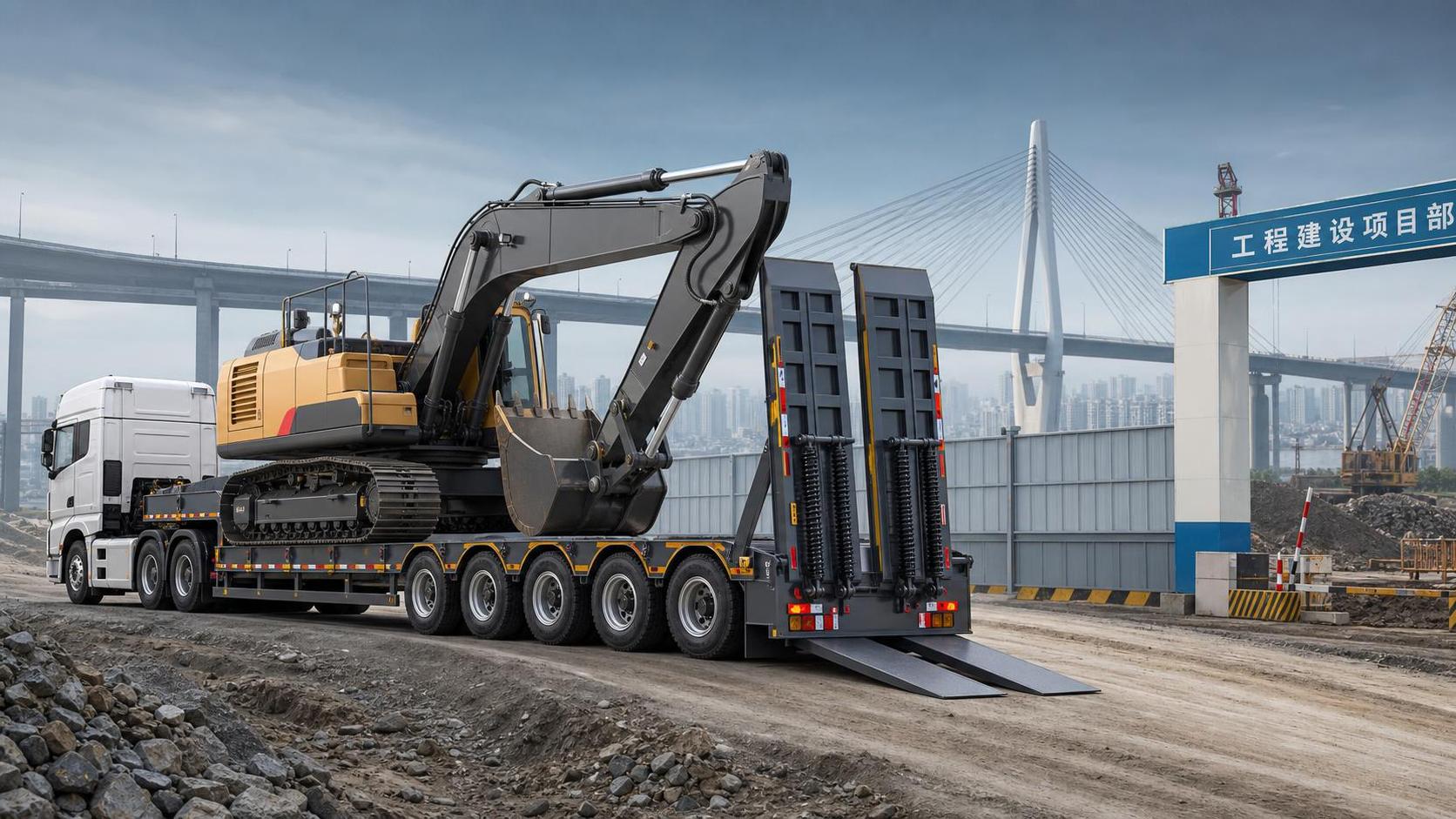
Low Plate Trailer Selection: Ground Clearance, Capacity, and Route Risk
A Low Plate trailer is often chosen for one reason: the cargo is too tall, too heavy, or too awkward for a standard flatbed. But in practice, selection is rarely about deck height alone. Operators usually run into problems when they treat all low deck trailers as interchangeable. A trailer that looks suitable on paper can become the wrong tool once the route includes uneven access roads, temporary bridges, steep ramps, or local axle restrictions.
That is why three factors tend to decide whether a Low Plate works well in real transport conditions: ground clearance, usable load capacity, and route risk. These are connected. Lowering the deck helps with height control and loading stability, but it can reduce underbody clearance. Increasing capacity may change axle layout, turning radius, tare weight, and permit requirements. A route that seems manageable for an empty trailer may become a different calculation once a machine is loaded and the suspension is carrying full weight.
For operators moving excavators, road machinery, transformers, steel structures, or other heavy equipment, the right question is not “What is the lowest trailer available?” It is “What trailer still works safely across the roads, site entrances, and legal limits I actually have to cross?”
Low deck does not mean zero compromise
In the engineering vehicle sector, “Low Plate” usually refers to a low-bed or low-deck trailer designed to keep the cargo platform closer to the ground than a conventional semi-trailer. That lower center of gravity matters. It improves stability during transport and often makes the difference between passing under a bridge or not. For tall machinery, every centimeter counts.
Still, low deck design introduces tradeoffs. A trailer with very limited clearance below the deck or frame can bottom out on crest points, drainage crossings, construction site entrances, ferry ramps, and badly repaired roads. This is not a minor inconvenience. Contact between the trailer underside and the road surface can damage the structure, affect suspension components, or shift the load if the impact is severe enough.
Operators sometimes focus on loaded height but ignore transition angles. That is a common mistake. A trailer may clear a bridge perfectly and still fail on a sharp yard entrance because the breakover angle is wrong for the wheelbase and deck geometry. In heavy haul work, route profile matters just as much as route width.
Ground clearance is not a brochure number
Ground clearance should be evaluated as a working condition, not a single specification line. Manufacturers may list unloaded clearance, but operators need to think about clearance under full payload, on suspension compression, during turning, and while crossing uneven surfaces. Air suspension, mechanical suspension, hydraulic suspension, tire size, axle spacing, and deck structure all influence the actual clearance available in use.
When the cargo is concentrated rather than evenly distributed, the trailer attitude can change. A machine with most of its weight over one section may create local sag or alter axle loading enough to affect how the trailer behaves on ramps. The result is that two loads with the same total weight may create different clearance risks.
A practical selection check usually includes these questions:
- What is the minimum ground clearance when the trailer is fully loaded, not empty?
- Where is the lowest point: under the gooseneck, main beam, axle area, or rear overhang?
- Will the route include temporary site roads, speed humps, culvert crossings, or steep transitions?
- Does the machine need to be driven onto the deck, and if so, what ramp angle is acceptable for that equipment?
These details are often more useful than a generic claim that one trailer is “better for rough roads.” Low Plate selection only becomes meaningful when road geometry is part of the discussion.
Capacity has two sides: legal load and structural suitability
Capacity is another area where buyers can oversimplify. A trailer may be described as 40 ton, 60 ton, or heavier, but that headline figure does not answer the real transport question. Operators need to separate structural capacity from legal operating capacity on the route. The trailer frame, axles, tires, kingpin, and suspension may be designed for a certain gross load, yet the permitted load on public roads can be lower depending on axle group limits, road class, local enforcement practice, and whether special permits are required.
The cargo itself also matters. A crawler excavator, a wheel loader, and an industrial tank may weigh the same, but they do not load the deck in the same way. Track contact length, point loading, center of gravity height, and the need for blocking or cribbing all affect whether a trailer is actually suitable. Capacity is not only about whether the trailer can “carry the weight.” It is about whether it can carry that specific piece of equipment without overloading a local area of the deck or creating unstable weight distribution.
This is where experienced exporters and equipment transport specialists add value. A reliable supply partner should not stop at quoting deck dimensions and axle count. The useful conversation includes cargo drawings, axle loads, operating dimensions, destination road conditions, and whether the unit will work mostly on highways, mining access roads, port yards, or mixed environments. Companies with broad commercial vehicle experience, especially those already handling multiple truck and trailer configurations for overseas markets, are usually better positioned to align equipment selection with local operating realities rather than only factory catalog options.
Route risk changes the trailer you should buy
Route risk is often underestimated because it does not appear in the trailer specification sheet. Yet for many operators, it is the factor that decides lifecycle cost. A trailer chosen only for payload and purchase price may turn into a poor asset if it frequently scrapes, struggles with access points, cannot meet local transport restrictions, or requires repeated detours.
Risk on route usually comes from a combination of issues rather than one obvious obstacle. Bridge height is the visible one, but not the only one. There may be weak shoulders, narrow turning spaces, roundabouts that limit long-wheelbase movement, seasonal road damage, informal detours around construction, or remote project sites with inconsistent road maintenance. In cross-border or export operations, route assumptions become even less reliable because road standards, permit systems, and enforcement intensity can vary significantly between markets.
For that reason, route assessment should be part of trailer selection before procurement, not after delivery. If the transport profile includes mixed paved and unpaved surfaces, some operators are better served by accepting a slightly higher deck in exchange for improved clearance and fewer underbody incidents. If the key bottleneck is vertical clearance under fixed infrastructure, then a lower deck may justify the added route sensitivity. Neither choice is automatically correct without context.
Where operators often get the decision wrong
One common misunderstanding is assuming that a heavier-rated trailer is always the safer choice. In reality, extra axles and stronger structure can increase tare weight and complicate maneuvering. If the typical load does not require that rating, the operator may carry unnecessary dead weight and face tighter route constraints than needed.
Another mistake is selecting around maximum load alone. Many operators rarely move the theoretical maximum cargo every week. What matters more is the normal operating range. A trailer that performs well across the 80 percent of real jobs may be more valuable than one optimized for a rare extreme case but awkward the rest of the time.
There is also a tendency to overlook loading and unloading conditions. A Low Plate that works well on the road may still be inefficient if the rear ramp angle is unsuitable for tracked equipment or if deck width does not match the machines being transported. These are not secondary details. Repeated awkward loading increases time, wear, and incident risk.
A practical way to compare options
When comparing trailers, operators usually make better decisions by scoring them against transport conditions rather than reading the specification sheet top to bottom. The useful comparison is operational, not just dimensional.
This kind of comparison tends to surface the real issue quickly. Sometimes the best Low Plate is not the lowest one. Sometimes it is the one with the most balanced compromise between cargo height control and route survivability.
What a sensible buying discussion should include
Before final selection, operators should be ready to provide at least the typical cargo dimensions and weight, how often the maximum load is moved, the tractor head configuration, and a realistic description of road conditions. Export suppliers with strong commercial vehicle experience can usually support this process more effectively when they understand the full transport chain, including documentation, logistics coordination, and destination market conditions. That matters because the trailer is only one part of the operating system.
A capable supplier should also be able to discuss customization where necessary, such as axle arrangement, deck length, ramp style, suspension preference, or other configuration details tied to actual use. The goal is not to make the trailer more complex than required. It is to avoid buying a nominally suitable unit that creates daily friction once it enters service.
If there is one useful rule for Low Plate selection, it is this: match the trailer to the route and the load together. Height, weight, and road profile should be assessed as one transport problem. Once those three are viewed separately, operators start solving the wrong issue. And in heavy equipment transport, the wrong trailer rarely fails in the sales conversation. It fails at the first difficult entrance, the first overloaded axle checkpoint, or the first job where the route looked easy until the machine was actually on the deck.
Search Starts Here