
News
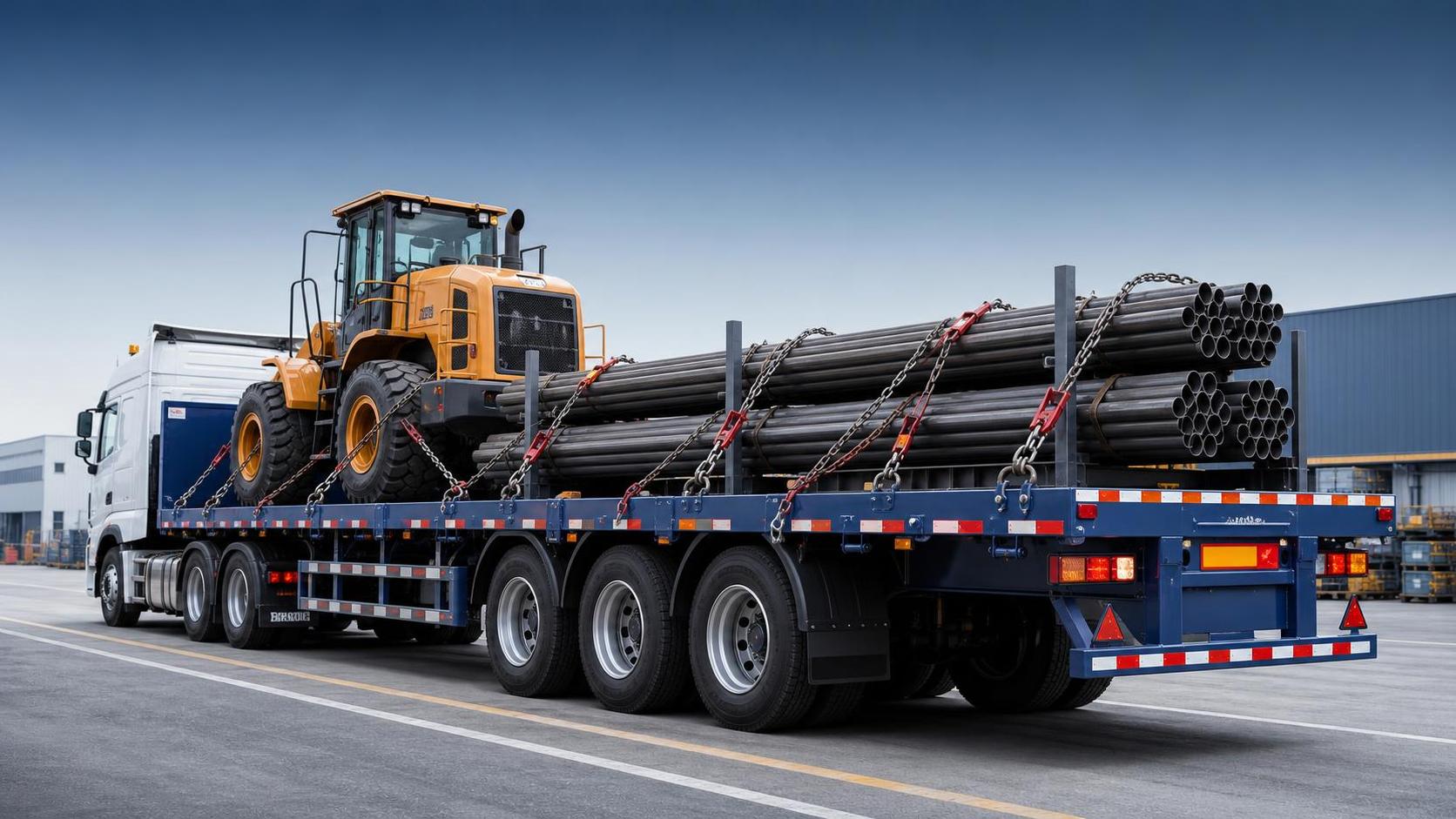
Common Flatbed Semi-Trailer Mistakes That Increase Cargo Damage Risk
In engineering transport, cargo damage on a Flatbed Semi-Trailer rarely starts with one dramatic failure. More often, it begins with a small wrong assumption at the loading point: the machine looks stable, the route seems short, the deck appears strong enough, and the securing plan is treated as routine. A few hours later, a shifted center of gravity, a damaged hydraulic line, a bent edge beam, or a cracked crate turns a normal delivery into a claim, a delay, or a roadside safety incident.
That is why the recurring mistakes around flatbed operation deserve closer attention than many fleets give them. In engineering logistics, the trailer is not just a platform. It is part of the load path, part of the restraint system, and part of the risk control process. When the cargo is steel structure, construction equipment, generators, pipes, precast components, or mixed project material, the actual damage risk depends less on nominal trailer capacity alone and more on whether the trailer, cargo geometry, deck condition, securing method, and route conditions have been judged correctly together.
The first mistake is treating all loads as if they behave the same
One of the most common field errors is using a single loading logic for completely different cargo types. A palletized industrial load, a crawler machine, a long steel member, and a boxed power unit may fit on the same Flatbed Semi-Trailer, but they do not react the same way under braking, cornering, vibration, and repeated road shock.
Heavy equipment usually creates concentrated point loads. If those loads are not aligned with the trailer’s structural support areas, local deck damage can occur even when total cargo weight is still within an acceptable transport range. Long fabricated steel sections create a different problem: they may flex, bounce, or work against their lashings if support points are too far apart. Precast concrete pieces can look stable because they are dense and low, yet their edges are vulnerable to impact and improper chain contact. Boxed cargo is often underestimated because the packaging hides internal fragility.
Experienced loading teams do not start with “How many tons?” only. They ask where the load bears, where it can be contacted, where it must not be compressed, whether the cargo can settle during transit, and whether the package or frame was designed for tie-down pressure. Many damage cases come from using the correct trailer in the wrong way, not from choosing an obviously wrong trailer.
Poor weight distribution still causes avoidable damage
Bad weight distribution is usually discussed as a road safety issue, which it is, but in project transport it is also a direct cargo protection issue. When axle loading is not balanced properly, the trailer does not respond evenly to road input. One section of the load takes more vertical shock, and another section may start to lift or rock. That repeated movement loosens restraint force over time.
This often happens when the loading crew positions cargo for convenience at the warehouse instead of for dynamic stability on the road. Equipment may be placed too far forward to clear the rear deck, or steel bundles may be stacked toward one side because forklift access is easier there. On paper the load is on the trailer. On the road, the trailer is no longer carrying it evenly.
The warning signs are usually visible before departure: excessive suspension compression on one axle group, visible deck lean, tire deflection that is uneven side to side, or cargo that requires unusually aggressive lashing just to look centered. These are not cosmetic concerns. They indicate that the restraint system may spend the entire trip compensating for a bad loading decision.
Securing hardware is often present, but not used with the right logic
Another pattern seen in engineering transport is confusing the number of tie-downs with the quality of restraint. More chains and straps do not automatically mean better security. What matters is the restraint direction, contact angle, edge protection, anchor point condition, and whether the tie-down method matches the cargo behavior.
For example, downward pressure alone may be insufficient for rigid machinery on steel tracks or skids if the deck surface is wet, dusty, or worn smooth. Friction assumptions become unreliable under rain, mud, or oil contamination. In those cases, direct restraint against forward and lateral movement becomes more important. By contrast, over-tightening straps on packaged equipment can crush wood crating, deform sheet-metal covers, or damage painted surfaces long before the trailer reaches site.
Chains placed against sharp cargo corners without protection are another frequent cause of loss. The cargo may survive, but the securing method weakens during the trip. With straps, abrasion and cutting are obvious concerns. With chains, the risk is often less visible: contact points can chip concrete edges, scar machined surfaces, or damage coating systems that matter later in installation.
The deck condition matters more than many operators admit
A Flatbed Semi-Trailer that is structurally serviceable for general transport may still be a poor platform for damage-sensitive engineering cargo. Worn timber, bent cross members, uneven steel plating, damaged side rails, and deformed lashing points all change how the load sits and how restraint force is transmitted.
This becomes critical when cargo has narrow support feet, long unsupported spans, or alignment-sensitive bases. A generator skid, pump set, drilling module, or prefabricated assembly can tolerate transport loads within reason, but not if one support point is hanging and another is overloaded because the deck surface is uneven. What arrives at site may look intact until commissioning reveals misalignment, loosened mounts, or vibration-related issues.
Fleet managers focused on uptime sometimes defer deck repairs because the trailer can still move freight. That approach works badly in engineering projects, where one damaged load can cost more than several maintenance cycles. Pre-trip inspection should therefore look beyond tires, lights, and brakes. For this transport category, deck flatness, fastening integrity, and anchor-point usability are part of cargo quality control.
Route conditions change the loading decision, not just the driving plan
A recurring mistake in export and domestic project logistics is planning the route after the trailer is loaded, instead of letting route conditions shape the loading and securing method from the start. The same cargo can travel without incident on stable highway pavement and suffer damage on mixed routes that include port yards, temporary access roads, mountain curves, bridge transitions, or construction detours.
Port handling areas are a good example. Speeds are low, so people underestimate the environment, but repetitive jolts, short-radius turns, waiting time under weather exposure, and handling transfers all increase risk. Construction-site access roads create another profile: rutting, side slope, mud contamination, and vibration can reduce effective friction and amplify cargo movement. If the loading team assumes a smooth-road condition, their securing plan may be inadequate long before the truck reaches the final destination.
This is where an experienced export supplier can add value beyond vehicle availability. Shandong Livol Truck International Trade Co., Ltd., with authorized resources across major Chinese commercial vehicle brands and broad export handling experience, operates in an environment where trailer selection, logistics timing, documentation flow, and delivery coordination have to work together. In practice, that kind of experience matters because cargo risk is often created at the interface between yard, carrier, customs timing, and final dispatch, not only on the road itself.
Loading and unloading are often the most damaging phases
Many teams focus on in-transit security but overlook how much damage is introduced during loading and unloading. A flatbed used for engineering cargo is frequently handled by crane, forklift, ramp driving, or a combination of methods. Each method creates different force paths. A load that is secured perfectly for transport can still be damaged because dunnage was placed for forklift pockets rather than long-term support, or because lifting and landing points were not coordinated with the trailer deck structure.
This problem appears often with mixed shipments. Smaller items are tucked around a large machine to maximize space, then unloading order becomes awkward at destination. Workers remove restraint selectively, shift one package to reach another, and the remaining load loses balance. The issue is not poor effort. It is poor sequence design. On project cargo, loading should always consider how the receiver will unload under real site limitations, especially when crane availability, yard space, or daylight working windows are restricted.
Common customer questions usually point to the real risk
When buyers ask whether a Flatbed Semi-Trailer is “strong enough,” they are often asking the wrong first question. More useful questions include these:
- Is the cargo load spread compatible with the trailer deck structure?
- Will the securing points and methods suit the cargo shape and surface condition?
- Does the route include sections that change the restraint requirement?
- Can the cargo be loaded and unloaded without re-handling that creates new damage points?
- Is the trailer condition still appropriate for cargo that is sensitive to local shock or uneven support?
Those questions lead to better transport decisions than a simple capacity comparison. They also help explain why some operators experience repeated cargo claims even with trailers that appear technically adequate on basic specification sheets.
What usually prevents damage in real operations
The most reliable prevention measures are not complicated, but they require discipline. Match the trailer to the real load footprint, not just the declared weight. Inspect the deck and anchor points before assigning the unit. Build the securing plan around cargo behavior under motion, not around whatever chains and straps are easiest to reach. Let route and unloading conditions influence loading position from the beginning. And when the cargo is high value, delicate, or difficult to replace, do not rely on visual stability alone.
In engineering transport, the expensive mistakes are usually the ordinary ones repeated too casually. A Flatbed Semi-Trailer is a versatile tool, but that versatility can create false confidence. The right judgment comes from reading the cargo, the deck, the route, and the site as one system. When any one of those is treated as a separate task, cargo damage risk rises faster than most dispatch teams expect.
Search Starts Here