
News
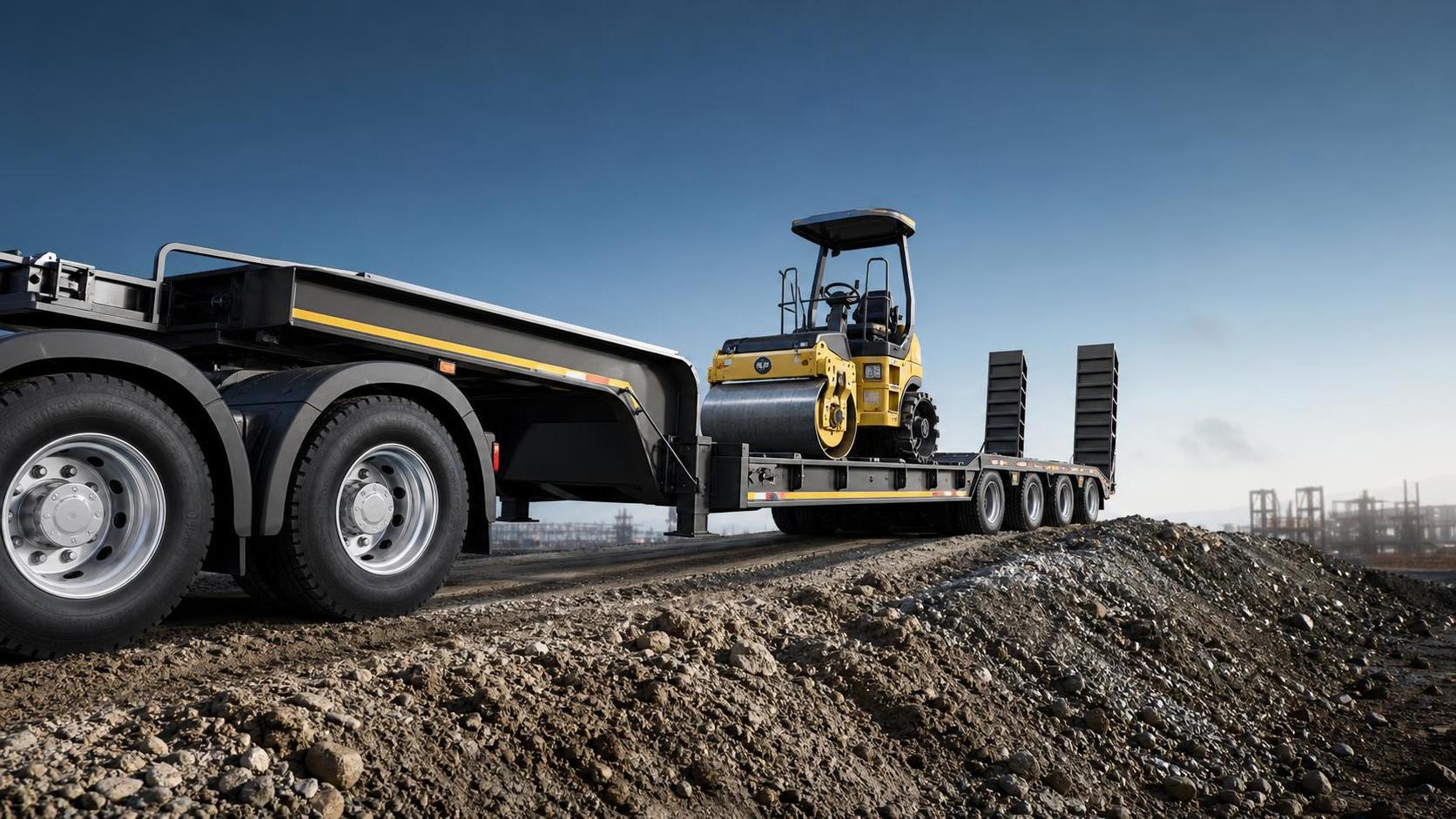
Ground clearance on a Low Plate trailer is not a minor spec
When people compare a Low Plate trailer, they usually start with payload, deck length, axle layout, and price. On actual construction transport jobs, though, ground clearance often becomes the detail that decides whether loading goes smoothly or turns into a delay, a damaged ramp, or a machine belly scraping at the wrong moment.
That is why this topic matters well beyond trailer engineering. A trailer that sits too low may help reduce overall transport height and make loading easier for some equipment, but it can also struggle at job site entrances, temporary haul roads, ferry ramps, workshop aprons, and uneven urban access points. A trailer with more clearance may pass rough terrain more confidently, yet create a steeper loading angle that is less forgiving for tracked machines, pavers, rollers, and low-slung equipment.
For project managers, the practical question is not “Is lower always better?” It is closer to: how low can the trailer be before it starts creating avoidable site access and safety problems?
What ground clearance changes in real loading conditions
On a Low Plate, ground clearance affects three things at the same time: breakover angle, ramp transition, and underbody exposure. These are related, but they do not fail in the same way.
A lower deck usually reduces the ramp angle. That is good news for equipment with long wheelbases, low approach angles, or vulnerable undercarriage components. If you are loading asphalt equipment, compactors, or some wheeled machinery with limited clearance, a gentler climb reduces the chance of the front lip, rear frame, or center section making contact during loading.
The trade-off appears once the loaded trailer leaves paved ground. Low trailer clearance means less room between the underside and the terrain. On a flat yard, that may not matter. On a quarry approach, a site with drainage humps, or a road with temporary steel plates over trenches, it matters immediately. The trailer can touch down at the gooseneck transition, near axle groups, or under the deck center. That contact may not look dramatic, but repeated strikes are hard on the trailer structure and can unsettle the load.
This is also where operators sometimes confuse deck height with usable clearance. A trailer can have a low loading surface but still be designed with better geometric transitions than another unit. So the nominal “low” profile alone does not tell the full story.
Loading safety is mostly about angles, transitions, and operator margin
From a safety standpoint, the critical moment is often not while traveling but while equipment is moving from ground to ramp, and from ramp to deck. Those transition points are where machines hang up, lose traction, or strike the trailer.
A lower Low Plate trailer generally gives the operator more margin during loading. That can reduce the need for improvised timber packing under ramps, aggressive throttle input, or repeated positioning attempts. Anyone managing multi-machine mobilizations knows that repeated loading attempts waste time and increase risk, especially when weather, mud, or fading daylight are already working against the crew.
But lower is not automatically safer. If the trailer underside is very close to the ground, even a moderate surface crown or drainage channel can shift the trailer attitude while loading. Ramps may no longer sit evenly. The rear support area may not remain stable. In those conditions, a very low trailer can become more sensitive to poor ground preparation than a slightly higher one.
That is why experienced transport planners do not look only at machine weight. They also look at machine geometry: track length, ground contact, overhang, center of gravity, and how the machine transfers weight as it climbs. The trailer’s clearance and ramp geometry need to match that behavior.
Site access is where a good specification proves itself
Many transport issues appear after dispatch, not during quotation. A trailer may be perfect for highway travel and still be awkward on the final 300 meters into the site. This is common on industrial expansions, remote energy projects, municipal works, and mines where the last access section was never designed for low transport equipment.
Typical problem points include:
- sharp entry aprons between public roads and site gates
- temporary ramps formed with compacted fill
- culvert crossings and drainage swales
- uneven concrete joints at workshops or precast yards
- ferry or barge loading points
- rutted internal haul roads after rain
In these situations, trailer ground clearance affects whether the unit can enter loaded, unloaded, or only with route preparation. Sometimes the solution is simple: build a smoother temporary transition, adjust loading direction, or schedule access when the surface is dry. Sometimes the trailer choice itself is wrong for the route.
That is one reason buyers with international project portfolios often ask for application-based guidance rather than just a catalog spec. Exporters with real commercial vehicle experience usually see this earlier in the process. Companies such as Shandong Livol Truck International Trade, which work across truck selection, customization, logistics, and export documentation, are often involved in discussions that go beyond the trailer alone—tractor matching, route constraints, spare parts support, and how a unit will actually perform once it reaches the destination market.
There is no universal “best” clearance, because the job decides it
It would be convenient to name one ideal ground clearance for every Low Plate application, but that would be misleading. The right balance depends on at least four variables:
- the machine being loaded
- overall transport height limits on the route
- surface quality at origin, destination, and transfer points
- how often the trailer must leave paved roads
If the main task is moving tall equipment through routes with strict height restrictions, a lower deck can be a decisive advantage. If the work involves repeated entry into rough civil sites, a bit more clearance may save more time than the lower deck ever gains.
This is where project teams sometimes make an expensive mistake: they optimize for one constraint only. They choose the lowest possible trailer to solve legal transport height, then discover that site access requires earthwork, alternate unloading points, or second-stage movement with other equipment. The trailer is not defective; it is just mismatched to the full operating environment.
Questions worth asking before you specify a trailer
A useful specification discussion is usually more operational than technical. Instead of asking only for deck height, ask questions like these:
- What is the lowest point of the equipment during loading and transport?
- Will the trailer regularly cross crowned roads, humps, or drainage dips?
- Is the loading area level and strong enough for stable ramp contact?
- Does the route include temporary access roads or mine/construction surfaces?
- What is the permitted loaded height in the destination market?
- Can the tractor and trailer combination maintain suitable approach and departure geometry?
These questions sound basic, but they often reveal whether the issue is really trailer clearance, or something adjacent such as axle position, neck design, suspension behavior under load, or poor route planning.
Standards and compliance still matter, but they do not replace field judgment
Transport teams naturally look at legal dimensions, axle loads, and local road regulations. Those checks are essential, especially for cross-border or export projects. Still, compliance on paper does not guarantee practical usability on site. A legal trailer height and axle configuration may still be inconvenient if the trailer grounds out on common access transitions.
For international procurement, this becomes even more important. Different markets have different road conditions, enforcement priorities, and maintenance realities. A trailer used mostly on smooth industrial corridors in one region may face very different demands in another where paved access ends early and project logistics depend on flexible site entry. That is why specification reviews often need input from both transport engineers and the people who actually run the job front.
Suppliers with established truck and trailer export experience can help coordinate those discussions more effectively, especially when the transport package includes tractor heads from brands such as FOTON, SHACMAN, or SINOTRUK and the buyer needs a workable combination rather than isolated equipment decisions. The value there is not marketing language; it is avoiding mismatched configurations before shipment and deployment.
Common misunderstandings around low-profile transport
One common misunderstanding is that lower deck height always means easier loading. It often helps, but if the trailer is too sensitive to uneven ground, loading can become more complicated in everyday field conditions.
Another is assuming that all rough-site problems can be solved by “driving carefully.” Skilled operators do make a difference, but they cannot change poor geometry. If the clearance is marginal, sooner or later the route will expose it.
A third is overlooking support and parts access. Low Plate trailers work hard, and when they operate internationally, after-sales readiness matters. A specification that looks attractive at purchase can become costly if service support, replacement parts, or technical guidance are difficult to obtain in the destination region. That is one reason many buyers prefer established exporters with inventory strength, coordinated logistics capability, and a clearer support path after delivery.
A more practical way to choose
If your projects are varied, the safest approach is usually not to chase the absolute lowest trailer. It is to define the real operating envelope: the tallest machine, the roughest likely access, the weakest loading surface, and the strictest route limit. Then choose a Low Plate configuration that stays workable across those conditions, even if it is not theoretically perfect for only one of them.
That may mean accepting slightly higher deck height in exchange for better site tolerance. Or it may mean staying very low because bridge and height restrictions leave no alternative, while planning route preparation and loading surfaces more carefully. Either decision can be correct. What causes trouble is making the decision without testing it against the job reality.
Ground clearance affects loading safety and site access because it sits at the intersection of geometry, regulation, and field conditions. On paper, it is one line in a specification sheet. In practice, it is often the difference between a transport plan that works cleanly and one that keeps needing exceptions.
Before ordering, it is worth reviewing the trailer together with the intended tractor, load type, route profile, and site entry conditions. That conversation usually saves more time than any last-minute workaround after the equipment arrives.
Search Starts Here