News
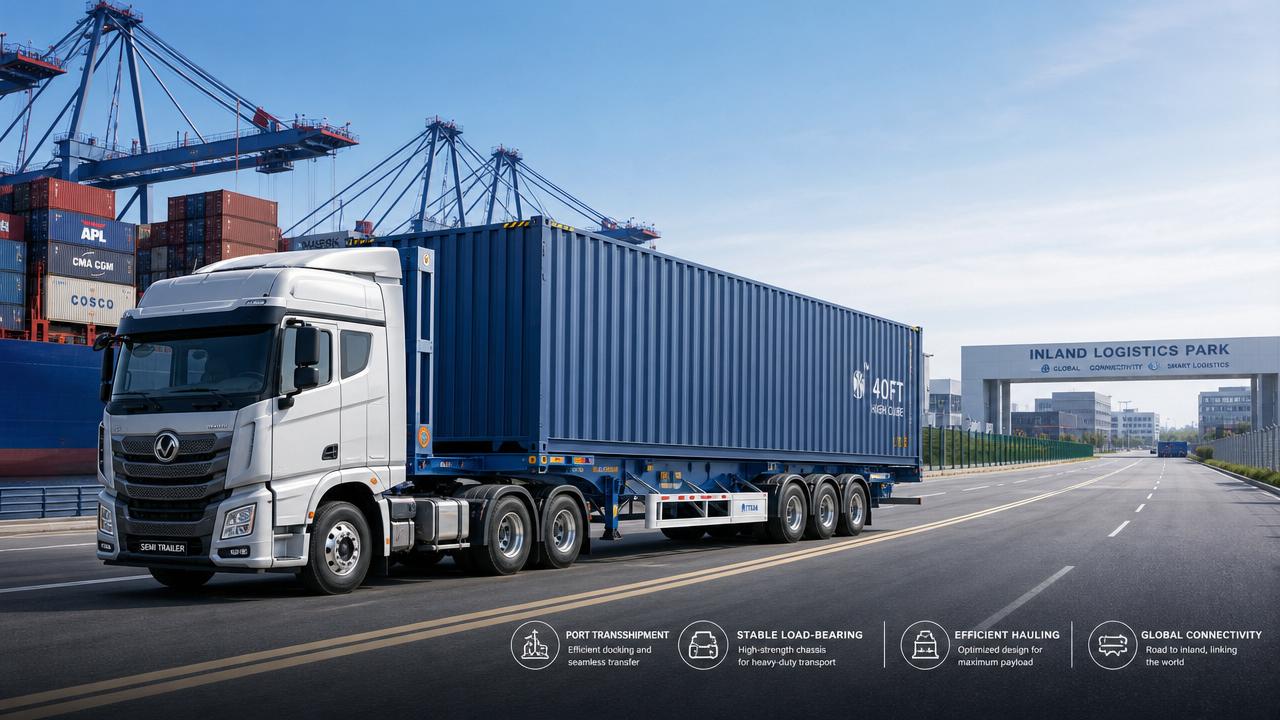
Choosing a Skeleton (Container) Semi-Trailer for port haulage is not only about price or payload.
It determines loading speed, container stability, route compliance, and total operating cost over years of service.
For busy port transport, the right trailer must fit container types, road conditions, terminal rules, and fleet turnover targets.
A well-matched Skeleton (Container) Semi-Trailer reduces delays, protects cargo, and improves daily container cycle efficiency.
Shandong Livol Truck International Trade Co., Ltd. supports global customers with reliable commercial vehicle export services and practical trailer selection guidance.
Why port haulage scenarios require different trailer choices
Port haulage is not one uniform task.
Some operations move standard 20ft containers inside terminal zones, while others run 40ft or 45ft boxes across urban roads and highways.
Each scenario changes the best Skeleton (Container) Semi-Trailer configuration.
Frame strength, axle layout, twist lock position, suspension type, and tare weight matter differently under different route conditions.
A trailer suitable for short shuttle work may perform poorly on rough access roads or long-distance drayage.
That is why selection should begin with transport scenarios, not catalog specifications alone.
Scenario 1: High-frequency terminal shuttle between port and nearby depot
This scenario values fast turnaround more than maximum route versatility.
The best Skeleton (Container) Semi-Trailer usually has simple structure, low tare weight, and durable locking components.
Frequent loading cycles increase wear on twist locks, landing gear, tires, and brake systems.
Choose a trailer with reinforced cross members and easy maintenance access.
If routes remain mostly flat and short, mechanical suspension may offer cost-effective durability.
For this use, simple and robust often outperforms complex designs.
Key checks for terminal shuttle work
- Fast container locking and unlocking layout
- Reliable brake response in stop-start traffic
- Strong anti-corrosion coating for coastal environments
- High parts commonality for rapid maintenance
Scenario 2: Port to inland logistics park on mixed urban and highway routes
This is one of the most common applications for a Skeleton (Container) Semi-Trailer.
The trailer must balance payload, compliance, stability, and operating economy.
Urban turns, speed bumps, bridge limits, and highway cruising all place different demands on the chassis.
A versatile 3-axle configuration is often preferred for 20ft and 40ft container transport.
Air suspension can improve ride quality and reduce shock on longer routes.
However, actual selection should reflect maintenance capability and road quality.
What matters most on mixed routes
Container compatibility should come first.
Check whether the Skeleton (Container) Semi-Trailer supports 20ft, 40ft, and optional 45ft containers without unstable load distribution.
Next, confirm axle load compliance under local transport regulations.
Then review kingpin quality, beam thickness, and side protection design for daily safety and durability.
Scenario 3: Heavy container haulage with rough port access roads
Some ports and inland yards have uneven pavement, puddles, broken concrete, or temporary road sections.
In these conditions, a lightweight trailer can become expensive if fatigue cracks appear early.
A heavy-duty Skeleton (Container) Semi-Trailer should use high-strength steel, reinforced gooseneck structure, and durable suspension components.
Ground clearance, tire specification, and brake line protection also deserve attention.
The goal is not only carrying weight.
It is surviving repeated shock loads without frequent downtime.
Core judgment points for harsh road conditions
- Main beam height and thickness
- Axle brand, bearing durability, and brake drum quality
- Welding consistency at stress concentration zones
- Anti-rust treatment for frame underside and exposed parts
Scenario 4: Multi-container flexibility for changing cargo programs
When container mix changes often, flexibility becomes a purchasing priority.
An extendable or multi-position Skeleton (Container) Semi-Trailer may support broader operations and reduce idle assets.
This suits routes handling 20ft, 40ft, and sometimes 45ft containers according to vessel schedule or inland demand.
Still, flexibility must not weaken structural reliability.
Extension mechanisms should lock securely and resist corrosion in marine environments.
If adjustment takes too long, the productivity gain may disappear.
How scenario needs differ in real port operations
Practical selection advice before ordering a Skeleton (Container) Semi-Trailer
A good buying decision comes from matching specifications to real operating patterns.
- List container sizes, gross weights, and weekly route distances.
- Check local axle, length, and safety regulations before selecting configuration.
- Compare suspension, beam structure, and coating by route condition.
- Review service parts availability, not only purchase price.
- Ask for production details on steel grade, welding process, and twist lock quality.
The best Skeleton (Container) Semi-Trailer is the one that performs consistently in your actual haulage environment.
Common mistakes when choosing for port haulage
One common mistake is focusing only on initial cost.
A cheaper Skeleton (Container) Semi-Trailer may lead to higher repair frequency, tire wear, and loading delays.
Another mistake is ignoring corrosion resistance.
Port environments expose trailers to salt, humidity, and standing water every day.
Some buyers also overlook compatibility with tractor units, yard equipment, or local inspection standards.
Even small mismatches can reduce efficiency across the transport chain.
A reliable next step for export-ready trailer sourcing
If you are evaluating a Skeleton (Container) Semi-Trailer for port haulage, start with route data and container requirements.
Then confirm structural configuration, compliance details, and after-sales support.
Shandong Livol Truck International Trade Co., Ltd. offers professional commercial vehicle export support across vehicle selection, customization, documentation, customs clearance, and logistics.
With authorized resources for leading Chinese commercial vehicle brands and stable supply capability, Livol helps global customers source transport solutions with greater confidence.
A carefully selected Skeleton (Container) Semi-Trailer can improve safety, uptime, and long-term return from every container movement.
Search Starts Here