
News
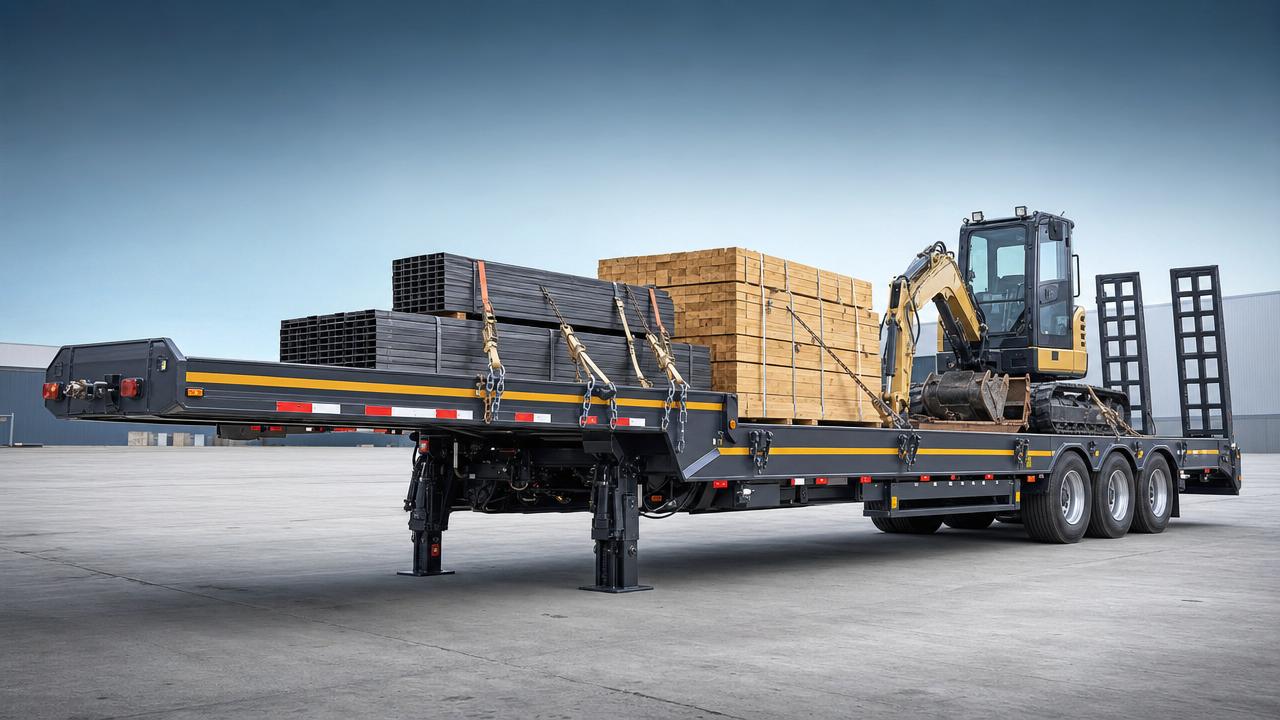
Choosing the right Flatbed Semi-Trailer is essential for safely moving steel, timber, and machinery across changing road and jobsite conditions.
Each cargo type creates different demands for payload, deck strength, cargo securing, axle layout, and loading efficiency.
A well-matched Flatbed Semi-Trailer reduces damage risk, improves legal compliance, and supports better long-term operating value.
This guide explains how to evaluate trailer structure, dimensions, suspension, and practical transport details for real engineering vehicle operations.
Basic Understanding of a Flatbed Semi-Trailer
A Flatbed Semi-Trailer is an open-deck transport trailer designed for oversized, heavy, or irregular cargo.
Its flat loading platform allows side, rear, and top loading by forklift, crane, or ramp, which increases operational flexibility.
Compared with enclosed trailers, a Flatbed Semi-Trailer offers easier loading for long steel sections, timber bundles, and construction machinery.
However, open transport also requires stronger load securing methods, weather consideration, and careful deck selection.
Core structural elements
- Main beam design and steel grade
- Deck length, width, and height
- Axle quantity and load distribution
- Suspension type and braking system
- Lashing points, side stakes, and optional ramps
These features determine whether a Flatbed Semi-Trailer can handle high-density steel, lighter timber loads, or self-propelled machinery.
Industry Background and Current Selection Priorities
Engineering transport projects now demand higher efficiency, better safety records, and closer control of lifetime operating cost.
That is why Flatbed Semi-Trailer selection is no longer based on price alone.
Operators increasingly compare structural durability, spare parts support, customization capability, and delivery reliability.
In global engineering vehicle trade, dependable supply is also important, especially for fleet expansion and urgent project schedules.
Shandong Livol Truck International Trade Co., Ltd. provides integrated export support backed by strong domestic inventory and industry resources.
Its experience in vehicle selection, customization, documentation, customs clearance, and logistics helps improve delivery certainty.
Operational Value of the Right Flatbed Semi-Trailer
A correctly specified Flatbed Semi-Trailer creates value far beyond basic transport capacity.
It supports safer loading, faster turnaround, lower maintenance pressure, and more stable cargo condition at destination.
Main business advantages
- Better cargo protection through suitable deck and securing layout
- Higher transport efficiency with easier loading methods
- Improved stability from balanced axle and suspension configuration
- Lower repair frequency through stronger frame materials
- Longer service life under heavy engineering use
When transport routes include highways, industrial yards, ports, and rough access roads, structural margin becomes especially important.
A robust Flatbed Semi-Trailer helps maintain performance under repeated loading cycles and uneven ground conditions.
Key Selection Factors for Steel, Timber, and Machinery
Cargo characteristics should always guide Flatbed Semi-Trailer selection.
Steel, timber, and machinery differ in weight density, center of gravity, shape regularity, and securing requirements.
1. Load capacity and axle configuration
Steel usually creates the highest concentrated load, so axle rating and beam strength must be carefully matched.
Timber may fill trailer volume before reaching weight limits, while machinery can create point loads and shifting forces.
A 3-axle or 4-axle Flatbed Semi-Trailer is often preferred for heavy engineering transport, depending on local regulations.
2. Deck length and usable platform area
Long steel bars and timber packs need sufficient deck length to avoid unsafe overhang and difficult load balancing.
Machinery transport may require extra spacing for tracks, attachments, or loading ramps.
Choose dimensions that fit the most frequent cargo, not only occasional maximum loads.
3. Deck material and surface design
Steel transport often benefits from anti-slip surfaces and reinforced contact zones to reduce abrasion and movement.
Timber loads may require side stakes or removable posts to prevent lateral shifting during braking and cornering.
Machinery needs strong deck plating and secure loading angles to handle concentrated wheel or track pressure.
4. Securing points and safety accessories
A good Flatbed Semi-Trailer should provide enough lashing rings, stake pockets, winches, and optional chains or binders.
Cargo securing flexibility is especially valuable when the trailer handles different engineering materials across multiple projects.
5. Suspension and braking performance
Mechanical suspension is often chosen for strength and simplicity in severe operating environments.
Air suspension can improve ride quality for sensitive machinery, but maintenance conditions should be considered.
Reliable braking, ABS options, and stable axle alignment are critical for heavy-duty Flatbed Semi-Trailer operation.
Typical Cargo Matching by Application Scenario
This comparison shows why one universal trailer specification may not deliver the best result in every engineering task.
Selecting a Flatbed Semi-Trailer around the dominant cargo profile usually brings better safety and productivity.
Practical Recommendations Before Finalizing the Trailer
Before purchase, evaluate real operating details rather than relying only on nominal specifications.
- Confirm the heaviest regular cargo, not just the average load.
- Check road limits, axle rules, and permitted dimensions in the target market.
- Review loading equipment, including crane, forklift, or ramp usage.
- Compare frame material thickness and beam construction details.
- Inspect tire, axle, landing gear, and brake brand support availability.
- Ask for customization if regular cargo has special securing or deck needs.
Export service quality is also an important practical factor in Flatbed Semi-Trailer procurement.
A supplier with stable stock, formal authorization, and complete export coordination can reduce hidden project delays.
Shandong Livol Truck International Trade Co., Ltd. combines commercial vehicle expertise with responsive customization and logistics support.
This helps ensure the selected trailer matches both transport needs and cross-border delivery requirements.
Next-Step Direction for Trailer Selection
The best Flatbed Semi-Trailer is the one that fits actual cargo structure, route conditions, legal limits, and maintenance capacity.
For steel, focus on strength and weight distribution.
For timber, prioritize deck length and lateral securing support.
For machinery, give extra attention to ramp design, deck reinforcement, and loading stability.
If a project requires dependable commercial vehicle export support, detailed configuration matching is worth discussing before ordering.
A professional review of cargo type, dimensions, and operating environment can lead to a more reliable Flatbed Semi-Trailer solution.
Search Starts Here