
News
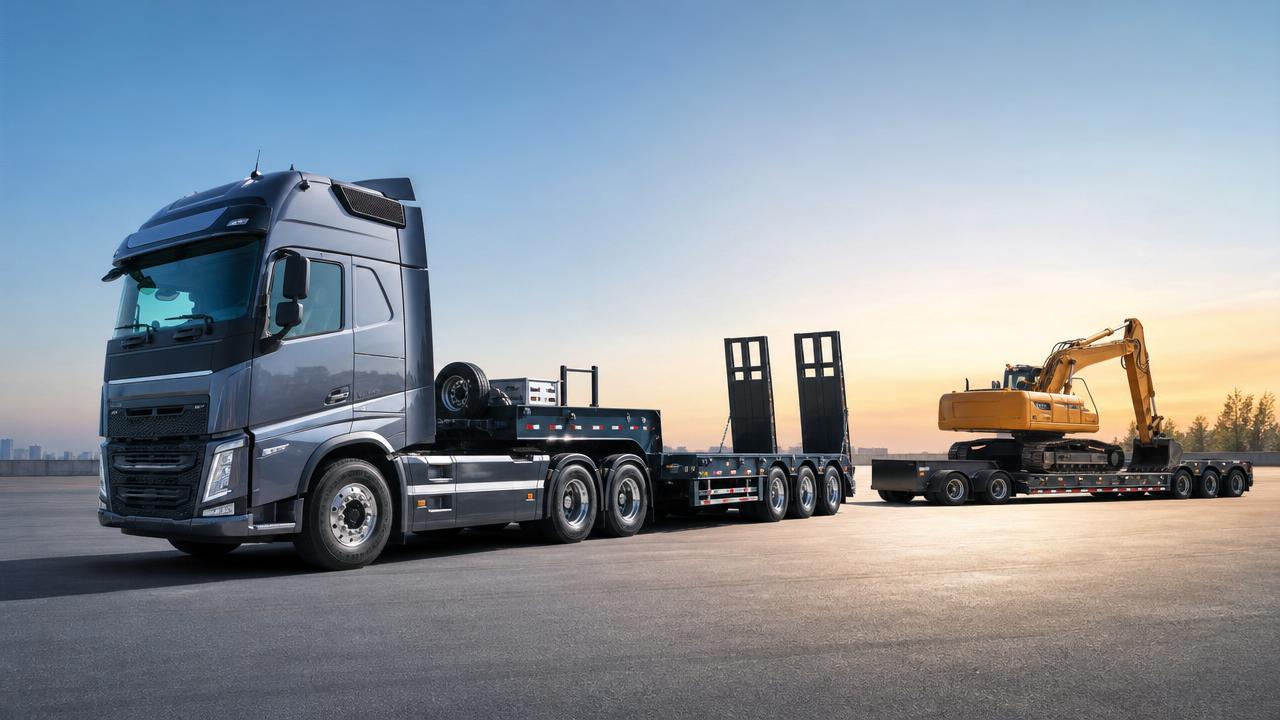
Flatbed Semi-Trailer vs Low Plate: Which Fits Heavy Loads?
Selecting the right trailer for heavy-load transport affects payload safety, route compliance, operating cost, and long-term fleet efficiency.
A Flatbed Semi-Trailer offers strong versatility for standard heavy cargo, while a low plate trailer supports taller or oversized equipment.
For engineering vehicle transport, the key factors include deck height, axle layout, structural strength, loading method, and local transport regulations.
Basic Structure and Transport Function
A Flatbed Semi-Trailer uses an open platform without side walls or roof panels.
This design makes it suitable for steel structures, containers, construction materials, machinery parts, and palletized heavy cargo.
The main advantage of a Flatbed Semi-Trailer is loading flexibility from the rear, side, or overhead crane.
A low plate trailer, also called a low bed trailer, has a lower deck between the gooseneck and rear axle group.
Its lower platform reduces cargo height and improves stability during the movement of tall engineering vehicles.
Common transported equipment includes excavators, bulldozers, wheel loaders, road rollers, cranes, and drilling rigs.
Both trailer types can handle heavy loads, but their best applications differ by cargo shape and route limitations.
Industry Factors Behind Trailer Selection
Heavy-load transport in engineering projects is becoming more complex due to larger equipment and stricter road supervision.
A Flatbed Semi-Trailer remains valuable where cargo dimensions stay within normal legal height and width limits.
Low plate trailers become important when machine height creates bridge, tunnel, or power-line clearance risks.
Axle regulations also influence the decision.
A Flatbed Semi-Trailer may use two, three, or more axles depending on legal payload requirements.
Low plate trailers often require reinforced beams and multi-axle designs for concentrated machine weight.
Operational Value in Heavy Engineering Transport
The operational value of a Flatbed Semi-Trailer comes from high daily utilization.
It can shift between construction materials, industrial equipment, steel coils, timber, pipes, and containerized cargo.
This versatility helps reduce idle time when transport tasks change across different engineering projects.
A Flatbed Semi-Trailer also supports faster loading when cargo can be lifted directly by crane.
For ports, factories, construction yards, and logistics hubs, this can improve dispatch efficiency.
The low plate trailer provides different value through height control and stability.
Lower deck height reduces the risk of overturning when moving tall machines on uneven roads.
It also helps keep total transport height within approved road limits.
For heavy equipment relocation, avoiding route detours can save time, fuel, permits, and escort costs.
Typical Heavy-Load Applications
Engineering vehicle transport usually involves irregular weight distribution and strict safety requirements.
The right trailer should match cargo footprint, center of gravity, loading access, and road environment.
A Flatbed Semi-Trailer is often the practical choice for mixed cargo fleets.
It performs well when the main requirement is deck space rather than reduced height.
A low plate trailer is more specialized, but it solves difficult height and stability problems.
For oversized engineering vehicles, this specialization can be essential rather than optional.
Technical Points for Comparing Load Performance
Payload capacity should not be judged only by the rated tonnage plate.
Frame material, beam section, welding quality, suspension type, tire rating, and axle brand all affect real performance.
- Check whether the Flatbed Semi-Trailer frame matches concentrated loads.
- Confirm deck thickness, cross-member spacing, and anti-slip surface design.
- Review axle load distribution under real cargo position.
- Verify suspension compatibility with rough construction access roads.
- Match tire specification with speed, heat, and road conditions.
A Flatbed Semi-Trailer normally has a higher deck than a low plate trailer.
This matters when transporting machines with high cabins, booms, tanks, or mounted attachments.
However, the higher deck can be acceptable for cargo that stays below route height limits.
The lower deck of a low plate trailer improves transport stability, but loading space may be less flexible.
Cost, Utilization, and Maintenance Considerations
Cost comparison should include purchase price, maintenance, fuel consumption, permit needs, and expected utilization rate.
A Flatbed Semi-Trailer usually provides better adaptability across many cargo categories.
This can improve return on investment when transport demand changes frequently.
Maintenance is also straightforward because the deck, chassis, suspension, and lighting system are easily accessible.
Low plate trailers may require stronger ramps, hydraulic components, and reinforced loading sections.
These features improve capability, but they may increase maintenance attention and inspection frequency.
If most cargo consists of standard industrial loads, a Flatbed Semi-Trailer can be more economical.
If cargo is mainly tall machinery, the low plate trailer often reduces total operating risk.
Practical Selection Guidelines
A practical selection process starts with accurate cargo data, not only estimated weight.
Record machine length, width, height, operating weight, center of gravity, track spacing, and loading clearance.
- Use a Flatbed Semi-Trailer for standard-height heavy goods and mixed freight.
- Choose a low plate trailer for tall machines and restricted routes.
- Confirm total combination length before applying for road permits.
- Check tie-down points, chains, binders, and anti-slip blocks.
- Review turning radius and ground clearance for site entry.
Cargo securing is critical for both trailer types.
A Flatbed Semi-Trailer needs reliable lashing points because the open deck exposes cargo to road forces.
Low plate trailers also need strong wheel stops, chain anchors, and ramp safety locks.
Before dispatch, inspect brake lines, electrical connectors, suspension, tires, kingpin, landing gear, and reflective markings.
Export Support and Vehicle Matching
International heavy-load transport also depends on documentation, customs clearance, shipping method, and destination compliance.
Shandong Livol Truck International Trade Co., Ltd. provides commercial vehicle export support from Shandong, China.
The company is an authorized dealer for FOTON, SHACMAN, and SINOTRUK vehicles in domestic and overseas markets.
Its inventory and 4S store network help support stable supply and timely delivery.
For trailer selection, matching the tractor head is as important as choosing the trailer body.
Engine power, gearbox, fifth wheel height, braking system, and axle ratio must suit the payload.
A Flatbed Semi-Trailer paired with the right tractor can improve fuel economy and transport reliability.
For oversized equipment, a low plate trailer and heavy-duty tractor combination should be evaluated together.
Decision Summary for Heavy Loads
A Flatbed Semi-Trailer is the stronger general-purpose option for heavy cargo with manageable height.
It offers flexible loading, broad cargo compatibility, simpler maintenance, and strong fleet utilization.
A low plate trailer is better for tall, oversized, or high-center machinery requiring lower transport height.
The final decision should balance payload, route limits, machine geometry, loading method, and long-term operating cost.
For reliable heavy-load planning, prepare cargo specifications and route details before confirming the trailer configuration.
Shandong Livol Truck International Trade Co., Ltd. can support vehicle selection, customization, documentation, logistics, and after-sales coordination.
For a suitable Flatbed Semi-Trailer or heavy-duty transport solution, request a configuration review based on your actual operating conditions.
Search Starts Here