
News
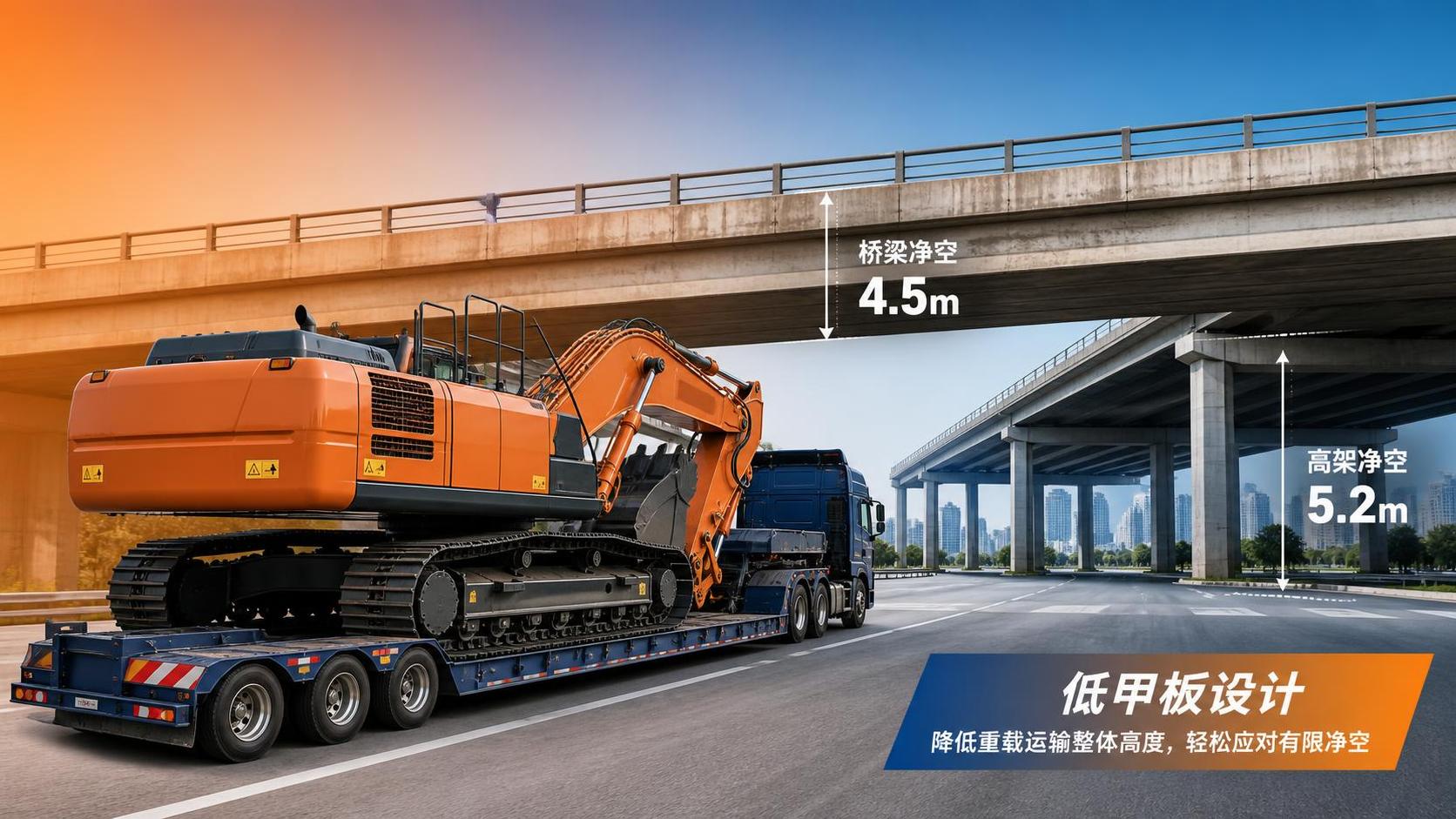
Yes. A low-deck trailer can reduce the loaded height of heavy cargo by placing the load-bearing platform much closer to the road surface than a standard flatbed or conventional platform trailer. For tall machinery, steel fabrications, industrial modules, tracked equipment, and large components, this difference can determine whether the shipment remains within the available clearance on the planned route.
The reduction comes from the trailer structure rather than from changing the cargo itself. A lower main deck, a dropped center section, smaller-diameter wheels in some designs, and a suitable axle arrangement allow the cargo base to sit lower. The practical result is a lower overall transport profile, a lower center of gravity, and often a more stable load during braking, cornering, and uneven-road travel.
However, reduced deck height does not automatically mean that every heavy load is easier or safer to transport. The real outcome depends on the cargo dimensions, its weight distribution, ground clearance, loading method, suspension travel, route conditions, and the relationship between the trailer, tractor unit, and tiedown plan.
How deck height changes total transport height
Total transport height is the height of the trailer deck plus the height of the cargo measured from its lowest supported point to its highest fixed point. If a machine is loaded on a higher platform, every component above its base rises by the same amount. Lowering the deck therefore reduces the entire loaded profile without requiring the machine to be dismantled.
This is especially useful when the cargo is tall but not unusually wide. Excavator booms, drilling assemblies, transformer housings, construction machinery cabs, and preassembled steel frames may have a height that creates clearance concerns even when their length and width remain manageable. A lower deck creates more room below bridges, utility lines, gantries, covered loading areas, and other overhead restrictions.
The amount of height saved is not determined by the trailer name alone. Two low-deck trailers can have different usable deck heights because of tire size, suspension type, axle layout, deck construction, and the position of the load. A specification should therefore identify the actual loaded deck height, not simply describe the trailer as “low.”
The drop deck is only part of the design
A lower central platform is often the most visible feature, but it works with several other structural elements. The gooseneck section, main frame depth, rear loading area, wheel recesses, and axle group all influence where the cargo can sit and how low it can be positioned.
A typical configuration has an elevated front section above the tractor connection, a lower center deck for the main cargo, and a rear section near the axle group. The center deck is usually the preferred location for tall equipment because it is lower than the front or rear portions. Yet that location also has length limits. Cargo that extends beyond the low center deck may rise onto a higher section, which can remove part of the expected height advantage.
For example, a long machine with a tall rear housing may need careful orientation. Loading it facing forward may place the highest point above the raised front deck, while reversing it may bring that point over the lower center section. The better orientation depends on axle loading, ramp approach, boom or attachment position, securement points, and whether the machine can be safely positioned without exceeding permitted overhang.
Ground clearance under the trailer matters
Lowering the deck reduces the clearance between the trailer structure and the road. This creates a tradeoff. A very low trailer can carry a tall load under restricted clearance points, but it is more exposed to contact at steep driveway entries, ramp transitions, construction-site access roads, uneven yards, ferry ramps, and raised crossings.
The lowest point is not always the deck surface. Crossmembers, landing gear, suspension components, air reservoirs, ramp hinges, and rear protection structures may sit lower. A trailer that clears a level roadway may still scrape when the tractor and trailer pass through a sharp change in grade. The angle between tractor and trailer can temporarily reduce clearance at the gooseneck or near the axle group.
Before loading, the route should be considered together with the entry and exit points. A low profile offers little value if the loaded vehicle cannot enter the jobsite, workshop, port area, or unloading yard without striking the ground.
Weight distribution can limit the usable low deck
Heavy cargo must be positioned to keep load within the allowed limits of the tractor drive axles, trailer axles, kingpin connection, tires, frame, and suspension. A low deck does not eliminate these requirements. It simply gives a lower support surface.
The cargo center of gravity is more important than its visible shape. A compact item may be very heavy at one end because of an engine, counterweight, hydraulic system, or dense steel section. Placing that heavy end too far forward can overload the tractor connection or drive axles. Moving it too far rearward can overload the trailer axle group, reduce steering-axle loading, or create instability.
Some cargo must sit in a specific part of the deck to achieve balanced axle loads. If that position places a tall component over a raised trailer section, the final overall height may be greater than expected. This is why a simple measurement of deck height and cargo height is not enough. The planned load position must be included.
Loaded height is different from parked height
A common error is measuring the trailer when it is empty, then using that figure to estimate the loaded transport height. Suspension compression, tire deflection, tractor coupling height, and cargo placement can alter the final deck position. Air suspension systems can also change height during coupling, loading, or leveling, but they should not be treated as a guaranteed way to solve a clearance problem.
The relevant figure is the height of the secured cargo in its actual transport condition on level ground. That means the tractor is coupled, the trailer suspension is set for travel, ramps are stowed, attachments are in their travel position, and the cargo is restrained. A raised exhaust stack, folded boom, removable guard, antenna, hydraulic fitting, or loose attachment can become the highest point even when the main machine body is below the anticipated limit.
Clearance should be measured at the point most likely to encounter an obstacle, not at a convenient flat area of the cargo. On irregular equipment, that point may be off center. A machine can fit under an obstacle at its centerline and still contact it with a high corner, cab roof, lifting eye, or extended side structure.
Axle arrangements influence both height and maneuvering
Axle configuration affects the deck design because wheels, brakes, suspension components, and axle travel all require space. A trailer with more axles may distribute a greater load, but the axle group can occupy more trailer length and affect the available low deck area. Closely spaced axles, steerable axles, and liftable axles each introduce different packaging and handling considerations.
Steerable axles can improve maneuvering in constrained areas and reduce tire scrub during turns, especially on long multi-axle trailers. Their inclusion does not automatically make the deck lower. The frame and axle arrangement must still provide adequate suspension movement and wheel clearance under full load.
Liftable axles may be useful when a trailer operates both loaded and empty, but the lifting function should not be confused with a deck-height control. When the cargo is loaded, the active axle configuration must provide the intended load distribution and stability. Removing an axle from service changes the load carried by the remaining axles and can change how the trailer responds over uneven surfaces.
Wheel recesses are another detail that deserves attention. They can create local low areas around the tire positions, allowing certain cargo shapes to sit lower. They are useful only when the cargo geometry matches the recess layout. A broad, flat-bottomed load may bridge over them and gain no height reduction, while a machine with tracks, narrow supports, or separated structural members may take advantage of the lower spaces.
Loading method can erase the expected advantage
A low deck often makes loading more demanding because the ramps must reach a lower platform while still maintaining a manageable approach angle. Tracked machinery, low-clearance equipment, long wheelbase vehicles, and cargo with attachments below the chassis can contact the ramps or deck transition during loading.
The risk is not limited to the ramps. The breakover angle between ramp and deck can cause a machine belly, fuel tank, blade, stabilizer, or rear structure to strike the trailer. Adding temporary ramp extensions can reduce the approach angle, but they must be rated, secured, and suitable for the equipment weight. Loose timber, improvised blocks, or unsupported plates create a shifting surface and can fail under concentrated track or wheel loads.
Loading direction also changes the result. A machine may climb more safely in one direction because of its center of gravity, attachment location, or track geometry. That direction may not be the best for transport height or axle loading. The loading plan has to resolve all three conditions together: safe ascent, correct transport position, and secure tiedown access.
Attachments and removable parts deserve separate attention
Reducing deck height is sometimes preferable to removing components, but removable parts can still affect the final profile. Buckets, booms, blades, counterweights, masts, hydraulic arms, and detachable frames may alter the highest point or prevent the cargo from sitting in its most stable location.
Removing a component can lower the overall height, yet it may create a separate transport item that requires its own support and restraint. It can also change the machine's center of gravity. A low-deck trailer should be selected around the cargo in its actual travel configuration, rather than around a simplified outline that ignores attachments and securement hardware.
Lower height also improves stability, within limits
Lowering the cargo base reduces the height of the combined center of gravity. This generally reduces body roll tendency and lessens load shift forces during cornering or sudden direction changes. That benefit is particularly relevant for tall, narrow, or top-heavy cargo.
Stability still depends on the cargo being properly supported. Concentrated loads need adequate bearing area beneath tracks, wheels, skids, or support points. Steel deck surfaces may require timber, rubber mats, purpose-made blocks, or other compatible packing to protect the deck, distribute load, and prevent sliding. The material selected must resist compression and remain stable under vibration, moisture, and changing temperature.
Securement should restrain forward, rearward, sideways, and upward movement. Chains, binders, lashing points, wheel restraints, and blocking must suit the cargo attachment points and the expected forces. A lower deck reduces leverage from a high center of gravity, but it does not compensate for weak tiedowns, unsuitable angles, damaged anchor points, or loose blocking.
When a low-deck trailer is not the best answer
A standard flatbed may be more suitable when the cargo is already low, when frequent access to rough sites is expected, or when a higher deck simplifies loading and unloading. The extra ground clearance can prevent underbody damage and reduce the need for ramp extensions. For cargo that is mainly wide, very long, or difficult to position over a dropped center section, deck height may not be the limiting factor.
A detachable-gooseneck or other specialized low-loading configuration may be appropriate for self-propelled equipment that needs a flatter loading path than rear ramps can provide. Conversely, a stepped deck may be sufficient for fixed industrial cargo that can be lifted onto the platform and does not require drive-on loading. The trailer type should follow the actual cargo shape and handling method rather than the assumption that the lowest deck always produces the best result.
The useful question is not simply whether the deck is lower. It is whether the cargo can be placed low enough, balanced correctly, loaded without contact, secured at suitable points, and carried over the full route without ground-clearance problems. When those conditions align, the reduced loading height of a low-deck trailer can make heavy cargo transport substantially more manageable.
Search Starts Here