
News
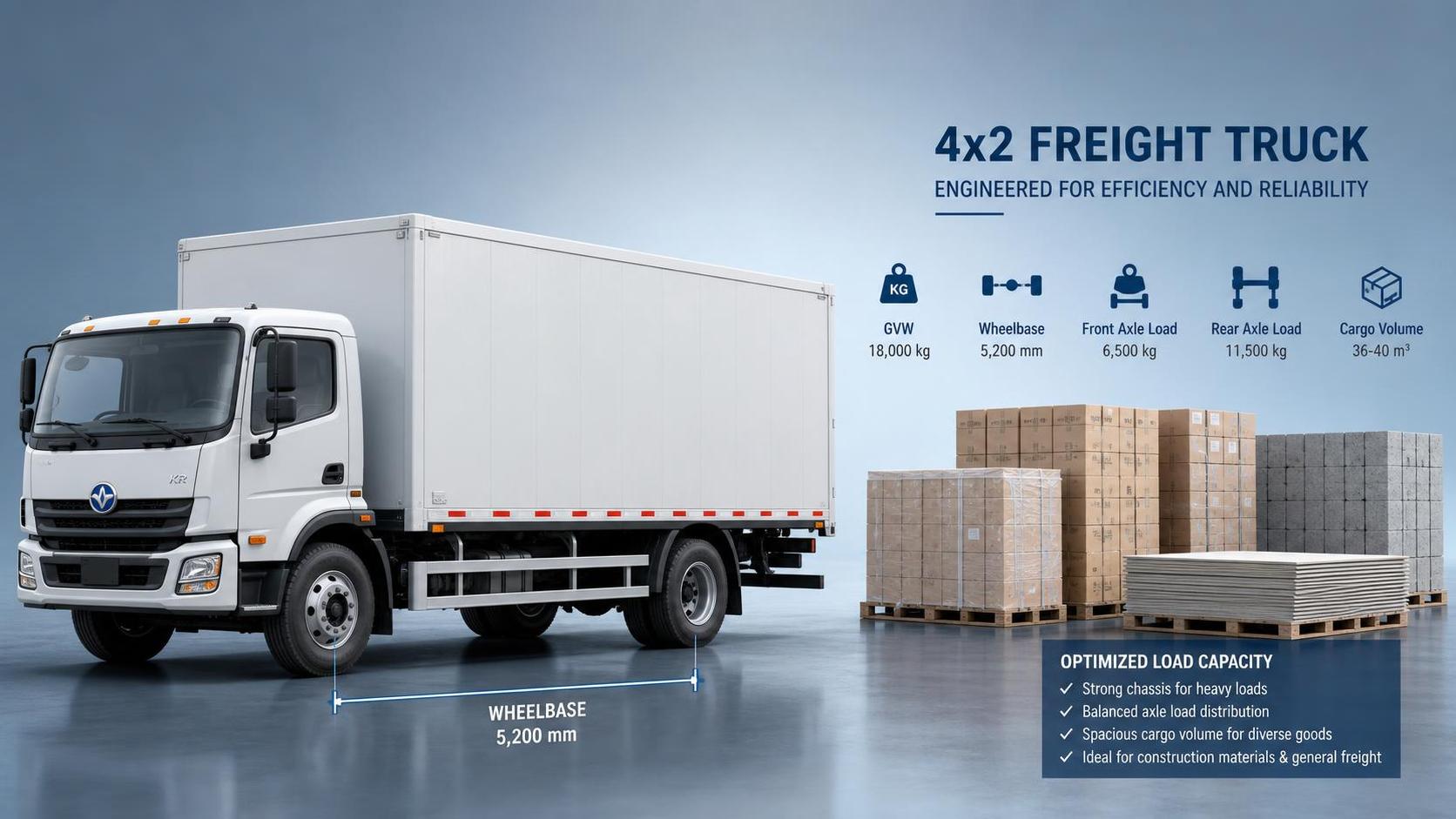
4_2 Cargo Truck Payload Limits: What Affects Real-World Transport Capacity?
The easiest mistake with a 4_2 Cargo Truck is to treat payload as a single number. It is not. What matters in daily work is not the headline figure from a brochure, but how much legal, stable, and repeatable cargo the truck can actually move on the routes it will run. A truck may look suitable on paper and still underperform once body configuration, tare weight, axle loading, road limits, and the nature of the cargo are taken into account.
In industry terms, a 4x2 truck means one front axle and one rear axle, with only one axle driven. That tells you something important immediately: capacity is constrained not only by total gross vehicle weight, but also by how the load is shared between the front and rear axles. This is why two trucks with similar engine power and cargo body length can end up with different usable payload in the field. The axle arrangement, frame strength, suspension specification, and wheelbase all influence how much cargo can be carried without overloading one part of the vehicle.
People often ask for “maximum payload,” but transport professionals usually think in three layers. First is the technical limit of the chassis. Second is the legal limit set by local regulations on gross weight and axle weight. Third is the operational limit, which may be lower because of cargo density, road quality, loading method, or customer requirements. The third layer is where many capacity calculations fail, because it is not visible in a simple specification sheet.
Payload starts with tare weight, not rated power
A common misunderstanding is to focus on horsepower when evaluating how much a truck can carry. Power affects gradeability, acceleration, and how comfortably the vehicle handles difficult terrain or time-sensitive delivery cycles. It does not directly determine payload. The first number to examine is curb weight or tare weight: the weight of the vehicle itself in working condition, including the cargo body and sometimes fuel and standard equipment depending on the specification method used.
If two 4x2 cargo trucks share the same legal gross vehicle weight, the lighter one usually offers more theoretical payload. But there is a tradeoff. A lighter build may reduce reserve strength for punishing roads, repeated overloading, or specialized body installations. In practical fleet selection, a truck that carries slightly less on paper may still be the better transport tool if it survives the operating environment with fewer failures.
This is one reason experienced exporters and distributors pay close attention to body matching. A stake body, van body, refrigerated box, dropside platform, or custom superstructure changes tare weight significantly. Once the body grows heavier, legal payload drops even if the chassis model remains the same. Buyers sometimes compare chassis ratings across brands without accounting for the body builder’s effect on final vehicle weight. That leads to unrealistic expectations before the truck ever enters service.
Axle limits often decide capacity before total GVW does
For a 4_2 Cargo Truck, rear axle loading is usually the first hard boundary. Dense cargo such as bagged materials, hardware, beverages, or machinery parts can push the rear axle beyond its permitted rating long before the truck reaches its advertised gross vehicle weight. This is especially true when cargo is loaded too far back, when the wheelbase is short relative to body length, or when loading discipline is poor at the warehouse.
That is why payload is not just about how much weight goes onto the truck, but where the weight sits. Center of gravity matters. Load distribution matters. Even pallet pattern matters. A truck can be under gross weight and still non-compliant because one axle is overloaded. In markets where axle checks are enforced, that distinction becomes expensive very quickly through fines, delays, and increased tire or suspension wear.
Front axle loading can also become a problem, though in a different way. If cargo is packed too far forward, steering axle weight may exceed limits. If it is packed too far rearward, the front axle can become too light, reducing steering stability and braking control. So the useful capacity of a truck is tied to the length and placement of the load floor just as much as to the rating on the chassis plate.
Volume-limited cargo and weight-limited cargo are not the same job
One of the most practical distinctions in truck selection is whether the operation is volume-limited or weight-limited. Light consumer goods, parcel transport, textiles, and some agricultural products may fill the cargo body before reaching weight limits. In that case, body dimensions and cube efficiency shape real transport capacity more than axle ratings do. A larger van body may improve trip efficiency even if the truck’s rated payload stays unchanged.
Dense goods create the opposite problem. Sandbags, feed, cement, bottled liquids, metal products, and certain industrial materials can reach legal weight quickly, leaving empty volume in the cargo body. Here, operators need to be more conservative. The truck may appear physically capable of carrying more because space remains, but legal and mechanical limits have already been reached. This is where inexperienced loading teams are most likely to overload a 4x2 platform.
This distinction also explains why one fleet may be satisfied with a modestly rated chassis while another needs a heavier-duty build for what seems like a similar route. The cargo itself changes everything.
Road conditions and route profile change the safe payload window
A 4x2 truck used on paved intercity roads behaves very differently from one working on broken industrial roads, quarry approaches, rural routes, or steep urban access roads. The legal payload may stay the same, but the sensible operational payload often does not. Repeated shock loads from poor roads increase stress on springs, bushings, frame members, cargo bodies, and tires. In these conditions, running continuously at the top of the legal limit may not be a wise long-term practice.
Grade and altitude can matter too, though not in the same direct way as axle ratings. Climbing performance under load depends on engine torque, transmission ratios, and rear axle ratio. A truck that is technically allowed to carry a certain load may still become inefficient or hard to operate on steep terrain if the driveline is not matched to the route. Operators notice this immediately in fuel consumption, clutch wear, and trip time consistency.
That is why route profiling should be part of payload assessment. A buyer who only asks for the “largest capacity 4x2” may end up with a truck that is legally adequate but commercially inefficient on actual duty cycles.
Regulations are local, and that changes the answer
No serious discussion of payload can ignore regulation. Gross vehicle weight limits, axle load rules, body dimension controls, and road access restrictions vary by country and sometimes by region or road class. This is one reason exported commercial vehicles often require careful specification adjustment rather than one universal configuration. A truck that is well matched for one market may need different axle ratings, tire specifications, body dimensions, or equipment to fit another market’s compliance environment.
It is also important to distinguish between homologation compliance and operating compliance. A truck may be built and documented correctly, but daily loading practice can still put it outside legal limits. For operators, this means payload control is not only a purchasing issue. It is also a dispatch, loading, and fleet management issue.
In export business, companies with broad brand access and after-sales experience often spend as much time clarifying the intended application as discussing the truck model itself. That is sensible. With brands such as FOTON, SHACMAN, and SINOTRUK, the real choice is rarely just between names; it is between specification combinations that fit different legal and operational contexts.
The most common misunderstandings
Several assumptions cause trouble again and again.
One is believing that a longer cargo body automatically means more payload. In reality, it may only mean more volume. If axle ratings and GVW stay unchanged, the truck does not become a heavier hauler simply because the body is longer.
Another is assuming all 4x2 cargo trucks in the same nominal class carry the same practical load. They do not. Frame section, suspension type, wheelbase, rear axle capacity, tire size, body structure, and equipment level can shift usable payload materially even when the trucks seem comparable at first glance.
There is also a persistent belief that occasional overloading is acceptable if the truck appears mechanically strong enough. That is a costly way to think. Even where enforcement is inconsistent, overloading tends to show up elsewhere: premature tire failure, braking stress, cracked bodies, unstable handling, insurance exposure, and shorter service life.
How operators should judge real transport capacity
A practical evaluation usually comes down to a short set of questions:
- What is the legal GVW and what are the axle limits in the operating market?
- What is the actual tare weight after the cargo body and options are installed?
- Is the cargo usually dense, bulky, mixed, or sensitive to load distribution?
- What are the road conditions, gradients, and stop-start frequency?
- How disciplined is the loading process in daily operation?
If those answers are clear, the right truck specification becomes easier to identify. If they are vague, advertised payload figures are almost meaningless.
For operators and fleet buyers, the useful way to read a 4_2 Cargo Truck specification is to treat payload as a controlled operating range rather than a single promise. The truck’s real transport capacity sits at the intersection of regulation, weight distribution, body design, route severity, and cargo behavior. Once that is understood, truck selection becomes less about chasing the largest number and more about matching the vehicle to the work it will repeat every day.
Search Starts Here