
News
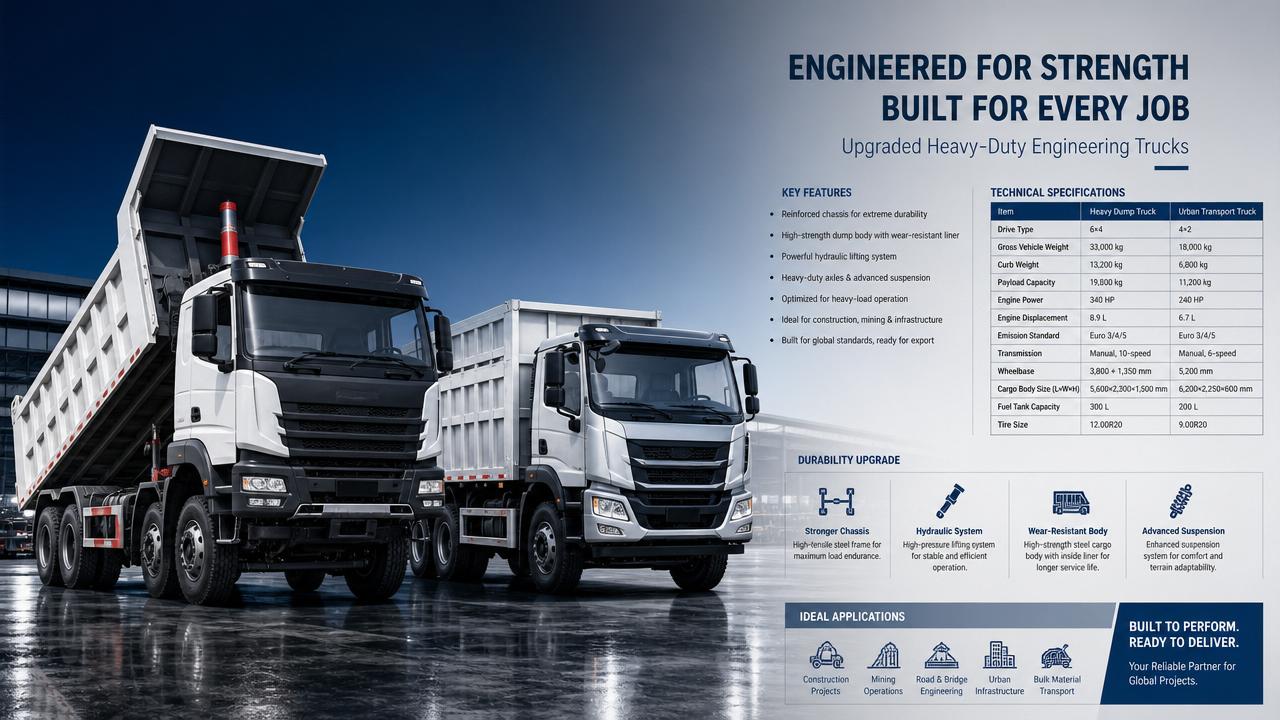
For dealers, distributors and agents evaluating market-ready truck options, the Cangshan Vehicle Configuration List reveals more than listed parts.
It shows how engineering vehicle upgrades affect payload, operating cost, driver comfort, compliance and sales potential in real projects.
When read correctly, the Cangshan Vehicle Configuration List becomes a practical sourcing tool, not just a specification sheet.
It helps compare variants, identify stronger product positioning and match truck configurations to changing construction and logistics environments.
Why the Cangshan Vehicle Configuration List matters in different engineering vehicle scenarios
Engineering vehicle demand is never uniform.
Urban infrastructure jobs, quarry transport, municipal service work and cross-border construction projects need different truck strengths.
The Cangshan Vehicle Configuration List helps uncover these strengths through axle ratings, engine output, suspension choices and body options.
A configuration upgrade that looks small on paper may deliver major field value.
Examples include reinforced frames, optimized gearbox ratios, larger fuel tanks or improved air-conditioning for hot regions.
These details directly affect uptime, maintenance intervals and buyer confidence.
That is why a careful reading of the Cangshan Vehicle Configuration List supports better product selection and stronger inventory planning.
When quarry and heavy-load operations are the target market
Heavy-load scenarios demand durability first.
In this setting, the Cangshan Vehicle Configuration List should be checked for frame thickness, axle capacity, tire specification and climbing performance.
Powertrain upgrades are especially important.
Higher torque at lower engine speed supports loaded starts on rough gradients and reduces driveline stress.
A suitable dump body design also matters.
Wear-resistant steel, stable hydraulic systems and optimized tipping angles improve cycle speed and reduce downtime.
If the Cangshan Vehicle Configuration List shows upgraded braking assistance or retarder options, that can add real safety value on downhill routes.
Core judgment points for quarry applications
- Engine torque curve suitability for loaded starts
- Axle and suspension strength under repeated impact
- Ground clearance for uneven surfaces
- Body material durability in abrasive environments
- Brake stability for descending operations
When urban infrastructure work values efficiency and compliance
Urban construction projects focus on maneuverability, emissions and operating efficiency.
Here, the Cangshan Vehicle Configuration List should be reviewed for compact wheelbase options, turning radius and cabin visibility features.
Cab upgrades often matter more than expected.
Better seating, reduced noise and clearer instrument layouts support longer work shifts and safer operation in dense traffic.
Fuel economy is another decisive factor.
If the Cangshan Vehicle Configuration List includes optimized transmission matching or lightweight structural improvements, lifecycle cost can improve significantly.
Urban projects also reward trucks with camera systems, reverse alarms and easier maintenance access.
Core judgment points for city projects
- Wheelbase fit for restricted streets
- Emission and noise compatibility
- Driver visibility and active safety support
- Fuel-saving configuration upgrades
- Service access for fast maintenance
When long-distance project transport needs reliability over mixed roads
Some engineering vehicle operations combine highway travel with rough site entry.
This mixed-use demand makes the Cangshan Vehicle Configuration List especially useful for balancing speed, fuel use and chassis toughness.
Look closely at gearbox ratios, tank capacity and suspension design.
A truck that saves fuel on highways but struggles at jobsite entrances can lose value quickly.
Likewise, an overbuilt configuration may carry unnecessary weight and reduce transport efficiency.
The best reading of the Cangshan Vehicle Configuration List is not about choosing the most features.
It is about identifying the right feature combination for route conditions and duty cycles.
How scenario needs differ across product upgrade priorities
Different operating scenarios emphasize different upgrade values.
The table below shows how the Cangshan Vehicle Configuration List can be interpreted by application type.
Practical adaptation suggestions before choosing from the Cangshan Vehicle Configuration List
A useful review method starts with route and load reality.
Then compare those needs with the Cangshan Vehicle Configuration List line by line.
- Define average payload, peak payload and road quality.
- Check engine, gearbox and axle matching, not single values alone.
- Review cabin and safety upgrades for actual operating hours.
- Estimate maintenance access and parts replacement frequency.
- Balance purchase price against fuel use and uptime value.
This approach makes the Cangshan Vehicle Configuration List a commercial planning reference, not only a technical comparison document.
Common misjudgments when reading the Cangshan Vehicle Configuration List
One common mistake is focusing only on horsepower.
In engineering vehicles, torque delivery, axle matching and structural strength often matter more than headline output.
Another mistake is ignoring comfort-related upgrades.
In long shifts, fatigue reduction supports safety, retention and steady daily productivity.
A third oversight is treating every market the same.
The Cangshan Vehicle Configuration List should be read against local climate, fuel quality, legal limits and service capability.
Missing these factors can lead to underperforming stock or slower turnover.
Why experienced export support improves configuration decisions
Product upgrades create opportunity only when they are matched correctly to market conditions.
That is where experienced export support becomes valuable.
Shandong Livol Truck International Trade Co., Ltd. supplies commercial vehicles from FOTON, SHACMAN and SINOTRUK through authorized channels.
With strong inventory, professional export coordination and full-process service, the company helps turn configuration analysis into executable sourcing plans.
This includes model selection, customization, documentation, customs clearance, logistics and after-sales support.
For buyers comparing engineering vehicle upgrades, that support reduces uncertainty and speeds deployment.
Next steps for using the Cangshan Vehicle Configuration List effectively
The Cangshan Vehicle Configuration List is most valuable when tied to real application scenarios.
Review target routes, load patterns, compliance needs and maintenance conditions before comparing models.
Then identify which product upgrades truly improve revenue, reliability and market appeal.
If detailed comparison support is needed, prepare operating data first, then request configuration matching based on actual use conditions.
That step turns the Cangshan Vehicle Configuration List from a static document into a practical tool for better engineering vehicle sourcing decisions.
Search Starts Here