
News
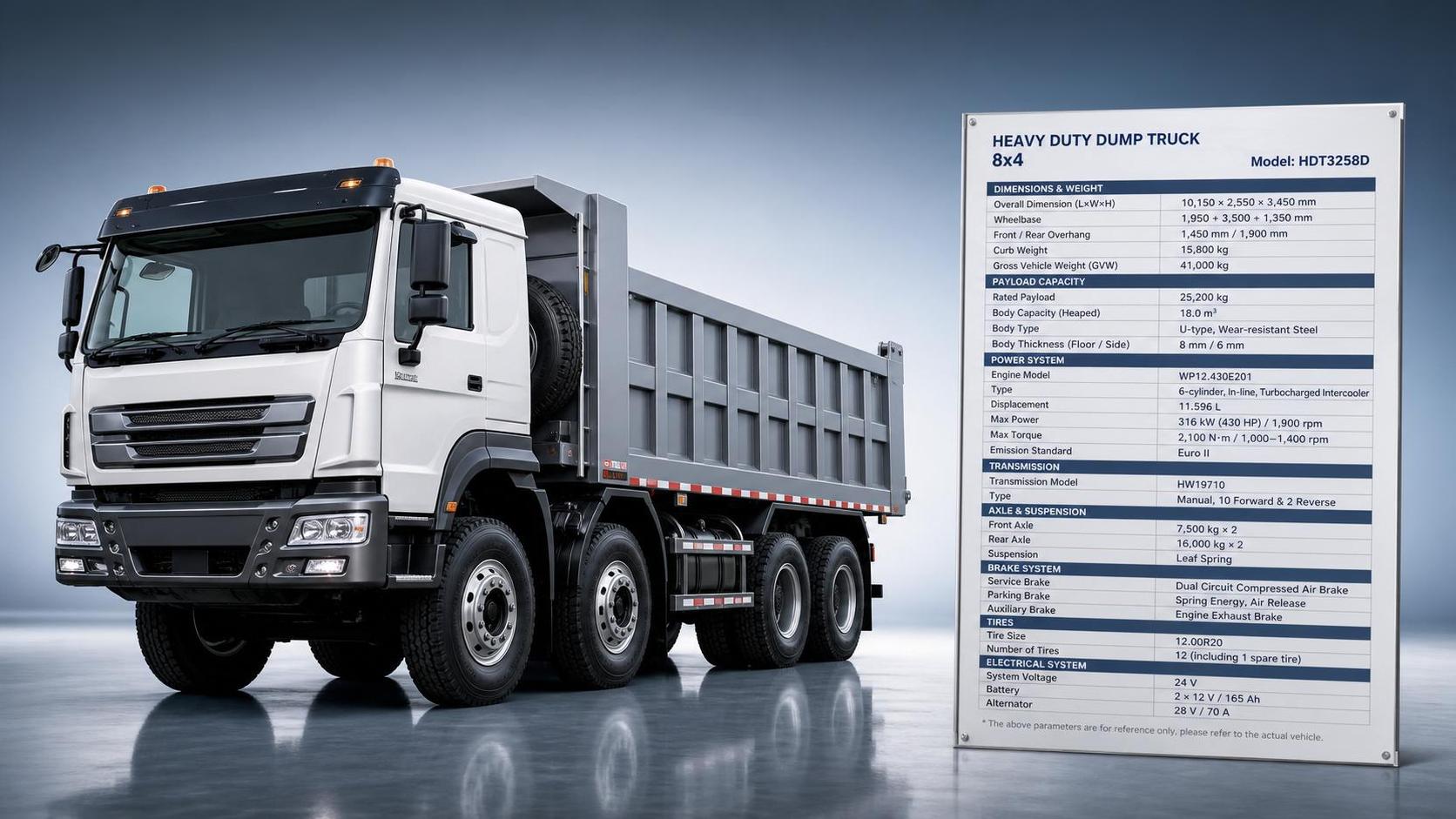
How to Read the Cangshan Vehicle Configuration List Without Missing Key Specs
For technical evaluation work, a Cangshan Vehicle Configuration List is more than a basic product sheet.
It is the fastest way to verify whether a vehicle truly matches jobsite demand, legal requirements, and operating expectations.
A small missed detail can change payload, fuel use, service intervals, or even local registration eligibility.
That is why reading a Cangshan Vehicle Configuration List carefully matters before procurement discussions move too far.
In practical business terms, the list helps you compare versions quickly and reduce costly specification misunderstandings.
This guide breaks the document into clear sections, shows what to check first, and explains where hidden risks usually sit.
Start With the Vehicle Identity Block
Most Cangshan Vehicle Configuration List documents begin with core identification data.
This section often includes model code, vehicle type, drive form, production series, and intended application.
Do not treat these lines as formalities.
A model code can contain important clues about axle layout, cabin level, emission standard, or chassis family.
If two trucks look similar in photos, the identity block often reveals whether they are actually built for different operating conditions.
What to confirm first
- Exact model designation and revision code
- Vehicle category, such as dump truck, mixer, cargo truck, or tractor
- Drive configuration, including 4x2, 6x4, 8x4, or other layouts
- Declared application range and road condition suitability
If the identity block already conflicts with project needs, the rest of the Cangshan Vehicle Configuration List becomes secondary.
Read Dimensions and Weight Data as a System
Dimensions and weight figures are often scanned too quickly.
That is a mistake because these values affect route access, body design, loading efficiency, and compliance.
A Cangshan Vehicle Configuration List usually shows overall length, width, height, wheelbase, curb weight, GVW, and axle loads.
Each figure should be read in relation to the others, not as isolated data.
Key questions behind the numbers
- Does the wheelbase support the required body length without hurting maneuverability?
- Is curb weight too high for the expected payload target?
- Are axle load limits aligned with local road regulations?
- Will vehicle height create issues in tunnels, plants, or warehouses?
From recent market changes, weight compliance is receiving more attention than before.
This means the Cangshan Vehicle Configuration List should be checked against local transport law at an early stage.
Focus on the Powertrain Section
The powertrain section is usually where performance expectations are either confirmed or corrected.
In a Cangshan Vehicle Configuration List, this section commonly includes engine model, horsepower, torque, displacement, gearbox, and rear axle ratio.
These items directly influence climbing ability, fuel economy, cruising speed, and drivetrain durability.
Do not compare horsepower alone
Two vehicles with similar horsepower may behave very differently on real routes.
The stronger signal usually comes from torque curve, transmission ratios, and axle matching.
For heavy engineering vehicle use, poor matching often leads to slow starts, higher fuel consumption, and faster clutch wear.
When reading any Cangshan Vehicle Configuration List, always judge the powertrain as a matched package.
Check Chassis, Suspension, and Braking Details
This section often looks routine, but it strongly affects uptime and operating stability.
A Cangshan Vehicle Configuration List may include frame size, suspension type, tire specification, brake system, and steering arrangement.
These details matter even more in mining, municipal, construction, and mixed-road conditions.
High-value checkpoints
- Frame section dimensions and material grade
- Leaf spring or air suspension suitability
- Brake type, including drum or disc combinations
- Tire size, load index, and tread match for terrain
More clearly than before, buyers now compare whole-life cost instead of only initial purchase price.
That also means the Cangshan Vehicle Configuration List should be reviewed for wear-related components, not just headline specs.
Look Closely at Cab, Electrical, and Safety Equipment
Cab and electrical details are often pushed to the bottom of the evaluation process.
In real operation, they influence driver retention, fault rates, and daily usability.
A good Cangshan Vehicle Configuration List should specify cabin type, seat configuration, air conditioning, instrument cluster, battery capacity, and safety aids.
Pay attention to ABS, ESC, reverse alarms, camera systems, and lighting package descriptions.
These items can affect tender scoring, fleet standardization, and regional compliance.
If the Cangshan Vehicle Configuration List uses optional equipment notes, verify what is standard and what requires separate confirmation.
Watch for Compliance and Export-Specific Notes
A technically strong vehicle can still be unsuitable if compliance details are incomplete.
That is why the compliance area of the Cangshan Vehicle Configuration List deserves its own review.
Check emission level, homologation status, left-hand or right-hand drive, and any destination-market adaptation notes.
This is especially important for cross-border procurement and mixed fleet planning.
In actual export business, configuration interpretation works best when linked with documentation and logistics planning.
Shandong Livol Truck International Trade Co., Ltd. supports this process through vehicle selection, customization, documentation, customs clearance, and logistics coordination.
As an authorized dealer for FOTON, SHACMAN, and SINOTRUK, the company helps align configuration review with actual export delivery conditions.
A Practical Method for Comparing Two Lists
When comparing two versions, use the same sequence every time.
This reduces bias from sales descriptions or attractive headline figures.
- Confirm model identity and application type.
- Check dimensions, curb weight, GVW, and axle loads.
- Review engine, gearbox, and axle ratio together.
- Verify chassis, brake, tire, and suspension details.
- Mark all standard and optional safety equipment.
- Cross-check compliance notes with destination requirements.
This process turns a Cangshan Vehicle Configuration List into a decision tool instead of a passive reference file.
Common Mistakes That Lead to Wrong Conclusions
Several errors appear repeatedly during technical review.
- Using horsepower as the main selection criterion
- Ignoring axle load and legal weight restrictions
- Missing optional equipment notes in the Cangshan Vehicle Configuration List
- Assuming export compliance without documentation review
- Comparing models from different application categories
Avoiding these mistakes usually improves evaluation accuracy faster than adding more analysis layers.
Final Takeaway
A Cangshan Vehicle Configuration List should be read from top to bottom, but judged as one connected system.
Identity, weight, powertrain, chassis, safety, and compliance all affect the final suitability of the vehicle.
The more disciplined your reading method becomes, the easier it is to spot mismatches before they become procurement problems.
For engineering vehicle assessment, that is often the difference between a workable specification and a costly compromise.
Use each Cangshan Vehicle Configuration List as a technical checkpoint, and tie every key spec back to real operating conditions, compliance risk, and lifetime cost.
Search Starts Here