
News
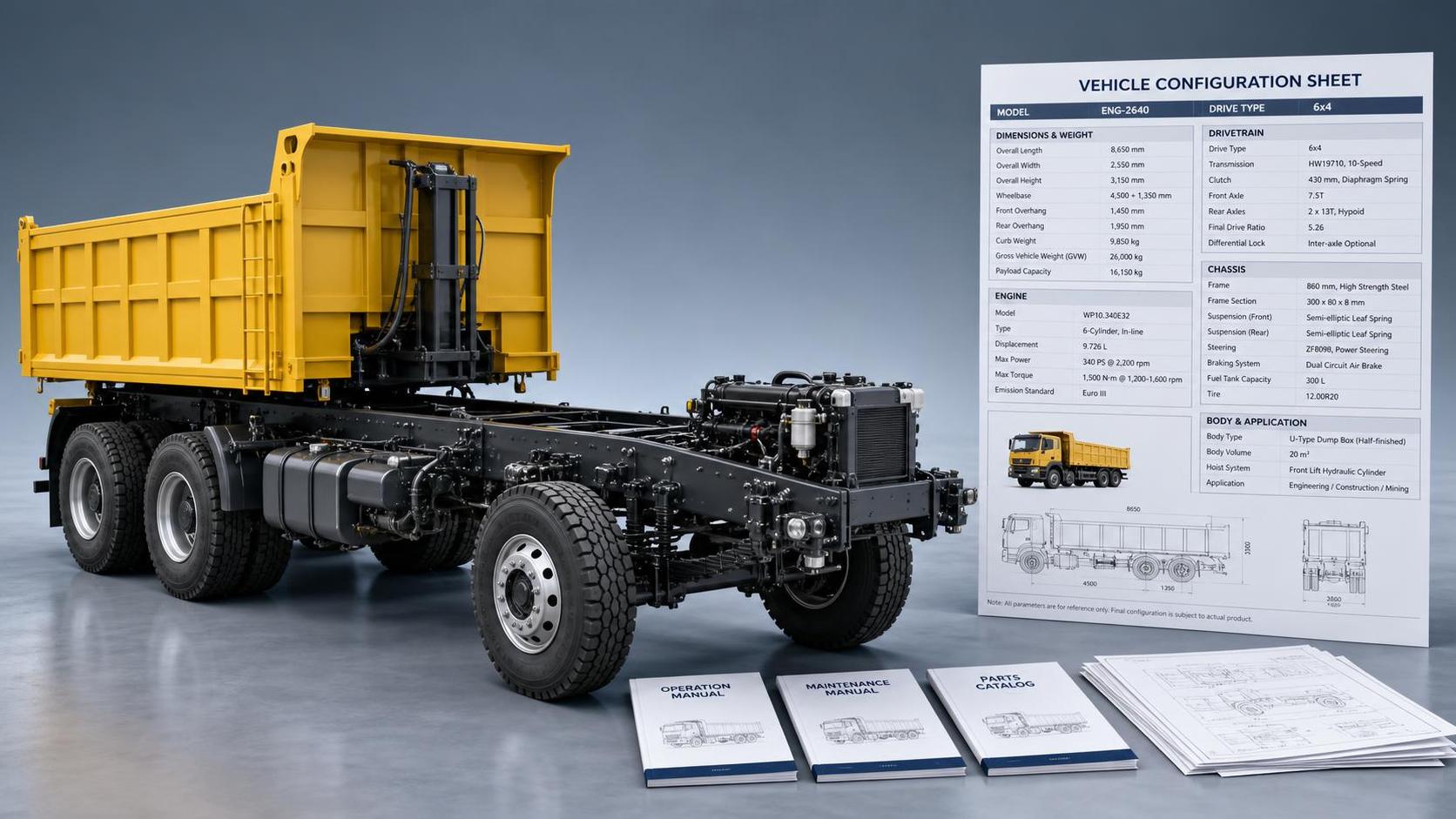
Start with the quote-critical fields, not the decorative ones
When a supplier sends a Cangshan Vehicle Configuration List, the fastest mistake is to read it like a brochure. For procurement work, it is not a marketing document. It is the base document that determines whether your quote will be usable, whether two offers can be compared fairly, and whether the delivered vehicle will match the job you are buying it for.
Before asking for price, read the list with one question in mind: which items will change cost, compliance, payload, operating life, or delivery scope? If you do that first, you avoid the common situation where two suppliers appear to have a large price gap, but are actually quoting different vehicle specifications.
The Cangshan Vehicle Configuration List usually gives you enough information to frame an accurate RFQ, but only if you separate the core build from optional equipment, transport packaging, and market-specific requirements.
Check the vehicle identity before reading the details
Do not jump straight to the engine line. First confirm that the document clearly identifies the vehicle family, intended body type, drive form, and configuration version. If the list mixes a general model name with a different chassis code or body description, the entire quote process becomes unstable.
What you want to see is internal consistency:
- Model or chassis code that matches the vehicle category
- Drive layout such as 4x2, 6x4, or 8x4 stated clearly
- Application description that fits the body structure
- Cabin type, wheelbase, and axle arrangement that make sense together
If any of those are vague, stop there and normalize the document before requesting price. A quote based on a half-defined platform almost always leads to revision rounds later, and those rounds cost time even when the supplier is responsive.
Read the chassis section as the cost foundation
For commercial vehicles, the chassis section is where pricing logic starts. Wheelbase, frame strength, suspension arrangement, axle specification, tire size, and fuel tank capacity are not background details. They shape carrying capacity, road suitability, maintenance profile, and body installation limits.
A common procurement error is comparing a shorter-wheelbase truck with a longer-wheelbase truck just because the cargo body dimensions look similar on paper. The longer frame may support a different body balance, turning radius, or load distribution. That changes both cost and practical use.
Pay extra attention to:
- Wheelbase: affects body fit, axle loading, and maneuverability
- Axle rating: influences legal loading and actual durability under working conditions
- Suspension type: matters for road quality, payload stability, and maintenance expectations
- Tire specification: changes replacement cost and availability in the destination market
- Frame or subframe notes: critical when the vehicle will carry specialized upper structures
If you are evaluating multiple offers, keep these fields aligned before you compare unit price. Otherwise, the lower quote may simply be built on a lighter chassis.
Do not read engine output alone
Buyers often look at horsepower first because it is easy to spot and easy to compare. In practice, that is too shallow. You need to read the engine line together with transmission, emission level, intended terrain, and gross vehicle loading.
An engine that looks stronger on paper may not be the better purchasing choice if it pushes up fuel cost, forces a different service parts chain, or does not match the target market’s registration and import conditions. The same applies to transmission. Gear count, manual or automated type, and matching with axle ratio can change drivability and operating cost more than buyers expect.
If the Cangshan Vehicle Configuration List gives only broad engine wording without a specific model or rated output reference, ask for a corrected configuration sheet before you request a final quote.
Treat axle load and GVW as decision filters
This is one of the most misunderstood areas in early-stage quoting. Business evaluators sometimes focus on body volume and overlook axle load ratings or gross vehicle weight. That can make a vehicle look commercially attractive while being operationally weak for the intended duty.
Read these numbers with the actual use case in mind. A construction-support vehicle, municipal service unit, or cargo platform may carry weight in very different ways. The issue is not just total mass. It is how that mass sits on the axles during real use.
When the list includes front and rear axle ratings, compare them against:
- The planned upper body or equipment weight
- The expected working load, not just empty vehicle transport
- The center-of-gravity effect of tanks, cranes, bins, or enclosed body structures
- Road condition and duty cycle, especially if the vehicle will work off paved roads
If the upper body has not been finalized yet, do not accept a quote as “comparable” until the supplier states the chassis loading basis used for the proposal.
Body structure is where hidden price drift starts
The body section of the Cangshan Vehicle Configuration List deserves slow reading. Material thickness, floor structure, side wall design, tailgate arrangement, hydraulic components, sealing details, reinforcement method, and mounting approach can all shift the quote materially.
This is where vague wording causes trouble. “Standard body” is not a usable procurement term. You need to know what standard means in physical terms. Steel or aluminum, reinforced or not, welded or bolted sections, body dimensions, and any wear-resistant upgrades should be stated in a way that can be priced and checked later.
One practical rule: if the body spec cannot be used by your technical team to detect substitution at inspection stage, it is still too loose for quotation stage.
Separate standard equipment from options immediately
Some configuration lists place optional items in the same block as standard equipment. That is where budget confusion begins. Air conditioning, sleeper cab variation, PTO, hydraulic accessories, reversing systems, extra lighting, fuel tank upgrades, fire extinguisher sets, warning devices, tool kits, and spare tire arrangements may all be handled differently from one supplier to another.
Create a quick split while reading:
- Items included in the base vehicle price
- Items quoted as chargeable options
- Items excluded but necessary for operation in your market
That third category is the one buyers miss most often. A feature can be absent from the supplier’s standard package and still be essential for your project scope. If it is not listed before RFQ issue, it tends to reappear later as variation cost.
Look for destination-market impact in the document set
The configuration list itself will not always tell you everything about import acceptance, but it should point you toward the fields that matter. Cabin side, lighting layout, emission designation, dimensions, and safety equipment can all affect whether the quoted vehicle is ready for the destination market or still needs modification.
The right move here is not to ask broad questions. Match the list against the exact documents used in your import or registration process: technical specification sheet, proforma invoice draft, homologation-related documents if applicable in your market, and any bid specification issued by your end user. You are checking field consistency, not collecting generic assurances.
Watch for quote gaps outside the visible configuration
A readable Cangshan Vehicle Configuration List still does not guarantee a complete commercial offer. Some cost items sit outside the configuration body but affect procurement comparison directly. Packaging method, spare parts scope, operator manuals, service tools, inspection requirements before shipment, and logistics assumptions may sit in separate commercial documents.
If you compare prices using the configuration list alone, note these side items in your quote request. Otherwise one offer may look lower simply because it excludes supply elements another seller has already included.
A workable reading sequence for business evaluators
If time is limited, use a short review order that mirrors real procurement risk:
- Confirm model identity, drive layout, and intended application.
- Check chassis fundamentals: wheelbase, axle ratings, suspension, tires.
- Read engine and transmission as a matched package.
- Review GVW and axle load against the real operating load.
- Open the body structure section and remove vague wording.
- Mark standard items, options, and missing must-have items.
- Cross-check destination-market requirements against document fields.
- Issue the RFQ only after the configuration sheet can support line-by-line comparison.
A good quote starts with a clean technical baseline. If the Cangshan Vehicle Configuration List is read properly before pricing starts, you reduce re-quotation cycles, expose false price comparisons early, and put the negotiation on the right variables: usable specification, total supply scope, and delivery fit for the job you are actually buying for.
Search Starts Here