
News
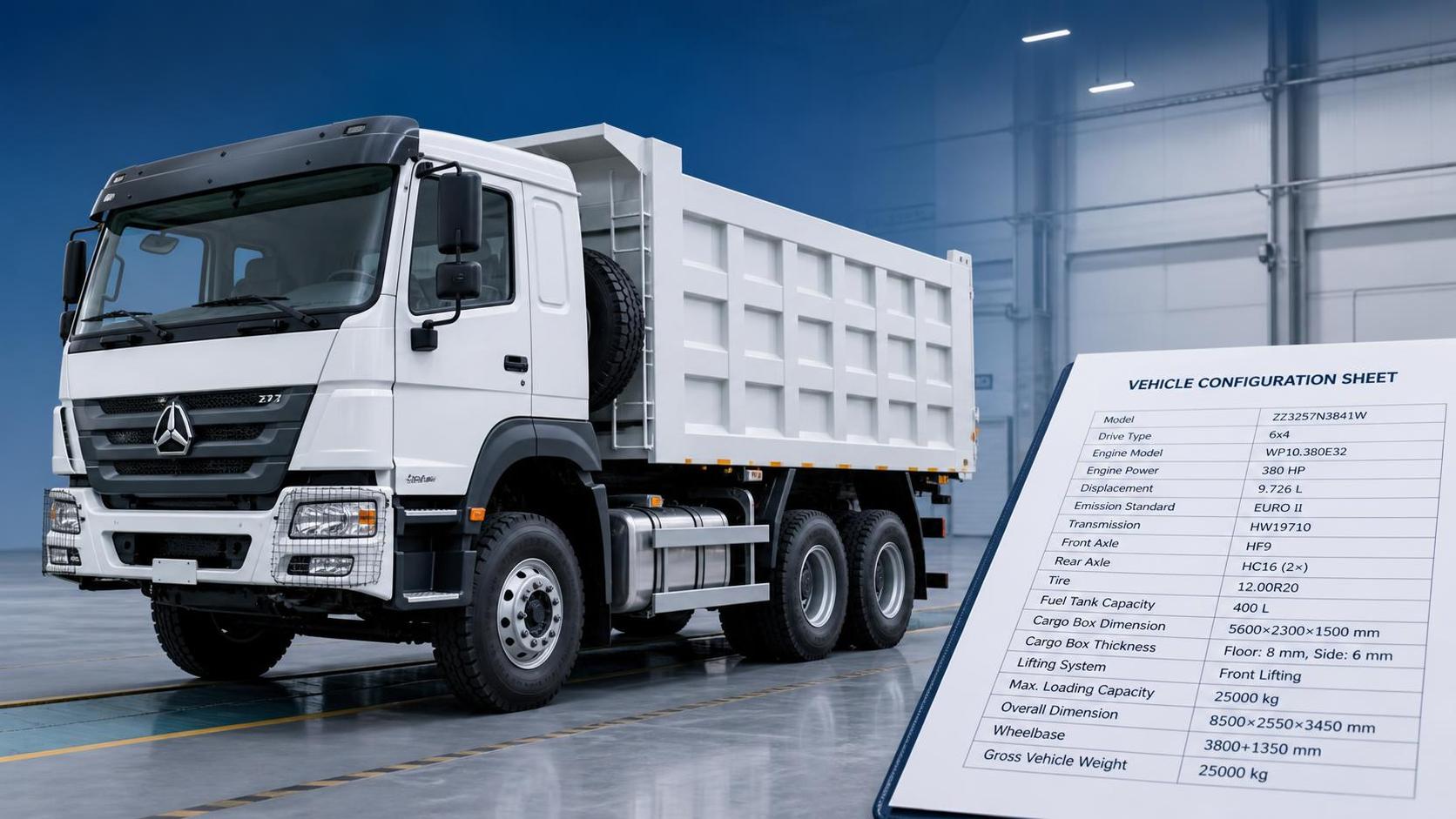
How to Read a Cangshan Vehicle Configuration List Without Missing Key Specs
For anyone buying commercial vehicles across borders, a configuration list is not just a technical sheet. It is the point where performance, compliance, operating cost, and delivery risk all start to show themselves. A Cangshan Vehicle Configuration List may look straightforward at first glance, but in practice, the details that get skipped are usually the ones that cause trouble later: an axle ratio that does not suit the route, a tire size that is hard to source locally, a fuel tank that is too small for long-haul work, or an emissions setup that does not match local import requirements.
That is why experienced buyers rarely read these lists from top to bottom in a single pass. They read them in layers. They begin with the operating task, then check the hard specs that determine whether the vehicle can legally and practically do the job, and only after that do they look at convenience features or optional upgrades.
If you are reviewing Chinese commercial vehicles, especially for export, this matters even more. Different factories, brands, and export markets may use slightly different naming habits, abbreviations, or option codes. Companies with hands-on export experience, including established dealers working with brands such as FOTON, SHACMAN, and SINOTRUK, usually know that the paperwork itself needs to be read as carefully as the truck. A spec sheet is not only about what the vehicle is; it is also about what can be built, documented, shipped, registered, and supported after delivery.
Start with the use case, not the brochure language
Before reading any Cangshan Vehicle Configuration List, define the actual working scenario. Is the vehicle for urban construction spoil removal, intercity bulk transport, mining roads, municipal work, or mixed on-road and off-road use? The same 6x4 truck can be acceptable in one project and a poor choice in another.
This is where many procurement mistakes begin. Buyers often focus on rated power or payload first because those numbers are easy to compare. But an engineering vehicle’s suitability is usually decided by a combination of factors: wheelbase, suspension type, approach angle, axle capacity, and even body dimensions. A dump truck that looks attractive on paper may be awkward on tight site entrances. A cargo chassis may carry the intended load but wear prematurely if road conditions are rough and the rear suspension is underspecified.
So read the list with one question in mind: does this configuration match the job cycle, not just the purchase budget?
The first block to verify: vehicle identity and layout
At the top of the document, you will usually see the basic identity data: model code, drive type, cab type, wheelbase, overall dimensions, and sometimes the intended body application. These entries matter more than they seem.
The model code is not just an internal label. It often links to a precise chassis family, axle platform, or homologation basis. If two offers look similar but carry different model codes, treat them as different products until confirmed otherwise.
Drive type tells you the basic operational envelope. A 4x2 may be enough for paved-road delivery. A 6x4 is common for heavier haulage and many construction tasks. An 8x4 may increase payload potential or body capacity, but it also changes turning radius, tare weight, tire consumption, and sometimes permit conditions. This is not a simple “more axles is better” decision.
Wheelbase deserves extra attention. On a spec list, it can look like a neutral dimension. In reality, it affects body length, load distribution, maneuverability, and ride behavior. A longer wheelbase may help with body fitment and straight-line stability, but it can become a burden on constrained worksites or poor access roads.
Engine specs: power is only the headline
When people scan a Cangshan Vehicle Configuration List, the engine line is often where the eye lands first. That makes sense, but engine evaluation should go beyond horsepower.
Check at least these points together: engine brand or series, displacement, rated power, emission level, and fuel type. In some markets, the emissions line is not a technical detail but a customs and registration issue. If local rules require a certain standard or specific supporting documents, that needs to be confirmed early, not after production.
Also pay attention to torque characteristics if they are available. For engineering vehicles working in stop-start conditions, on gradients, or with heavy body equipment, usable low-end pulling power can matter more than a higher peak power figure. Two trucks with similar horsepower may behave very differently when fully loaded.
Fuel system details can also become practical issues. In some destinations, buyers prefer simpler mechanical or widely serviceable systems; in others, fuel quality and maintenance capability influence the acceptable engine choice. A strong export supplier will usually discuss this point because a technically advanced engine is not automatically the best engine for every operating environment.
Transmission, axle ratio, and what they say about real-world performance
One of the most commonly overlooked parts of a vehicle configuration list is the driveline match. Buyers see engine power and assume performance is covered. It is not.
The transmission model, number of gears, and rear axle ratio tell you how the truck is meant to work. A gearbox set up for highway efficiency will feel different from one intended for heavier, slower conditions. Likewise, the axle ratio can shift the balance between gradeability, launch capability, and cruising speed.
If the vehicle is expected to operate with frequent heavy starts, rough haul roads, or climbing, an unsuitable ratio will show up quickly in fuel use, clutch wear, and driver complaints. On the other hand, choosing an overly short ratio for long-distance paved transport can hurt efficiency. This is one of those specs that rarely sells the truck, but often determines whether the truck is pleasant and economical to run.
Weights and payload: read every number in relation to another number
Procurement teams often compare gross vehicle weight, curb weight, and rated payload, but the real discipline is checking whether those numbers make sense together and whether they align with local rules.
A configuration sheet may include GVW, chassis weight, axle load limits, and body-related dimensions. None of these should be read in isolation. A payload target might look attractive, but if the body material, tire rating, or local legal axle limits differ from the assumed setup, that payload may not be practical in service.
For engineering vehicles, body choice changes the whole equation. A dump body, mixer drum, crane setup, or tanker installation shifts weight distribution and affects usable load. If the list only shows chassis data, ask whether the figures reflect the complete vehicle or just the base platform. That distinction matters.
Suspension, tires, and ground clearance are not secondary items
This is where practical buyers separate themselves from paper buyers. Suspension type, leaf spring count, tire specification, and clearance-related data can tell you a lot about durability and operating fit.
For rough-duty use, it is worth checking whether the suspension and tires are selected for the actual site condition rather than the nominal load only. Tire size and ply or load rating should also be reviewed from a supply-chain angle. If the vehicle uses a specification that is uncommon in the destination market, replacement cost and downtime can become part of the true purchasing cost.
Ground clearance, departure angle, and similar geometry-related entries may not always be listed in a standard way, but when available, they are valuable for construction and uneven-road applications. A vehicle can be strong on paper yet vulnerable in daily site access.
Cab, electrical, and “small” options that often become big issues
Configuration lists usually include cab version, sleeper or day cab, air conditioning, seat setup, battery arrangement, fuel tank capacity, and optional equipment. These are easy to dismiss during early comparison, but they often affect operator acceptance, daily productivity, and market suitability.
Take fuel tank size. For short municipal cycles, a smaller tank may be fine. For remote project transport or export markets with long distances between fueling points, it may be a weak point. The same goes for battery capacity and electrical setup if auxiliary equipment is installed.
Cab details also have a commercial side. In some tenders, comfort features are not optional in practice because driver retention and fatigue management matter. In others, a simpler cab is preferred because serviceability is valued over extra electronics. There is no universal best spec here, only a better match for the application.
Watch the wording around optional and standard equipment
One line on a configuration sheet can cause a lot of misunderstanding: whether an item is standard, optional, deleted, or subject to final factory confirmation. That matters for PTO interfaces, differential locks, body preparation, auxiliary braking, tool kits, spare wheel carriers, and safety equipment.
Do not assume that an item shown in a photo, catalog, or previous quotation is included in the current unit. The configuration list should be treated as the governing technical reference, but even then, export orders may require a final signed confirmation because destination-country rules, stock availability, or factory scheduling can affect the exact build.
This is where experienced exporters are useful. A company managing vehicle selection, customization, documentation, customs work, and logistics is usually better positioned to catch these gaps early, especially when the purchase involves brand families with multiple factory options and fast-moving inventory.
A simple reading method that works in real procurement
If you need a practical way to review a Cangshan Vehicle Configuration List, use a three-pass approach.
On the first pass, confirm mission-critical fit: drive type, wheelbase, engine, transmission, axles, and legal or import-related items. On the second pass, check operational practicality: body compatibility, tank size, tires, suspension, and serviceability. On the third pass, review the commercial details: optional equipment, exclusions, document consistency, and delivery implications.
This method sounds basic, but it helps prevent a common problem in truck sourcing: spending too much time comparing visible features before confirming the hidden constraints.
What to ask when the sheet is still not clear
Even a good configuration list does not answer everything. When in doubt, ask for clarification on whether the listed vehicle is a chassis or complete unit, whether the shown equipment is standard or optional, whether local compliance documents are available, and whether any substitute components may be used during production.
It is also reasonable to ask for confirmation that the offered configuration matches the final proforma invoice and export documents. In international transactions, the technical list, commercial quote, and shipping paperwork should support the same vehicle identity. If they drift apart, problems tend to appear at inspection, customs, registration, or after-sales stage.
Reading a configuration list well is less about memorizing spec terms and more about understanding which lines drive performance, legality, maintenance, and resale. Once you read it that way, the document stops being a formality. It becomes one of the most useful tools in making a safer buying decision.
Search Starts Here