
News
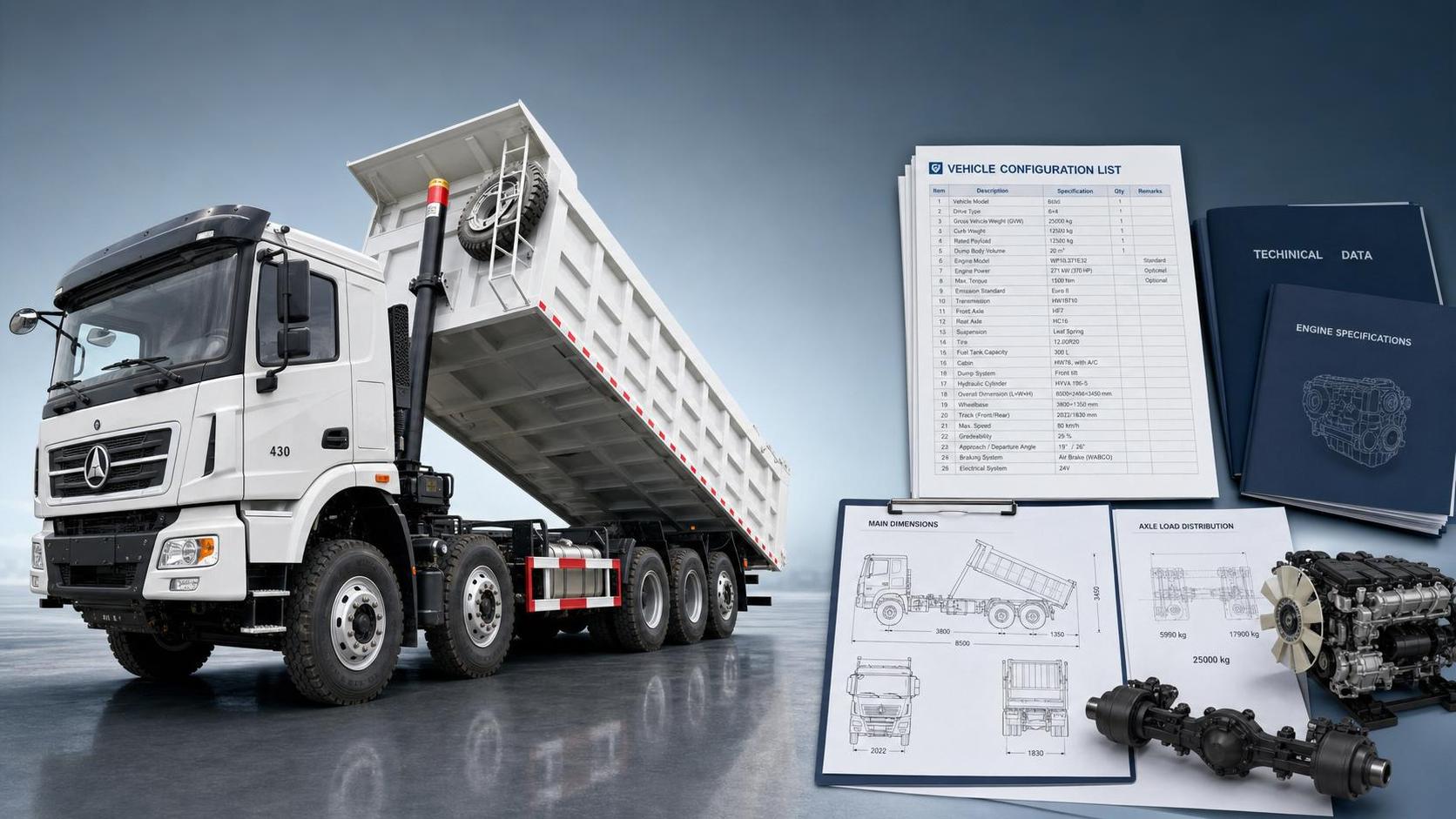
Why does the Cangshan Vehicle Configuration List come before price talks?
A quotation looks clear only after the vehicle specification is clear. That is why the Cangshan Vehicle Configuration List should be checked before price, lead time, or freight terms.
In engineering vehicle sourcing, two units may look similar on paper yet differ in engine output, axle ratio, suspension strength, and legal payload. Those differences change operating cost and site performance.
A careful review of the Cangshan Vehicle Configuration List helps confirm whether the truck matches road conditions, loading patterns, compliance needs, and local service expectations.
This matters even more in cross-border trade. Specification gaps can delay customs documents, affect homologation, or create disputes over what was actually ordered and delivered.
In practical evaluation, the list is not just technical paperwork. It is the baseline for judging risk, resale value, maintenance planning, and commercial realism.
When reading the Cangshan Vehicle Configuration List, what should be checked first?
Start with the items that affect application fit. Many people jump to cab trim or optional accessories too early. The better approach is to confirm core working specifications first.
- Engine model, horsepower, torque range, and emission level.
- Transmission type, gear count, and intended operating terrain.
- Axle layout such as 4x2, 6x4, 8x4, plus axle load rating.
- Gross vehicle weight, curb weight, and effective payload capacity.
- Frame strength, suspension structure, and tire specification.
- Brake system, ABS, retarder options, and safety equipment.
If the vehicle is intended for construction, mining support, or municipal heavy-duty work, powertrain matching is usually the first filter. Underpowered units may appear cheaper but fail in real duty cycles.
The Cangshan Vehicle Configuration List should also show dimension data. Overall length, wheelbase, dump body size, and turning radius affect site access and legal road movement.
Another early checkpoint is whether optional items are already included or still pending confirmation. This prevents confusion when comparing suppliers or brand platforms.
A quick screening table for early review
The table below helps separate critical items from secondary ones during the first reading of the Cangshan Vehicle Configuration List.
How do you judge whether the listed configuration actually fits the job site?
This is where many reviews become too theoretical. A correct Cangshan Vehicle Configuration List is not enough if the configuration is wrong for the operating environment.
Look at the duty cycle first. Will the vehicle carry dense material, run mixed road conditions, climb steep grades, or idle for long periods on site?
For example, a dump truck serving urban infrastructure work may need tighter turning ability and cleaner emissions. A unit for quarry haul support may need stronger suspension and higher torque priority.
The Cangshan Vehicle Configuration List should be read against at least four operating variables:
- Road type: paved route, rough haul road, or off-road transition.
- Load character: sand, aggregate, machinery, wet soil, or mixed cargo.
- Climate exposure: heat, dust, humidity, altitude, or seasonal rain.
- Maintenance access: local parts, trained technicians, and service intervals.
A useful habit is to convert the list into a pass-or-fail worksheet. If a unit meets paper specifications but creates maintenance difficulty, it may still be the wrong selection.
That is why experienced exporters often review technical data together with delivery route, destination regulations, and after-sales support options, rather than treating them as separate topics.
Which differences inside the Cangshan Vehicle Configuration List usually change total cost the most?
The biggest cost drivers are rarely decorative options. They are usually hidden in powertrain matching, load structure, compliance details, and supportability.
A higher-spec engine may raise purchase cost but reduce overload stress and downtime. On the other hand, an oversized engine can increase fuel expense without adding useful productivity.
Axle ratio is another common blind spot. If the ratio does not suit terrain and speed profile, the vehicle may consume more fuel or lose climbing efficiency.
The Cangshan Vehicle Configuration List should also be checked for component brand consistency. Brake systems, tires, hydraulic units, and filters influence maintenance planning more than many buyers expect.
In actual export business, support structure matters too. Shandong Livol Truck International Trade Co., Ltd. works with authorized channels for FOTON, SHACMAN, and SINOTRUK, which helps keep specification confirmation and parts coordination more stable.
That kind of support does not replace technical review, but it reduces one practical risk: receiving a correct model family with unclear or inconsistent detailed configuration.
Questions worth asking before accepting a quotation
- Does the quoted truck match the exact Cangshan Vehicle Configuration List version?
- Are optional items priced separately or already included?
- Is the emission standard accepted in the destination market?
- Are body dimensions and axle loads aligned with local road rules?
- Can spare parts and service items be supplied without long interruption?
What mistakes appear most often during configuration review?
One frequent mistake is reading only headline specifications. Horsepower and payload are important, but they do not reveal the full vehicle capability.
Another issue is assuming one market configuration can be copied directly into another. Local compliance, fuel quality, climate, and axle regulations may require adjustment.
Some reviews also ignore document consistency. The Cangshan Vehicle Configuration List should match the proforma invoice, build sheet, certificate data, and shipping description.
A smaller but costly error is overlooking optional safety items. Reverse cameras, warning alarms, reinforced lighting, and fire protection kits may be standard in one project but absent in another.
More importantly, do not separate vehicle choice from delivery execution. Export documentation, customs handling, and logistics planning affect whether the selected unit reaches site as expected.
Suppliers with export experience can usually support these links together. That integrated process becomes valuable when there are multiple units, custom body requirements, or staged shipment schedules.
What is the most practical next step after reviewing the Cangshan Vehicle Configuration List?
After the first review, turn the configuration list into a decision sheet. This keeps discussion focused on suitability, not just headline cost.
A practical next step is to divide findings into three groups: confirmed fit, items needing clarification, and items that create measurable risk.
Then compare those findings across at least two vehicle options or brands. With FOTON, SHACMAN, and SINOTRUK platforms, the useful comparison is not brand image alone, but exact configuration logic.
If supply timing matters, add one more layer: stock status, parts support, and document readiness. A technically suitable vehicle still needs a reliable delivery path.
The Cangshan Vehicle Configuration List works best when used as the center of a broader evaluation. It connects engineering suitability, compliance control, service planning, and commercial negotiation.
In short, review the list first, question the details that affect application, and only then compare price and terms. That sequence usually leads to clearer decisions and fewer downstream surprises.
Search Starts Here