
News
Cangshan Vehicle Configuration List: How to Compare Specs Efficiently
For procurement teams evaluating commercial vehicles, the Cangshan Vehicle Configuration List is not just a price attachment or a factory formality. It is the working document that tells you what a vehicle really is once sales language is stripped away. If two trucks look similar in a quotation sheet but differ in axle ratio, suspension type, emission setup, tire specification or cargo body dimensions, the configuration list is where those differences become visible. That matters because in engineering vehicle purchasing, small specification gaps often turn into large operating costs after delivery.
Many buyers treat a configuration list as a checklist to confirm whether a unit has air conditioning, an ABS system or a certain engine power band. That is only the surface. In practice, the document is more useful as a comparison framework. It helps a sourcing team answer a harder question: which configuration is actually appropriate for the intended route, payload profile, regulatory environment and maintenance conditions? A vehicle can be well equipped and still be poorly specified for the job.
What the list is really telling you
A Cangshan Vehicle Configuration List usually functions as a structured specification record covering the core technical, dimensional and compliance details of a vehicle. Depending on the manufacturer, exporter or project, the format may vary, but the logic is usually consistent. It tells you how the truck is built at the chassis level, what powertrain it uses, how the load body is defined, and which mandatory or optional systems are included.
This is why experienced buyers do not read it line by line in isolation. They read it in layers. The first layer is operational fit: engine, gearbox, axle, wheelbase, suspension, tires and rated loading data. The second layer is legal and market fit: emissions standard, safety equipment, left-hand or right-hand drive, lighting configuration, and country-specific requirements if applicable. The third layer is lifecycle fit: parts commonality, serviceability, ease of maintenance, and whether the specification matches the operating environment rather than just the purchase budget.
That layered reading is especially important in export transactions. A professional exporter working across multiple brands such as FOTON, SHACMAN and SINOTRUK will often see that buyers focus heavily on headline figures like horsepower and cargo capacity, while the real compatibility issues appear elsewhere: transmission matching, rear axle load rating, body material thickness, or whether the cooling system suits hot-climate or mountainous use. Those are not secondary details. They are often what determine whether a truck performs reliably in the field.
Why comparison becomes inefficient
The main reason buyers struggle with configuration comparison is that quotations are often presented in inconsistent language. One supplier lists engine displacement and torque; another highlights only horsepower. One body drawing shows internal cargo dimensions; another shows overall vehicle dimensions. A dump truck may be described by gross vehicle weight in one document and payload estimate in another. When the terms are not normalized, comparison becomes slow and misleading.
There is also a common assumption that more features mean better value. In commercial vehicle procurement, that is not a reliable rule. A heavier-duty specification can increase acquisition cost, curb weight, fuel consumption or maintenance complexity without improving your actual operation. The right reading of a configuration list is not “which unit has more,” but “which unit has the most coherent specification set for the job.”
The fastest way to compare: start with five anchors
When time is limited, compare around five anchors before you look at optional details. This approach filters out unsuitable units early.
If a unit does not align on these five points, deeper comparison is often a waste of time. The trim details may look attractive, but the truck is already wrong for the operation.
Parameters that are often misunderstood
Horsepower is the most obvious example. Buyers often compare trucks by engine power alone, especially when multiple Chinese commercial vehicle brands are under consideration. But horsepower without transmission matching and rear axle ratio tells only part of the story. A truck working in steep terrain, stop-start construction routes or overloaded informal operating conditions may need a different driveline balance than a unit doing long-distance highway work. In other words, the usable performance comes from the combination, not from a single engine number.
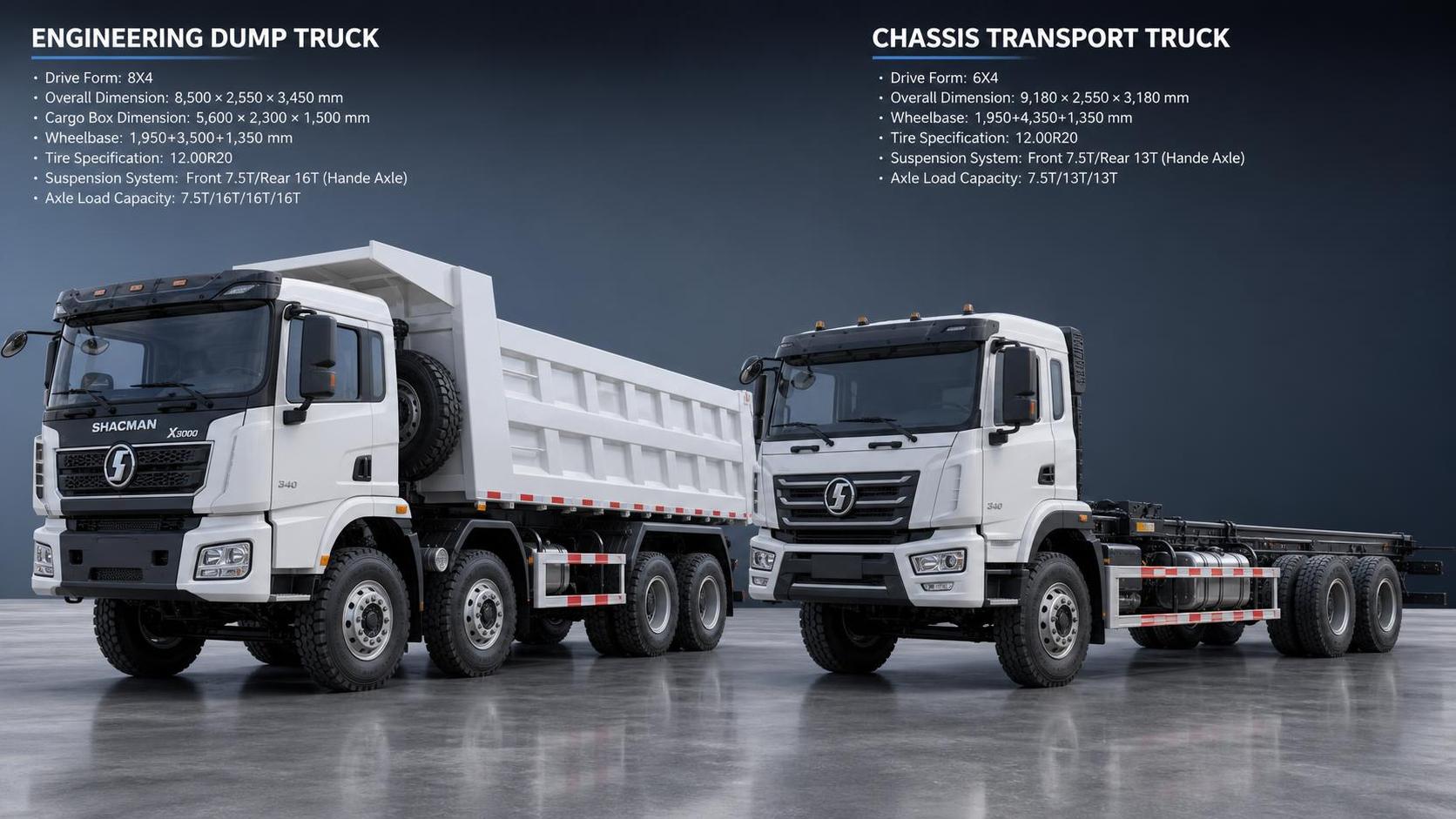
Another frequent confusion is between body volume and effective payload. A larger cargo body does not automatically mean more productive hauling. Material density, local weight restrictions, chassis rating and loading method all shape actual carrying efficiency. This is particularly relevant for dump trucks, mixers and special engineering vehicles, where body design must match the material handled. A configuration list can help identify these limits, but only if the buyer reads body dimensions together with gross weight and axle capacity.
Tire specification is also easy to underestimate. In many procurement reviews, tires are treated as a replaceable accessory rather than a core operating parameter. Yet tire size, ply rating or load index, tread pattern and tube or tubeless setup all influence traction, durability and maintenance planning. A truck configured for rough site conditions with the wrong tire strategy may create problems before the engine or chassis does.
What procurement teams should normalize before comparing offers
Efficient comparison depends on putting all candidate vehicles into the same frame. That means building a simple internal comparison sheet rather than relying on each supplier’s preferred format. The fields should be standardized: engine model, rated power, transmission model, axle load, wheelbase, suspension type, tire specification, overall dimensions, cargo body dimensions, emission standard, safety features, and included accessories. Where definitions may differ, note the source wording instead of guessing.
This matters even more when one exporter can source from several brands and multiple authorized channels. A company with broad domestic stock access and 4S store resources may be able to offer close alternatives quickly, but the burden is still on the buyer to compare them on consistent terms. The value of a professional supplier is not only availability; it is also the ability to clarify where two apparently similar configurations diverge in build logic, homologation status or delivery feasibility.
In practical sourcing work, documentation support is part of the configuration conversation. Procurement teams should confirm whether the listed specification is tied to the final export documents and whether any market-specific changes affect technical content. A truck described one way in an initial offer and another way in the shipping or customs file can create unnecessary risk. That is why reliable exporters tend to treat vehicle selection, customization, documentation and logistics as one process rather than isolated steps.
Where the configuration list helps beyond selection
A good Cangshan Vehicle Configuration List remains useful after the purchase decision. It becomes a reference point for pre-delivery inspection, spare parts planning, operator training and after-sales coordination. If your fleet team knows exactly which gearbox model, brake system, tire fitment and electrical layout were ordered, they can prepare much more effectively for deployment. This is especially relevant for cross-border purchases, where lead times and parts planning deserve more attention than in local domestic procurement.
It also helps control customization requests. Buyers sometimes ask for changes late in the process without considering how those changes affect compliance, delivery timing or parts commonality. A clear configuration list makes trade-offs visible. Adding a different cargo body, changing tire specification or modifying the cab setup may be reasonable, but it should be evaluated against the whole vehicle package, not treated as a harmless isolated option.
A more useful way to read the document
The most effective buyers do not ask, “Which truck has the best spec?” They ask, “Which spec sheet is internally consistent with my operation?” That shift in thinking changes the entire evaluation process. It reduces the temptation to compare isolated figures, and it pushes the team to judge configurations as working systems.
For engineering vehicles, that is the right discipline. A configuration list is not an administrative attachment. It is the document that connects budget, compliance, performance and service reality. Read it that way, and it becomes one of the fastest tools for filtering risk before a purchase order is issued.
Search Starts Here