
News
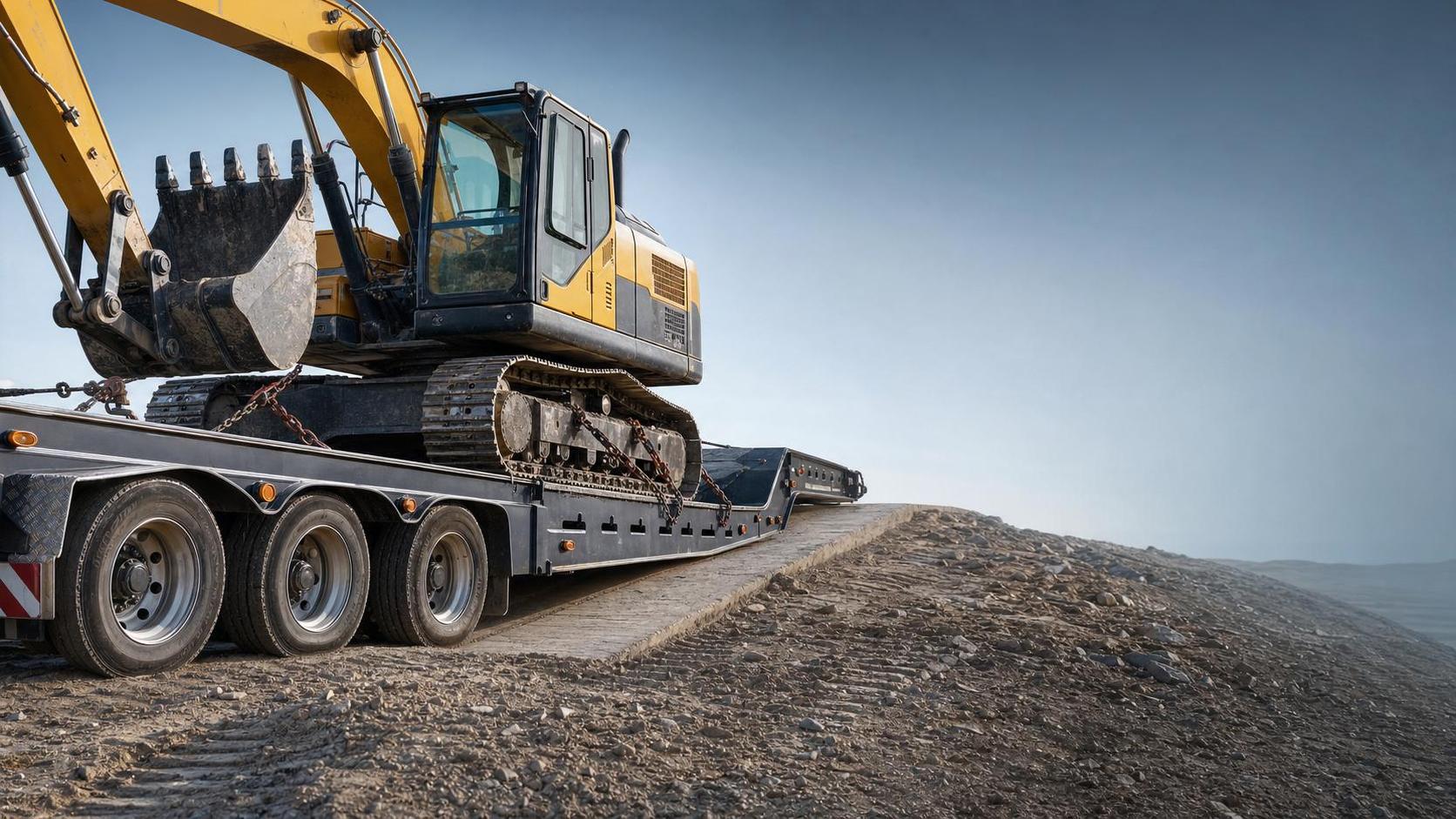
Why does Low Plate trailer ground clearance cause so many transport problems?
Low Plate trailer ground clearance looks like a small detail, but it affects almost every stage of heavy equipment transport.
If clearance is too low for the route, the trailer may scrape on ramps, speed bumps, bridge transitions or uneven construction roads.
That scraping does not only damage the trailer.
It can also shift equipment, stress tie-down points and delay unloading at the destination.
In practice, many transport teams only check payload capacity, axle layout and deck length.
The more costly mistake is ignoring how Low Plate clearance behaves when the trailer is fully loaded.
A trailer may look acceptable when empty, then become risky after the machine weight compresses the suspension.
This matters even more with excavators, rollers, pavers and compact wheel loaders.
These machines often travel through mixed road conditions, not only smooth highways.
That is why Low Plate selection should always include route review, loading angle and real operating clearance.
Is low ground clearance always better for loading heavy equipment?
Not always, and this is one of the most common misunderstandings.
A lower deck helps reduce loading angle, which is useful for machines with low approach clearance.
It also improves overall transport height, especially where height limits are strict.
But a very low Low Plate trailer can create new risks if the route includes rough access roads or steep entries.
Simple loading convenience should not be confused with overall transport suitability.
A balanced decision usually depends on four checks:
- Loaded ground clearance under actual machine weight
- Ramp angle during loading and unloading
- Breakover angle on road transitions
- Local road restrictions and site access quality
When these points are ignored, operators often solve one problem and create two more.
A better Low Plate setup is the one that loads safely and still clears the route without repeated contact.
Which mistakes happen most often when choosing a Low Plate trailer?
Most mistakes are not technical failures.
They come from incomplete judgment before dispatch.
The table below shows the issues that appear most often in heavy equipment movement.
More often than not, the problem starts before loading begins.
The wrong assumption is that all Low Plate configurations behave similarly.
They do not.
Axle count, suspension type, deck design and gooseneck structure all influence usable clearance.
How can you tell whether a Low Plate trailer fits the route before loading?
The quickest way is to stop thinking only in product dimensions and start thinking in route events.
A route is not just distance.
It is a sequence of entries, exits, turns, slopes and surface changes.
Before dispatch, it helps to review several practical points:
- Yard entrance slope and drain channels
- Temporary steel plates or uneven paving
- Village roads with raised intersections
- Bridge joints and toll station transitions
- Site unloading areas with soft or broken ground
These points are where Low Plate clearance problems usually appear first.
In real transport work, the route to the construction site is often harder than the main road section.
If the trip includes mixed terrain, a slightly higher clearance may save more time than a lower deck.
This is also where experienced exporters add value.
Companies with strong vehicle supply and customization experience can help compare trailer specifications against actual transport conditions.
Shandong Livol Truck International Trade works with major Chinese commercial vehicle resources and coordinated export processes.
That kind of support is useful when equipment transport needs matching trucks, trailer options, documents and delivery planning together.
What should be compared besides clearance when selecting a Low Plate solution?
Ground clearance should never be judged alone.
A workable Low Plate choice comes from the relationship between several parameters.
If one value looks good but the full combination does not, operating risk stays high.
Key checks that make a real difference
- Deck height under load, not only on paper
- Ramp strength and angle for tracked machines
- Axle configuration for legal and stable load sharing
- Suspension response on rough road sections
- Tie-down positions that suit machine shape
- Availability of parts and after-sales support
This last point is often underestimated.
A Low Plate trailer that fits the job but lacks service support can create downtime later.
When transport fleets also use tractor heads from FOTON, SHACMAN or SINOTRUK, it helps to coordinate trailer matching and service planning together.
That reduces compatibility issues and simplifies cross-border delivery arrangements.
Can poor Low Plate clearance increase cost even when no accident happens?
Yes, and this is where the hidden cost becomes clear.
Not every clearance mistake ends in visible damage.
Many of them show up as slower operations, rerouting, escort changes or repeated loading adjustments.
A few centimeters of wrong Low Plate clearance can lead to:
- Extra site preparation before unloading
- Longer waiting time for safer entry angles
- Premature wear on ramps, suspension or underbody parts
- Higher fuel use from detours and low-speed maneuvering
- Scheduling disruption across several machines
So the right question is not only whether the trailer can move the machine.
The better question is whether it can do the job smoothly, legally and repeatedly.
That is the standard most operations should use.
What is the smartest next step before ordering or dispatching a Low Plate trailer?
Start with a short checklist based on the actual machine and route, not a generic brochure figure.
Measure machine dimensions, travel weight and lowest contact points.
Then review the route sections most likely to cause bottoming or poor approach angles.
If the transport task crosses borders or requires coordinated vehicle sourcing, it also helps to confirm supply, documentation and service support at the same time.
A reliable partner with inventory access, export experience and customization capability can shorten that process and reduce mismatches.
In the end, Low Plate selection is not about choosing the lowest trailer available.
It is about choosing the clearance range that protects the machine, fits the road and keeps transport predictable.
When that judgment is made early, heavy equipment transport becomes safer, faster and far less expensive to manage.
Search Starts Here