
News
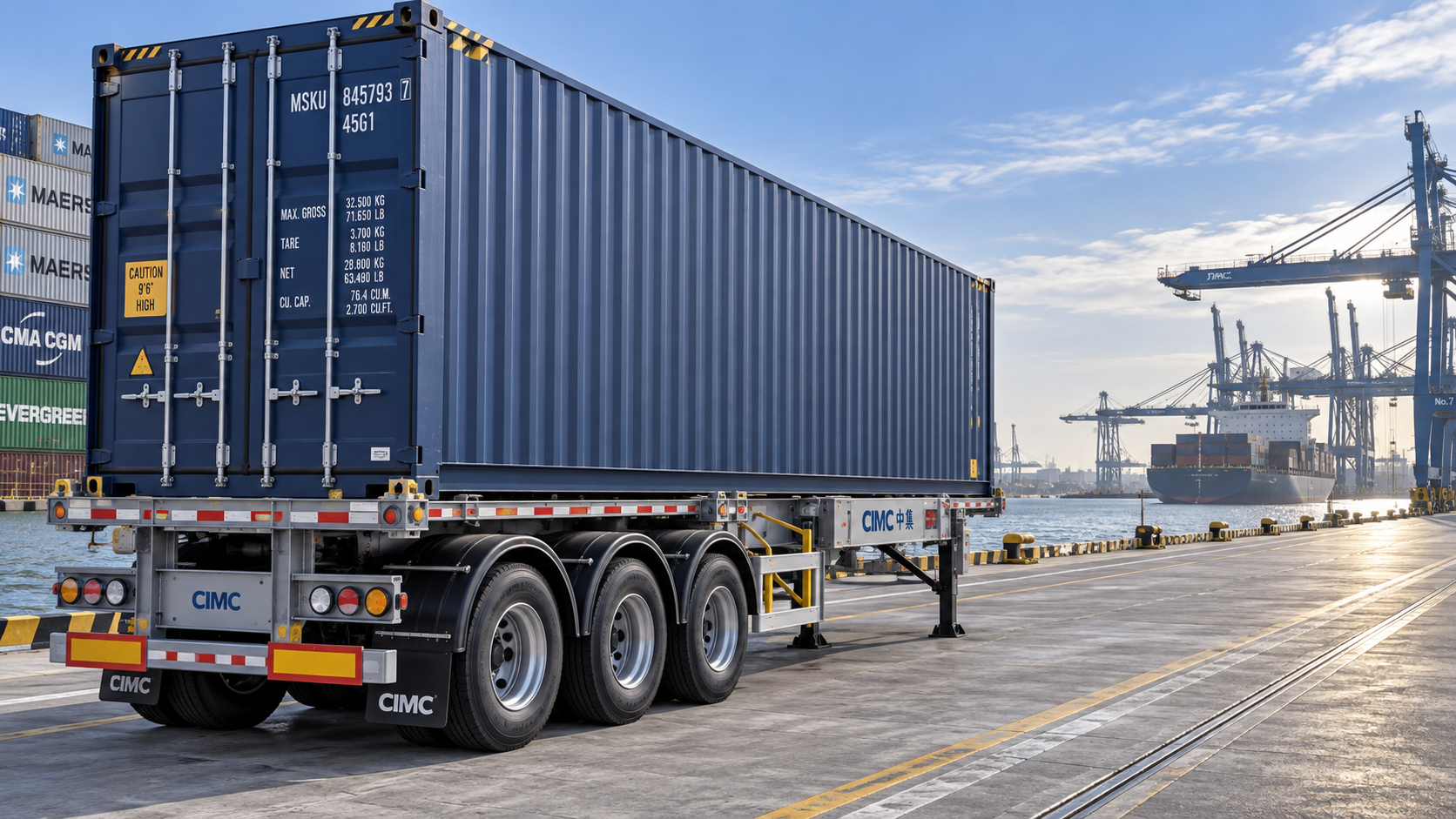
A container chassis should be selected from the container's corner-casting geometry, loaded mass, route envelope, and loading method, not from nominal length alone. A 40 ft frame may appear suitable for a 40 ft box while still being wrong because its rear lock spacing, front stop position, axle group location, or kingpin setting does not match the intended operating conditions. The result can be poor weight distribution, unusable locks, excessive rear overhang, or a combination that cannot legally travel on the planned route.
Start with the container types that will actually move during the trailer's service life. Record whether the work is limited to 20 ft ISO containers, 40 ft standard and high-cube units, 45 ft units, or mixed traffic. Then separate loaded moves from empty repositioning. A chassis that accepts several lengths through additional lock stations may be appropriate for mixed work, but it introduces more inspection points and may not provide the same structural simplicity as a dedicated fixed-length design.
Match the lock stations before comparing overall length
Containers are retained by their lower corner castings. The critical trailer dimensions are therefore the longitudinal and transverse positions of the twist locks relative to those castings. Overall deck or frame length is only a reference dimension. A trailer can be physically longer than the container and still secure it correctly, provided the intended lock set aligns with all four lower corners and the container is seated on proper support surfaces.
For a dedicated 20 ft chassis, the front and rear lock stations are positioned for the 20 ft container corner castings. A 40 ft chassis uses a much wider lock spacing. A 45 ft arrangement needs its own rearward lock position or an approved extension geometry. Do not assume that a 40 ft unit can carry a 45 ft container merely because the extra length appears modest. If the rear locks do not engage the rear corner castings, the container is unsupported as a transport load, regardless of whether its base rails rest on part of the chassis.
Review the lock layout on the supplier drawing, not only in descriptive text. The drawing should identify every lock station, fixed stops, folding locks, sliding locks, and the reference point used for dimensions. A useful review also confirms whether intermediate locks are intended for a 20 ft container loaded at the front, centered, or positioned elsewhere. These configurations produce different kingpin load and axle load distributions.
20 ft containers require a weight-distribution decision
A 20 ft container is short enough that its placement on a longer chassis materially changes axle loading. A chassis with front intermediate locks carries the container close to the kingpin; a centered arrangement shifts more load toward the trailer axle group. Neither arrangement is automatically preferable. The correct position depends on the tractor wheelbase, fifth-wheel location, axle ratings, permitted gross combination mass, and the actual cargo density.
Dense cargo in a 20 ft container can create a severe concentrated load. The container may remain within its own maximum gross mass while the tractor drive axle, fifth wheel, or trailer axle group exceeds a local limit. Conversely, moving the box too far rearward can reduce steering axle load on the tractor or increase rear overhang effects. The selection review should use realistic loaded container masses rather than a generic payload figure.
Also inspect the chassis cross-member arrangement beneath the container. The main load should transfer through the corner castings and designed support points, not through accidental contact between damaged base rails and a cross member. A support layout that works with an empty container can produce noise, wear, or local deformation when the box is heavily loaded and the route includes uneven terminals, ramps, or unpaved access roads.
40 ft and high-cube units change the height question
For 40 ft containers, lock spacing is usually straightforward, but vertical geometry often decides whether a specification is usable. A standard-height container and a high-cube container share the same basic plan dimensions, yet the high-cube body raises the overall transport height. Fifth-wheel height, chassis deck height, tire size, suspension travel, and road clearance limits must be assessed as one system.
A gooseneck chassis lowers the container's front portion by receiving the container tunnel. This arrangement is commonly associated with 40 ft high-cube transport because it can reduce overall height compared with a flat-frame design. However, the container must have a compatible tunnel, and the chassis neck shape must match it without interference. A gooseneck chassis is not a universal substitute for all 40 ft containers. Flat-bottom or non-compatible units require the correct flat-deck support configuration.
Measure the loaded operating height rather than relying on an unloaded trailer dimension. Air suspension ride height, tire growth, fifth-wheel adjustment, and terminal surfaces affect the final result. Clearance under bridges, overhead structures, loading canopies, and site gates should be checked against the complete tractor-trailer-container combination. This is especially important where route constraints differ between port access roads and the final delivery location.
45 ft containers need more than a longer rear frame
A 45 ft container places its rear corner castings farther from the front reference point and usually increases rearward projection behind the axle group. A chassis intended for this length must hold the extension positively in its operating position. The extension mechanism should have clear mechanical locking provisions; loose movement, incomplete pin engagement, or reliance on an unverified sliding position is unacceptable for loaded road transport.
Examine the extended chassis as a structural configuration, not as a 40 ft frame with added length. The rear extension changes bending load paths and exposes the rear section to vibration, docking contact, and turning forces. The rear bumper, lights, underrun protection where applicable, mudguards, air lines, and electrical harness must remain protected and functional in every working position.
Rear swing also deserves a route-specific review. During turns, the rear of a long container follows a wider path than a short unit. This can interfere with gate posts, parked equipment, loading bays, or roadside barriers even where the tractor has sufficient turning room. An extendable chassis should be evaluated in its fully extended condition on the most restrictive terminal and delivery approach, not only on open-road geometry.
Fixed, multi-length, and extendable designs serve different work patterns
A fixed chassis has fewer moving parts, fewer lock-position decisions, and a clear structural purpose. It is often the sound choice where one container length dominates and turnaround speed matters. Its limitation is obvious: it cannot absorb a change in container mix without an additional trailer or an incompatible operating workaround.
A multi-length chassis uses several lock stations on a common frame. It can be suitable where 20 ft and 40 ft containers are both routine, provided the approved container positions are clearly marked and loading staff can verify the selected locks before departure. The main risk is treating every visible lock as an interchangeable position. Some locks may be intended only for a specific container length, a particular front reference, or empty-container handling.
An extendable chassis creates physical frame length for long containers while reducing parked or empty transport length in a retracted position. It should be selected only after reviewing the extension sequence, locking pin access, contamination protection, sliding-surface lubrication requirements, and the rated load for each position. Gravel, ice, corrosion, and poor cleaning can prevent a telescopic section from seating correctly. These are operational issues, not minor maintenance details, because they directly affect whether the intended lock geometry can be achieved.
Axle capacity must be read with the whole combination in mind
Trailer axle rating alone does not establish a usable payload. The loaded container mass is shared among the tractor steering axle, tractor drive axle or axles, trailer axle group, and fifth wheel. Kingpin position, chassis axle spacing, fifth-wheel position, container placement, and cargo distribution all influence that split.
A chassis with a higher-rated axle group may still be unsuitable if the expected load concentrates beyond a tractor axle limit. Likewise, reducing trailer tare mass is useful only when it does not compromise frame durability, twist-lock support, suspension capacity, or the required gross combination rating. Compare the chassis tare weight, rated payload, gross axle ratings, and permissible kingpin load as a set of connected values.
Container cargo distribution is frequently overlooked. Machinery concentrated near one end, coils loaded toward the doors, or pallets stacked unevenly can shift the center of gravity substantially. The external container dimensions remain unchanged, but axle loading and handling behavior do not. For recurring heavy cargos, use an axle-load calculation based on the cargo plan rather than the container's total gross mass alone.
Frame, suspension, and connection details affect size compatibility in service
The chassis main beams and cross members must support the chosen container positions without excessive deflection. A convertible or extendable frame has additional joints, reinforcement zones, and wear interfaces compared with a dedicated frame. Inspect welding quality, corrosion protection, drain paths, and access to components that will need periodic service. Water retained around lock housings or telescopic rails accelerates wear and can make lock operation unreliable.
Twist locks should be easy to see and operate from a safe standing position. Confirm that the lock heads rotate fully, return to the correct condition, and do not foul container base rails. Lock indicators are useful only if they show actual engagement rather than merely the handle position. Bent lock heads, worn retaining components, or damaged corner castings must be treated as fitment defects, not cosmetic issues.
Suspension selection should reflect the route and loading surface. Mechanical suspension can offer a simple, robust arrangement; air suspension can assist ride-height control and improve protection for certain loads. Either type needs adequate travel, stable handling under the expected center of gravity, and compatible brake and axle specifications. Tire selection affects deck height, rolling capacity, and clearance around mudguards and frame members, so it belongs in the size-matching review.
Use the actual operating envelope as the final filter
Before release, compare the selected Skeleton (Container) Semi-Trailer configuration against the complete operating envelope: tractor fifth-wheel height, container types, cargo mass and distribution, terminal equipment, roadway limits, turning areas, and maintenance conditions. A basic trial fit should include every intended container length and chassis position. Verify four-point lock engagement, container support, line clearance, landing-gear clearance, rear protection position, and absence of interference during full steering articulation.
Document the permitted combinations in a clear operating record. It should identify the container length, approved lock station, extension position where relevant, maximum allowed loading condition, and any tractor or route limitation. This prevents a correct chassis from being used in an incorrect configuration after dispatch patterns change. The strongest match is the one that remains mechanically secure, axle-compliant, and practical to inspect every time the container is loaded.
Search Starts Here