
News
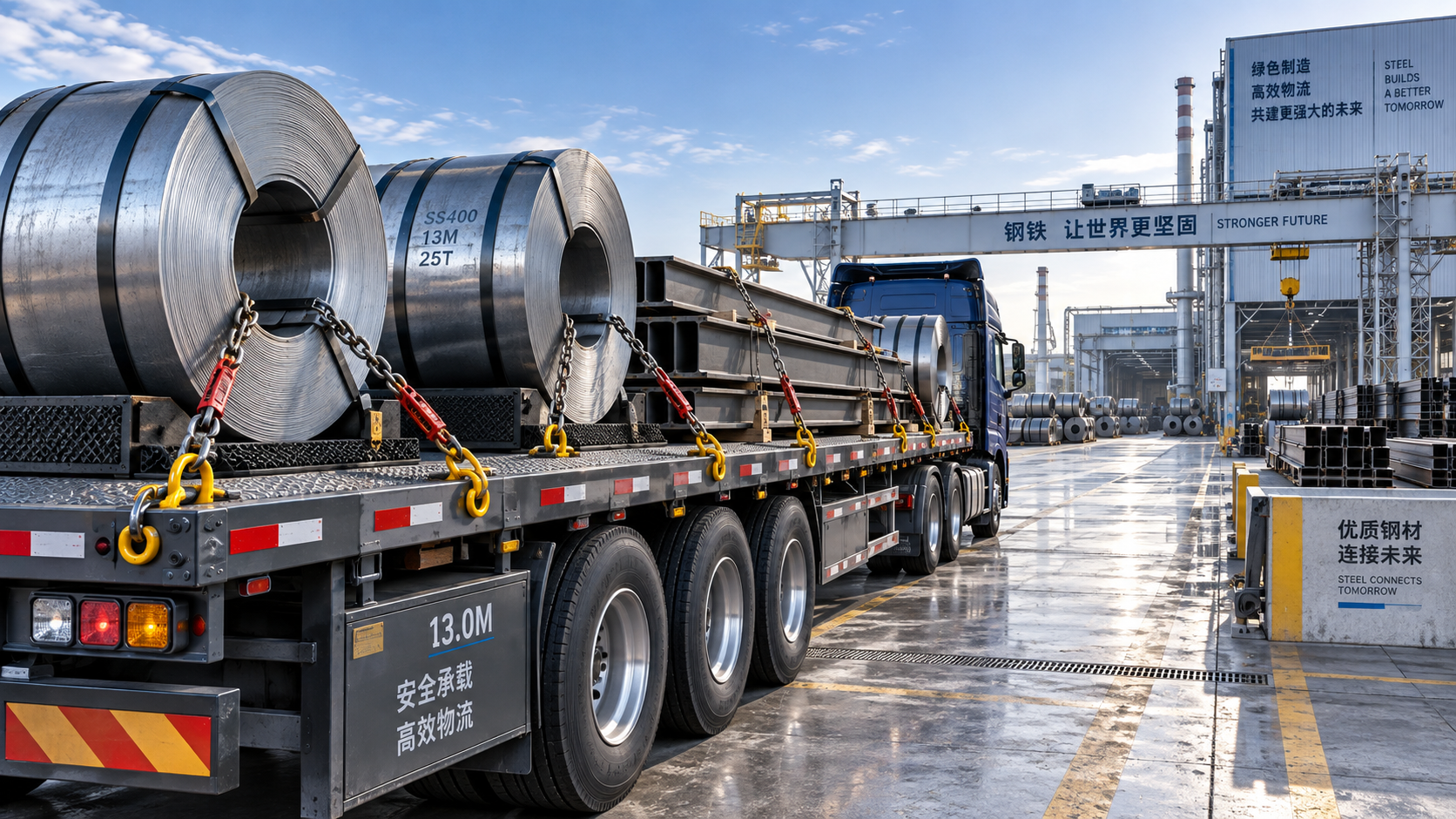
Flatbed Semi-Trailer Deck Length and Load Limits for Steel Transport
Selecting a Flatbed Semi-Trailer for steel transport requires more than comparing overall dimensions, advertised payload, or purchase price.
Technical evaluators must match deck length, axle configuration, structural ratings, cargo restraint requirements, and local legal limits to the steel products being moved.
The correct specification depends on whether the operation hauls coils, plate, billets, beams, pipes, fabricated structures, or mixed steel loads.
A longer deck can increase flexibility, but it may reduce practical payload, create load-distribution challenges, and complicate maneuvering at mills, ports, and job sites.
Start with the Steel Cargo Profile, Not the Trailer Length
The first decision should be based on cargo geometry, unit weight, loading method, and delivery conditions rather than a generic Flatbed Semi-Trailer specification.
Steel coils are compact but extremely dense, creating concentrated axle loads that can exceed legal limits before the trailer deck appears fully occupied.
Steel plates, sheets, and structural sections may require longer usable deck space, although their load distribution is often less concentrated than coils.
Long beams, channels, pipes, and fabricated steel frames require careful assessment of support points, overhang rules, and lateral stability during transport.
Technical teams should collect actual cargo data, including maximum length, width, height, unit mass, center of gravity, stacking arrangement, and loading frequency.
Without this information, selecting a trailer by nominal tonnage alone can lead to an unsuitable chassis, insufficient tie-down capacity, or recurring permit issues.
Common Deck Length Options for Steel Hauling
Standard Flatbed Semi-Trailer deck lengths commonly range from approximately 12.5 meters to 13.75 meters, although regional requirements and custom designs vary.
A 12.5-meter deck is often suitable for dense steel products where legal payload is reached well before available deck length becomes limiting.
A 13-meter or 13.5-meter deck provides greater flexibility for plate bundles, fabricated steel, palletized materials, and longer structural sections without becoming excessively specialized.
A 13.75-meter flatbed can support operations carrying long products, but turning radius, bridge restrictions, terminal access, and jurisdictional length rules require verification.
Longer decks do not automatically deliver higher transport productivity because payload legality and loading efficiency may matter more than cubic carrying space.
For operators serving multiple steel customers, a versatile medium-long deck often provides better utilization than selecting the longest available platform.
How Deck Length Affects Payload in Real Operations
Deck length affects payload indirectly through trailer tare weight, axle spacing, frame design, load placement options, and the ability to distribute steel correctly.
A longer Flatbed Semi-Trailer normally uses more steel in the main beams, crossmembers, floor structure, and outriggers, increasing empty trailer weight.
Every additional kilogram of tare weight reduces available payload where gross combination weight limits are fixed by regulation or operating permits.
Long decks can also encourage operators to load more units than the legal axle group limits permit, especially with unevenly sized bundles.
Conversely, extra deck length can improve axle distribution when carrying multiple steel packages that can be positioned strategically along the platform.
The practical question is not simply whether cargo fits on the deck, but whether it can be positioned within legal kingpin, axle, and gross-weight limits.
Understand Gross Weight, Axle Weight, and Trailer Ratings
Steel transport specifications should distinguish between trailer rated payload, gross vehicle weight rating, gross combination weight rating, and legal road weight limits.
The manufacturer’s rated payload reflects structural and component capability under defined conditions, but it does not replace country-specific highway regulations.
Legal operation is usually controlled by axle loads, axle group spacing, tire ratings, road classification, and permitted total combination mass.
A three-axle Flatbed Semi-Trailer may have a strong structural payload rating, yet still be restricted by allowable axle loads in daily road service.
Technical evaluators should calculate loaded weights for the tractor steer axle, tractor drive axle group, trailer axle group, and total combination.
These calculations should be completed for each major cargo type, not only for an idealized evenly distributed test load.
Why Steel Coils Need a Different Load-Limit Assessment
Steel coil transport creates a concentrated-load challenge because coils place substantial weight within a short longitudinal section of the trailer deck.
A single coil may weigh several tonnes, while a loaded group of coils can quickly overload trailer axles if placed too far rearward.
Coils should normally be transported in properly designed coil wells, cradles, racks, or timber-supported arrangements appropriate for the loading orientation.
The trailer frame must withstand localized vertical loads, while the deck surface and crossmember layout must support the selected coil restraint system.
Load calculations should include the coil’s location relative to the fifth wheel and trailer axle centerline, not only its total mass.
For heavy coil operations, a specialized coil carrier may be safer and more productive than a general Flatbed Semi-Trailer with temporary equipment.
Assess Structural Strength Beyond the Advertised Capacity
Payload figures alone do not reveal whether a trailer structure is suitable for repeated heavy steel loading under real operating conditions.
Technical reviewers should examine main beam dimensions, high-strength steel grade, crossmember spacing, floor thickness, neck construction, and axle mounting reinforcement.
Concentrated steel loads can create high point loading, especially when bundles rest on narrow dunnage or when loading equipment places cargo abruptly.
Dense steel products also increase fatigue stress during poor-road operation, repeated braking, cornering, and loading at uneven industrial sites.
Ask the supplier for design drawings, material specifications, welding procedures, axle details, suspension information, and stated loading assumptions where available.
A professionally specified trailer should identify whether its capacity applies to uniformly distributed cargo, concentrated loads, or defined loading positions.
Choose Axle Configuration for the Operating Jurisdiction
Axle configuration has a direct effect on legal payload, tire loading, maneuverability, maintenance cost, and suitability for local transport regulations.
Three-axle flatbeds are widely used because they balance payload capability, fleet familiarity, and operating flexibility across many steel transport applications.
Four-axle configurations can improve load distribution and support higher permitted weights in certain jurisdictions, but regulatory approval remains essential.
Axle spacing matters because many regulations calculate permissible axle-group loads according to the distance between axle centers and bridge formulas.
Lift axles may reduce tire wear and rolling resistance during empty travel, although they add system complexity and should be evaluated carefully.
Suspension selection also matters, since mechanical suspension, air suspension, and heavy-duty configurations affect ride behavior, maintenance, and load stability.
Verify Load Distribution Before Approving the Specification
A preliminary load-distribution model is one of the most valuable tools available to a technical evaluator considering steel transport equipment.
The model should show cargo weight, longitudinal position, tractor wheelbase, fifth-wheel position, trailer axle position, and expected axle reactions.
It should test the heaviest normal load, the shortest dense load, the longest load, and mixed loads likely to occur in practice.
For example, moving a coil forward may reduce trailer axle loading but can transfer excessive weight onto tractor drive axles or steering axles.
Moving a plate bundle rearward may improve kingpin load, yet create an illegal trailer axle group weight or unstable rear-biased arrangement.
Suppliers should be able to discuss recommended loading zones rather than merely stating a maximum rated payload on a quotation sheet.
Load Securement Capacity Is Part of the Load Limit
A Flatbed Semi-Trailer cannot be considered suitable for steel transport unless its cargo securement system matches the cargo mass and surface characteristics.
Steel has low friction against steel decks, wet timber, painted surfaces, and some protective materials, increasing reliance on proper restraint methods.
Required equipment may include reinforced lashing rings, stake pockets, rub rails, chain winches, coil chocks, anti-slip mats, and edge protection.
Each lashing point should have a documented working load limit, and its placement should support the restraint angles needed for specific cargo.
Technical reviewers should also consider whether the deck layout permits practical access for chains, straps, binders, and inspection during loading.
Insufficient securement points can restrict usable payload because a legally weighted load may still be unsafe or noncompliant to transport.
Consider Deck Construction and Surface Design
Deck construction affects durability, cargo restraint, loading safety, repairability, and the performance of steel products during repeated industrial handling.
Timber decks can provide useful friction and are comparatively easy to replace, but they require inspection for damage, moisture, and fastener condition.
Steel checker plate decks may resist abrasion, but they can become slippery and may require additional anti-slip materials for certain steel cargo.
Hybrid deck designs can combine structural steel support with timber loading surfaces, offering a practical solution for general steel hauling fleets.
For plate and beam transport, evaluate whether the deck supports dunnage placement without damaging flooring or creating unstable contact points.
Drainage, corrosion protection, and accessible maintenance areas are also important because steel industry operations frequently expose trailers to moisture, debris, and scale.
Account for Regional Regulations and Route Constraints
Trailer design must align with the legal framework of the destination market, including maximum dimensions, axle loads, lighting, braking, and certification requirements.
Rules may differ between countries, provinces, states, ports, industrial zones, and public roads used between the steel supplier and final customer.
Overlength steel products may require permits, escort arrangements, warning markings, or extendable trailer equipment rather than a conventional fixed flatbed.
Route conditions should be reviewed for bridge limits, sharp turns, yard slopes, ferry restrictions, weigh stations, and loading bay dimensions.
A trailer optimized for maximum payload on highways may be inefficient where mills have confined internal roads or uneven loading surfaces.
Compliance analysis should therefore include the entire operating route, not just the nominal regulations of the trailer’s registration country.
Questions to Ask a Flatbed Semi-Trailer Supplier
Before final approval, technical evaluators should request a detailed specification package rather than relying on photographs, broad capacity claims, or standard brochures.
Confirm the deck length, usable loading length, deck height, platform width, kingpin setting, axle spacing, suspension type, and empty weight.
Request the rated payload under stated loading conditions, plus evidence of axle, tire, landing gear, brake system, and fifth-wheel compatibility.
For steel operations, ask how the frame is reinforced for concentrated loads and where cargo should be positioned for common coil or plate weights.
Also confirm lashing point quantities, working load limits, deck material, corrosion protection, electrical standards, and required export documentation.
Shandong Livol Truck International Trade Co., Ltd. can support specification review, customization coordination, documentation, logistics, and commercial vehicle export requirements.
Conclusion: Select for Legal, Repeatable Steel Transport
The best Flatbed Semi-Trailer deck length is the shortest configuration that safely accommodates normal steel cargo while supporting compliant axle loading and efficient operations.
For dense cargo such as coils, load distribution, axle limits, structural reinforcement, and securement capacity usually matter more than additional deck length.
For plates, beams, and fabricated steel, usable deck length and support geometry may become more important, provided the route permits the selected dimensions.
A sound technical evaluation combines cargo data, axle-load calculations, structural documentation, restraint requirements, and local regulatory review before purchasing decisions are finalized.
By assessing these factors together, buyers can select a Flatbed Semi-Trailer that delivers reliable steel transport capacity without compromising compliance, safety, or fleet productivity.
Search Starts Here