
News
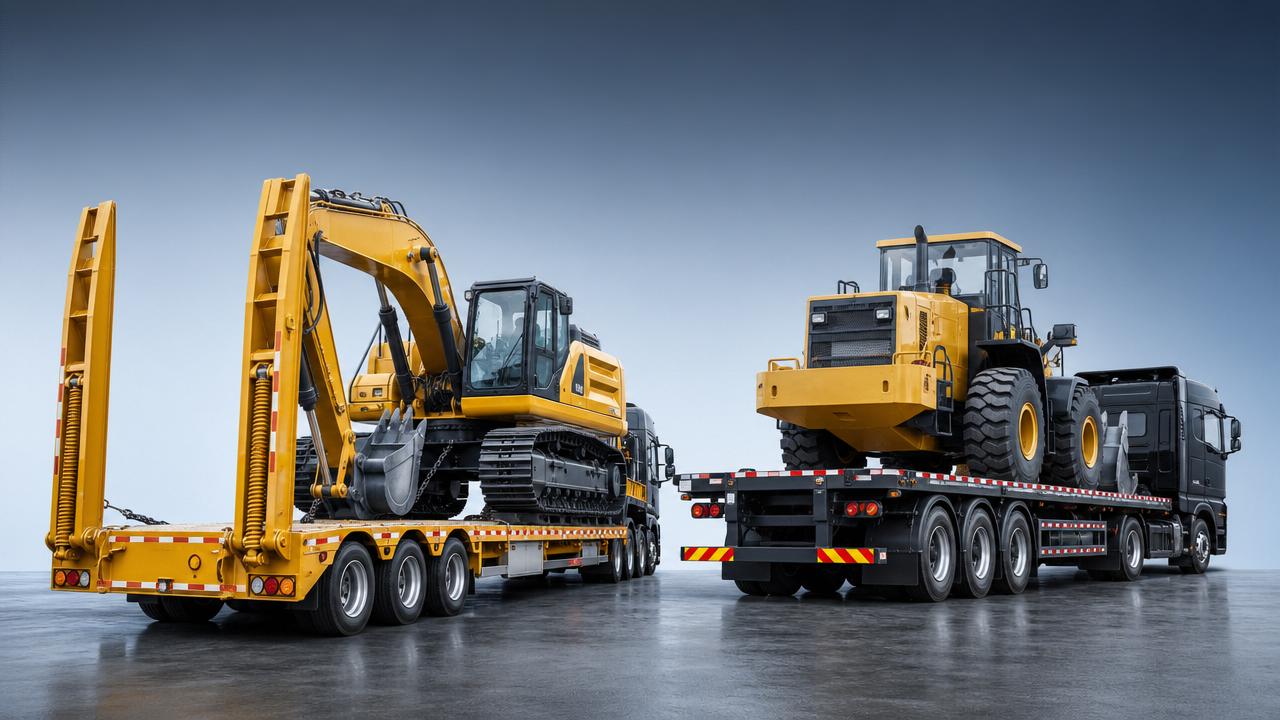
When transporting excavators, loaders, or other oversized machinery, choosing between a Flatbed Semi-Trailer and a low plate trailer directly affects loading efficiency, road compliance, and equipment safety. For technical evaluators, the right decision depends on cargo height, weight distribution, and operating conditions. This article compares both trailer types to help identify which solution better supports heavy equipment transport needs.
For most heavy equipment applications, the short answer is clear: if the machine is tall, heavy, or has a high center of gravity, a low plate trailer is usually the safer and more practical choice. If the equipment is lighter, dimensionally simpler, and loading flexibility matters more than deck height, a Flatbed Semi-Trailer may be the better fit.
That said, technical evaluation should never rely on a general rule alone. The better trailer depends on legal transport height, axle load distribution, loading angle, road conditions, route restrictions, and how frequently the trailer must handle different machine types. For buyers and fleet evaluators, the real question is not which trailer is “better” in abstract terms, but which one lowers transport risk while improving operating efficiency in actual field use.
What is the core difference between a Flatbed Semi-Trailer and a low plate trailer?
A Flatbed Semi-Trailer uses a standard flat loading deck positioned relatively higher above the ground. Its structure is simple, versatile, and widely used for general cargo, construction materials, containers, and some wheeled or tracked machinery. Because of its open deck layout, it offers flexible loading positions and can support a broad range of freight types.
A low plate trailer, often understood in practice as a low-bed or low-deck equipment trailer, is designed with a lower cargo platform. That reduced deck height is the defining advantage. It helps transport taller or heavier equipment while keeping the overall loaded height within legal road limits. It also improves stability because the machine sits closer to the ground.
For technical assessors, this distinction matters more than naming conventions. The comparison is fundamentally about transport geometry and operational suitability. A standard Flatbed Semi-Trailer provides flexibility, but a low plate trailer provides better dimensional control and safer heavy equipment handling.
Which trailer fits heavy equipment better in real transport conditions?
For heavy equipment transport, low plate trailers generally fit better in real-world operations. Excavators, road rollers, bulldozers, graders, and loaders often present challenges in height, weight concentration, and loading safety. A lower deck solves several of these problems at once.
First, lower deck height reduces total transport height. This is critical when moving machines with cabs, booms, arms, enclosed operator stations, or large tires. Even if the equipment can physically sit on a standard flatbed, the loaded height may exceed bridge or road regulations. In that case, a Flatbed Semi-Trailer becomes less practical or may require partial disassembly, increasing labor and downtime.
Second, the low plate design improves loading and unloading. Heavy machinery often climbs onto the trailer under its own power. A lower platform reduces ramp angle, making loading safer for both wheeled and tracked machines. This becomes especially important for machines with low ground clearance, long wheelbases, or steel tracks that need controlled entry.
Third, stability is better during transit. Lowering the center of gravity helps reduce sway, roll risk, and dynamic load transfer during cornering, braking, and uneven road travel. For technical teams assessing risk, this is one of the strongest arguments in favor of low plate designs.
That said, a Flatbed Semi-Trailer may still fit better when the equipment is compact, route regulations are less restrictive, and the operator needs a more multi-purpose trailer for mixed cargo duties. In fleets where one trailer must handle machinery one day and palletized materials the next, the flatbed retains a strong commercial advantage.
How cargo height and legal road limits affect trailer selection
One of the most overlooked mistakes in trailer evaluation is focusing only on payload capacity while underestimating height compliance. In many export markets, total vehicle height is tightly regulated. If the trailer deck is too high, even a medium-size machine can become an over-height load.
This is where the low plate trailer usually outperforms the Flatbed Semi-Trailer. By lowering the deck, it allows taller machines to travel without disassembly or special permit complexity in some cases. That can reduce route limitations, escort requirements, and waiting time at checkpoints.
Technical evaluators should calculate loaded height using actual machine transport configuration, not brochure dimensions alone. For example, boom position, tire pressure, attachments, canopy height, and suspension compression can all affect the final loaded profile. A trailer that appears suitable on paper may fail compliance once these real factors are included.
If a fleet frequently transports excavators or loaders with variable attachments, the margin created by a low deck can be operationally valuable. It gives more flexibility across machine models and reduces the risk of route rejection. In contrast, a standard Flatbed Semi-Trailer may require stricter machine matching and route planning.
Weight distribution and axle loading: the technical factors that matter most
Heavy equipment rarely behaves like evenly distributed cargo. The engine, counterweight, tracks, axles, or rear frame may concentrate mass in one area. This means trailer suitability depends not just on gross capacity, but on how the load sits across the deck and how that weight transfers to the tractor and trailer axles.
Low plate trailers are often better suited for concentrated heavy loads because their structure is purpose-built for machinery transport. Many designs provide reinforced deck sections, stronger main beams, and layouts intended to support the wheel or track pressure of construction equipment. This can improve structural reliability and reduce long-term fatigue.
A Flatbed Semi-Trailer may have sufficient rated capacity, but its deck arrangement may be less optimized for point loading from tracks or heavily loaded axles. If the machine’s contact area is small relative to its weight, evaluators should verify deck strength, beam design, and floor material very carefully.
Axle loading is equally important. Improper machine positioning can overload trailer axles or create unstable kingpin loads. A low plate trailer often makes positioning easier because the deck is designed for machinery balance, with more predictable loading zones. On a Flatbed Semi-Trailer, flexibility is higher, but that flexibility can also increase setup errors if loading procedures are not standardized.
For technical assessment, the correct approach is to review machine operating weight, transport weight with attachments, contact point spacing, and expected center-of-gravity position. These inputs should be matched against trailer beam strength, axle arrangement, tire specification, suspension type, and legal axle load limits in the destination market.
Loading efficiency and ramp performance in daily operations
Daily loading performance has a direct effect on transport cost and safety. On paper, two trailers may both carry the same excavator. In practice, the easier one to load repeatedly under field conditions will usually create better fleet performance.
Low plate trailers usually offer a major advantage here. Their reduced deck height results in shorter or less steep ramps, which improves machine approach angles. This reduces the risk of underbody contact, track slip, or unstable climbing, especially in muddy jobsite conditions or when loading older equipment with weaker traction response.
For wheeled loaders, compactors, and pavers, ramp transition is especially important. A poor loading angle can damage tires, underframes, or accessories. For tracked machinery, a steep angle can increase stress on ramp ends and raise operator risk. From a process standpoint, a low plate trailer often shortens loading time and lowers dependence on ideal ground conditions.
A Flatbed Semi-Trailer can still work efficiently if equipped with proper ramps and used for suitable equipment classes. However, loading usually requires more care, more space, and sometimes more site preparation. If the customer’s operating environment includes temporary roads, uneven ground, or high-volume loading cycles, the low plate option usually creates fewer complications.
When does a Flatbed Semi-Trailer make more sense?
Although low plate trailers are often the stronger choice for heavy equipment, the Flatbed Semi-Trailer remains highly relevant. It makes sense when transport tasks are diverse, equipment dimensions are manageable, and versatility is a higher priority than the lowest possible deck height.
For example, a contractor or distributor that moves smaller loaders, forklifts, agricultural machines, steel products, or packaged cargo may benefit more from a flatbed. It can serve multiple business functions with fewer configuration limits. In these cases, the extra deck height may not create a legal or operational problem.
Flatbeds also tend to be simpler in construction and may be easier to maintain in some markets. Their open, standardized layout can make cargo securing more flexible, especially when the transported units vary in shape or when the trailer is used beyond heavy machinery applications.
For technical evaluators, this means trailer selection should reflect utilization rate by cargo type. If heavy equipment transport is only occasional and most loads are general freight, a Flatbed Semi-Trailer may produce better asset efficiency. But if machinery transport is core to the operation, the compromises may become costly over time.
How to evaluate total operating value instead of purchase price alone
Many buyers initially compare trailers by purchase price, but technical assessment should focus on lifecycle operating value. The cheaper trailer is not always the more economical one if it causes extra permits, slower loading, route limitations, or higher accident exposure.
A low plate trailer may cost more depending on specification, but it can reduce hidden operating costs. These include fewer disassembly requirements, reduced escort complexity, faster machine loading, lower compliance risk, and better cargo stability. If a fleet moves high-value equipment regularly, those advantages often justify the investment.
A Flatbed Semi-Trailer may offer better value when transport tasks are mixed and the trailer spends significant time on non-equipment cargo. In this case, the broader usability improves return on investment. The key is to match trailer economics to actual dispatch patterns rather than theoretical maximum capability.
Technical evaluators should build a comparison model that includes loading time, legal route availability, maintenance implications, cargo damage risk, frequency of oversize scenarios, and average annual utilization. This leads to a more accurate decision than unit price comparison alone.
Questions technical evaluators should ask before making a final decision
To choose between a Flatbed Semi-Trailer and a low plate trailer, evaluators should ask several practical questions. What are the heaviest and tallest machines to be moved? Are attachments transported installed or separately? What are the typical road regulations in the target country? How often is loading performed on uneven worksites instead of paved yards?
They should also confirm whether the trailer will serve a dedicated equipment transport role or a mixed freight role. This distinction strongly affects the business case. A dedicated heavy equipment fleet should typically prioritize low deck stability and compliance. A mixed-use fleet may value flatbed versatility more.
Other key questions include axle count requirements, suspension preference, ramp design, deck reinforcement needs, and the quality of after-sales parts support. In export procurement, documentation accuracy, homologation suitability, and spare parts availability can be just as important as technical specification.
This is where working with an experienced commercial vehicle exporter adds value. Shandong Livol Truck International Trade Co., Ltd. supports global buyers with vehicle and trailer selection, customization, documentation, logistics coordination, and professional export service. For technical teams, supplier support matters because the right specification often depends on destination regulations and real operating scenarios, not just catalog comparison.
Final verdict: which fits heavy equipment better?
If the primary task is transporting heavy construction machinery safely, efficiently, and within road height limits, the low plate trailer is usually the better solution. It offers lower deck height, improved stability, safer ramp angles, and stronger suitability for oversized or high-center-of-gravity equipment. For most excavators, loaders, rollers, and similar machines, that combination makes technical and operational sense.
If the operation needs broader cargo flexibility and the machinery being moved is not especially tall or difficult to load, a Flatbed Semi-Trailer can still be the right choice. Its strength lies in versatility, simpler general cargo use, and better utilization across mixed transport tasks.
So the answer is not simply about trailer category. It is about matching trailer geometry, structural design, and legal fit to actual equipment transport conditions. For technical evaluators, the best decision comes from assessing total loaded height, axle load distribution, loading safety, route compliance, and utilization profile together.
In short, when heavy equipment transport is the priority, low plate trailers usually fit better. When operational flexibility is the priority, a Flatbed Semi-Trailer may deliver greater overall value. The smarter investment is the one that reduces transport constraints while supporting the way your fleet actually works.
Search Starts Here