
News
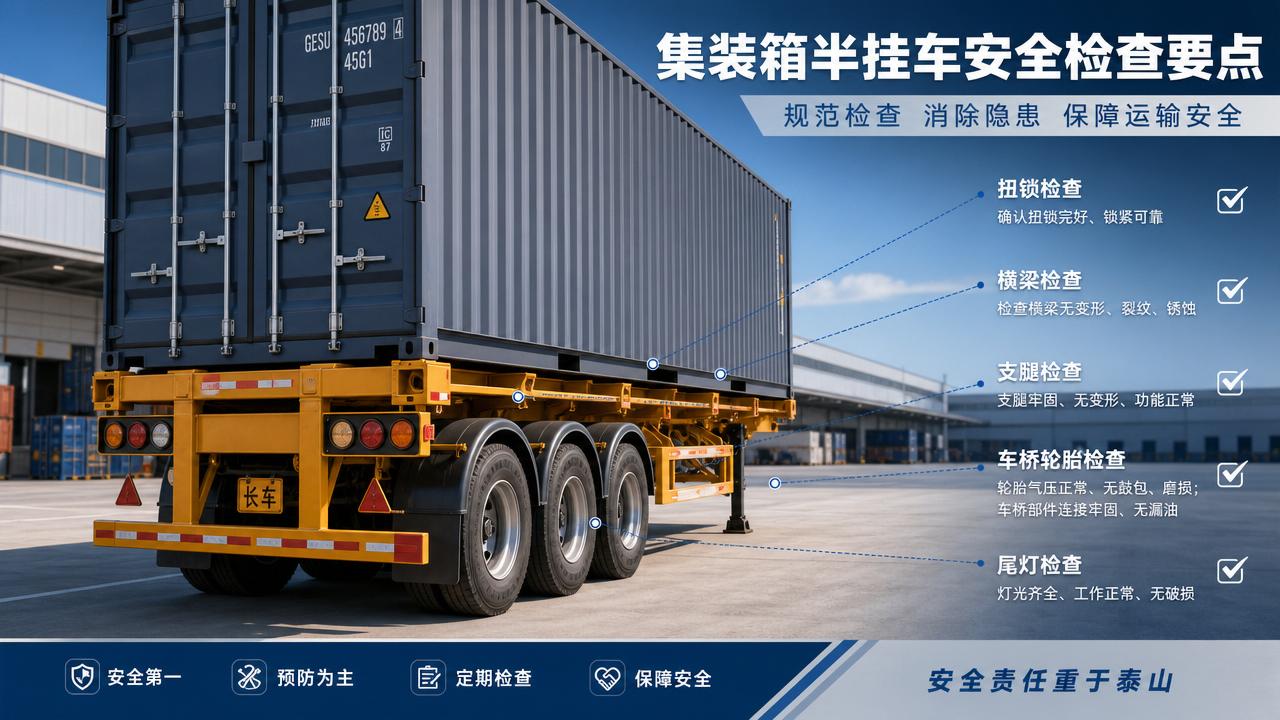
Before any container leaves the yard, the most important question for quality control and safety teams is simple: is the Skeleton (Container) Semi-Trailer structurally sound, correctly locked, compliant, and ready for a predictable road journey? A missed defect in the chassis, twist locks, landing gear, tires, brakes, lights, or markings can quickly turn into cargo loss, roadside detention, schedule disruption, or a serious safety incident. That is why pre-dispatch inspection should never be treated as a routine sign-off.
For quality control personnel and safety managers, the goal is not only to “check the trailer.” It is to verify that the trailer can safely support the container, withstand route conditions, and meet operational and regulatory requirements before handover. In practice, the most effective inspection process focuses on high-risk points first: frame integrity, container locking security, running gear condition, braking response, visibility systems, and documentation consistency.
A strong dispatch standard for a Skeleton (Container) Semi-Trailer reduces uncertainty across the transport chain. It helps prevent loading errors, protects container stability, lowers the chance of roadside failures, and gives management clearer evidence that equipment was released in acceptable condition. For companies handling export logistics, port transport, or inland container movement, this discipline directly supports delivery reliability and brand credibility.
What safety teams are really trying to prevent before dispatch
When users search for guidance on Skeleton Semi-Trailer safety checks before container dispatch, they are usually not looking for a generic maintenance article. They want a practical inspection framework that helps them prevent real operating failures. The key risks are usually structural fatigue, improper container locking, brake or tire failure, unstable load distribution, missing legal equipment, and preventable delays caused by non-compliance.
For safety managers, the concern is exposure: what defect could create an incident on the road, in the terminal, or during loading and unloading? For quality control staff, the focus is traceability and release standards: what must be checked, what is a reject condition, and what can be corrected immediately before dispatch? These readers need an inspection process that is fast enough for operations but strict enough to stop unsafe release.
The value of a good pre-dispatch check is not limited to avoiding accidents. It also reduces container damage claims, detention costs, emergency repairs, loading disputes, and interruptions to fleet planning. In other words, a disciplined inspection routine supports both safety performance and commercial efficiency.
Start with the chassis and frame: the foundation of container transport safety
The first inspection priority should always be the structural condition of the Skeleton (Container) Semi-Trailer. Unlike box trailers, a skeleton trailer relies on an exposed frame design to carry concentrated container loads through a relatively simple structure. If that structure has fatigue cracks, deformation, weak welds, or corrosion at critical points, the risk is not theoretical. It affects load stability, axle alignment, and the overall safety margin during transport.
Inspectors should check the main beams, cross members, gooseneck area, rear end frame, kingpin mounting area, twist lock support structures, landing gear brackets, and suspension connection points. Look for visible cracks, previous repair marks, bent steel, missing fasteners, and abnormal rust build-up around welded joints. Areas with repeated stress concentration deserve special attention, especially on trailers used in heavy port cycles, rough roads, or frequent container repositioning.
A trailer should not be dispatched if any structural defect affects load-bearing capacity, alignment, or lock mounting integrity. Temporary acceptance of a visibly compromised frame is one of the most common management mistakes in high-pressure dispatch environments. If the chassis is questionable, every other inspection result becomes less meaningful.
It is also important to verify dimensional suitability for the planned container. If the trailer is designed for 20-foot, 40-foot, or extendable multi-size operation, the locking positions and support points must match the actual container configuration. A mismatch between trailer setup and container length can create load transfer problems even when the trailer appears mechanically sound.
Container locking points are the most critical dispatch checkpoint
If there is one area that should never be rushed, it is the container securing system. Twist locks, lock housings, pins, handles, and related mounting points must all be inspected carefully. A structurally sound trailer can still become unsafe if the container is not properly engaged at the designated locking points.
Inspect each twist lock for wear, deformation, damage, incomplete rotation, restricted movement, corrosion, and poor return action. Confirm that handles can move freely and that the locking mechanism can fully engage and hold position. If a lock is loose in its housing, bent, partially seized, or visually worn to the point that engagement reliability is doubtful, the trailer should be held for repair.
Just as important, verify lock compatibility with the container corner castings to be carried. Operational teams sometimes assume that “if it fits, it works,” but partial engagement or misalignment can remain unnoticed until the vehicle hits uneven pavement, brakes sharply, or makes a tight turning movement. That is exactly when a poor locking condition can become a cargo security event.
For quality teams, the best practice is to require both a visual check and a functional confirmation. The inspection should confirm not only that the locks are present, but that they are actually capable of securing a loaded container under transport conditions. This is where many superficial dispatch checks fail.
Running gear failures create some of the highest roadside risks
After the structure and locks, the next major area is the running gear system. Tires, wheels, axles, suspension, hubs, and bearings have a direct impact on whether the Skeleton (Container) Semi-Trailer can complete the trip safely. Many roadside incidents begin with defects that were visible in the yard but not taken seriously at dispatch.
Check tire condition for tread depth, cuts, exposed cords, sidewall damage, bulges, irregular wear, embedded objects, and inflation condition. Uneven wear may indicate deeper problems such as misalignment, suspension wear, overloaded use, or axle-related issues. Tire replacement decisions should follow clear internal criteria rather than informal judgment under time pressure.
Wheel rims and fasteners should be inspected for cracks, deformation, missing or loose nuts, elongated holes, and signs of overheating. Hub areas should be checked for oil or grease leakage and unusual temperature history if recent operation data is available. A leaking hub or damaged wheel end is not a minor issue on container transport routes where long waiting times and stop-start movement can worsen mechanical stress.
Suspension components including leaf springs, air suspension bags, torque arms, U-bolts, equalizers, and shock absorbers should also be reviewed. Any broken spring leaf, leaking air bag, shifted component, or loose fastening point can affect stability, tire wear, braking behavior, and container ride quality. Even if a defect does not cause immediate immobilization, it can increase cargo shock and reduce control under emergency response.
Brake system checks should be evidence-based, not assumed
A loaded container trailer puts heavy demand on the brake system, especially in mixed road conditions, port queues, downhill sections, and urban entry zones. Safety managers should treat brakes as a dispatch-critical verification point, not as a maintenance item to be addressed later.
Inspect air lines, couplings, hoses, chambers, valves, and reservoirs for leakage, abrasion, cracking, insecure routing, and physical damage. Confirm that service and emergency lines are correctly connected and protected. Listen for air leaks after pressurization and verify that pressure builds and holds within the expected operating range.
Brake linings, drums or discs, slack adjusters, and mechanical linkages should be checked according to the fleet’s inspection standard. If brake stroke is excessive, wear is near limits, or response is uneven across axles, the trailer should not be released. It is especially important to avoid dispatching trailers with “acceptable enough” brake conditions when they are scheduled for heavy loads or longer inland routes.
Parking brake performance must also be confirmed. A trailer that cannot remain stable during coupling, waiting, loading, or yard staging creates risk not only during road movement but throughout the dispatch process. For QC teams, documenting brake check results strengthens accountability and reduces post-incident ambiguity.
Lights, reflectors, markings, and visibility items affect both compliance and accident prevention
Many transport delays come from issues that seem small but trigger enforcement attention immediately. Faulty lighting, missing reflectors, unclear license plate mounting, damaged conspicuity tape, or missing safety markings can lead to roadside stops, fines, and dispatch disruption. More importantly, poor visibility significantly increases collision risk in night operation, rain, fog, and terminal traffic.
Inspect all mandatory lighting functions, including tail lamps, brake lamps, turn signals, side markers, and license plate illumination where applicable. Check reflectors and reflective tape for cleanliness, damage, and visibility. Wiring should be secure, protected, and free from exposed sections that may short or fail during vibration.
Safety managers should also confirm that any required hazard labels, fleet ID, registration display, and operational markings are present and legible. This is particularly important in cross-border logistics or regulated export movement where document and equipment consistency is examined more closely.
Landing gear, kingpin, and coupling condition deserve more attention than they often get
Dispatch checks often focus heavily on the container and tires, while coupling-related components receive only a quick visual glance. That is a mistake. The landing gear, kingpin, and coupling interface are essential for safe tractor-trailer connection and operational stability.
Check the kingpin for abnormal wear, deformation, cracks, insecure mounting, and evidence of impact or improper coupling. If the kingpin condition is poor, coupling reliability is compromised and the consequences can be severe. The inspection should include the surrounding mounting plate and structural area, not just the pin itself.
Landing gear should be checked for bent legs, damaged bracing, insecure mounts, poor crank operation, and footplate condition. A weak or unstable landing gear system can cause problems during parking, loading, and trailer exchange. For facilities where trailers are staged with containers before tractor connection, this checkpoint becomes even more important.
Any sign that the trailer sits unevenly, drops abnormally, or transfers weight inconsistently during coupling should trigger a hold for further inspection. These are not cosmetic defects; they indicate mechanical weakness that may affect dispatch safety.
Do not ignore load readiness, container condition, and fit-for-dispatch compatibility
A safe Skeleton (Container) Semi-Trailer can still become part of an unsafe dispatch if the container itself is unsuitable or improperly positioned. Quality and safety teams should therefore expand inspection beyond the trailer to include basic transport compatibility checks.
Verify that the container type, size, and gross weight are suitable for the trailer specification and legal route limits. Confirm that the container corner castings are intact, that there is no major floor or frame damage affecting support, and that the unit can sit correctly on the trailer contact points. If the container appears twisted, heavily damaged, or structurally compromised, even a compliant trailer setup may not be safe to dispatch.
Weight distribution matters as well. Uneven loading, incorrect center of gravity, or improper positioning can overload axles, reduce braking stability, and increase rollover risk. Dispatch personnel should confirm that loading plans, declared weights, and actual trailer setup are aligned. For safety managers, this is where process discipline and communication with loading teams become critical.
Build a release standard that clearly defines pass, repair, and reject conditions
One of the biggest reasons unsafe trailers still get dispatched is the absence of a clear decision standard. If inspectors are left to rely on personal judgment alone, acceptance quality becomes inconsistent. A better system defines three outcomes: pass for dispatch, hold for immediate correction, or reject for maintenance intervention.
For example, a dirty reflector may be corrected on site, while a seized twist lock or cracked cross member should trigger rejection. A minor wiring clip issue may be repairable before departure, while air leakage in the brake system should stop release entirely. These distinctions should be documented in a practical checklist that matches the actual operating environment of the fleet.
Digital inspection records can improve traceability, especially for fleets serving ports, export yards, and high-frequency dispatch schedules. Photo records, defect codes, and sign-off logs make it easier to monitor recurring issues, identify weak maintenance trends, and prove due diligence in case of claims or incidents.
For management, this structured release approach does more than improve safety. It creates measurable control over asset condition, dispatch quality, and maintenance planning. That is where operational discipline becomes a strategic advantage rather than just a compliance exercise.
Why equipment quality and supplier reliability matter in pre-dispatch safety
Even the best inspection routine cannot fully compensate for poor trailer manufacturing quality, inconsistent components, or weak after-sales support. For companies sourcing new Skeleton (Container) Semi-Trailers, long-term dispatch safety begins with product reliability, structural design quality, and dependable parts support.
Shandong Livol Truck International Trade Co., Ltd., based in Shandong, China, supports global customers with professional commercial vehicle export services and integrated supply solutions. As the official authorized domestic and overseas dealer for FOTON, SHACMAN, and SINOTRUK, the company combines strong industry resources, wide 4S network coverage, stable inventory, and export experience to help customers secure vehicles that meet operational demands more reliably.
For buyers responsible for fleet quality and transport safety, supplier evaluation should include manufacturing consistency, specification matching, customization capability, document support, and after-sales responsiveness. A Skeleton (Container) Semi-Trailer is not just a product purchase; it is a transport risk-control asset that will directly influence dispatch reliability over time.
Conclusion: a safe dispatch starts with a disciplined inspection mindset
Before container dispatch, the most effective safety check is not the longest checklist. It is the one that focuses on the failure points that matter most: frame integrity, container lock security, running gear condition, brake performance, visibility compliance, coupling safety, and load compatibility. For quality control and safety management teams, these are the checkpoints that prevent incidents, protect cargo, and maintain dispatch confidence.
A Skeleton (Container) Semi-Trailer should only be released when there is clear evidence that it is structurally sound, functionally secure, and operationally compliant for the planned trip. If there is doubt in a critical area, the right decision is to stop the dispatch, not to hope the route will be forgiving.
In container logistics, safety is rarely lost because teams lack a checklist. It is lost when known risks are normalized under schedule pressure. A disciplined pre-dispatch standard helps organizations avoid that trap and build more reliable transport performance from the yard gate onward.
Search Starts Here