
News
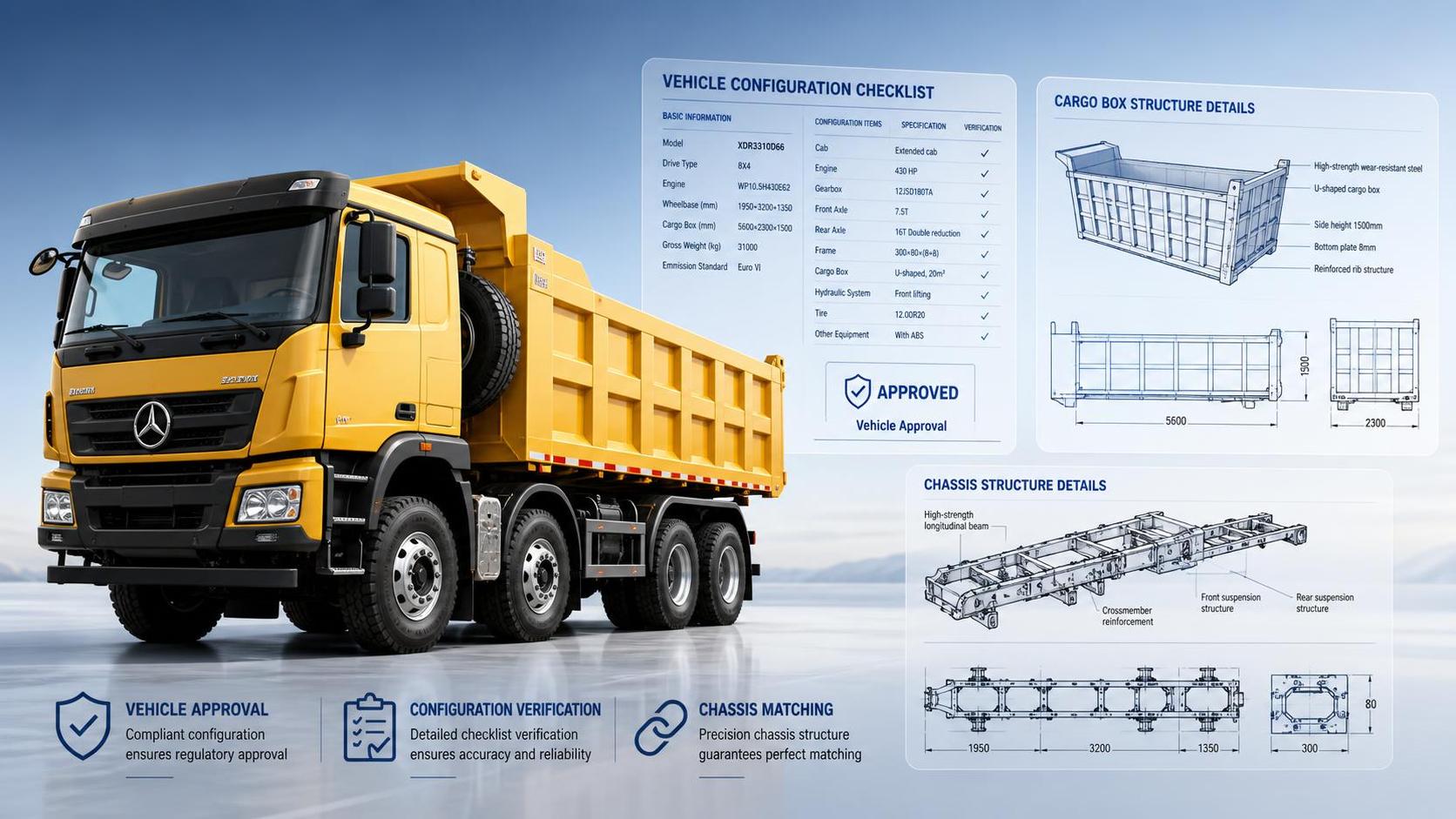
Before a construction vehicle model is approved for a project, the most expensive mistake is often not choosing the wrong brand. It is approving the wrong configuration on paper. That is why the Cangshan Vehicle Configuration List deserves close attention. For project managers, fleet planners, and engineering teams, this list is not a routine attachment. It is the document that determines whether the vehicle arriving on site will actually match the operating environment, compliance expectations, and lifecycle cost assumptions built into the project plan.
In practice, many approval problems start the same way: the vehicle looks correct by model name, the quotation seems aligned, and delivery timing is acceptable. But once the configuration list is reviewed in detail, gaps appear in axle ratio, cargo body dimensions, PTO arrangement, suspension type, tire specification, or emission setup. Those gaps may look minor during procurement, yet they can materially affect payload efficiency, road access, fuel burn, maintenance intervals, and even registration feasibility in the destination market.
For that reason, anyone searching for how to read a Cangshan Vehicle Configuration List is usually asking a deeper question: how do I use this document to avoid downstream trouble before model approval is locked in? That is the right question.
Why this document matters more than the brochure
A brochure tells you what a vehicle family can do. A configuration list tells you what the approved unit will actually be. In the engineering vehicle business, that distinction is critical. Two trucks carrying the same model badge may serve very different roles depending on chassis layout, engine output, transmission pairing, wheelbase, spring pack, axle capacity, and body integration details.
For project use, especially in infrastructure, mining support, municipal works, or cross-border fleet deployment, the vehicle configuration list sits at the intersection of four decisions:
- whether the unit can legally and safely operate in the target environment;
- whether it can perform the job without overloading or underutilization;
- whether the support and parts plan remains realistic after delivery;
- whether the approved budget still holds once the vehicle is put into daily service.
This is also where many internal misunderstandings happen. Procurement may focus on price and lead time. Operations may care about uptime and payload. Compliance may look at homologation or local registration requirements. Finance may assume all trucks in one category are interchangeable. The configuration list is one of the few documents that forces these viewpoints onto the same page.
Read it in the order of operational risk, not in the order it is printed
Most configuration sheets are arranged by manufacturer logic: basic model code, dimensions, engine, transmission, axle, tires, cab, options, and remarks. That is useful for factory control, but it is not the best reading method for a project decision-maker.
For approval work, a better sequence is: application fit, legal fit, durability fit, and only then commercial fit.
1. Start with the actual duty cycle
Before reviewing any line item, define the real operating conditions. Is the vehicle expected to run on paved roads between depots and urban sites, or spend most of its time on mixed terrain, soft ground, inclines, and temporary haul roads? Will it carry bulk aggregate, steel formwork, machinery, water, fuel, or personnel support equipment? Is it a high-frequency shuttle unit or a low-utilization standby asset?
Without this context, configuration reading becomes superficial. A specification that looks stronger on paper may be unnecessary for one project and inadequate for another. For example, a higher horsepower rating may seem attractive, but if the transmission ratio and axle ratio do not support the actual gradeability and load profile, the practical gain can be limited. On the other hand, an oversized configuration may increase fuel consumption and acquisition cost without improving utilization.
2. Check chassis and body compatibility early
In construction vehicles, body and chassis mismatches create some of the hardest-to-fix problems. If the list includes cargo body length, subframe arrangement, hydraulic interface, PTO position, or mounting points, these should be reviewed before engine or cabin features. A dump truck, crane carrier, mixer, water truck, or flatbed support vehicle cannot be judged only by gross vehicle rating. The frame section, wheelbase, rear overhang, and body installation parameters directly affect turning radius, load distribution, and durability under repeated site cycles.
One common mistake is assuming the nominal payload class is enough. It is not. What matters is whether the structure can carry the intended body and material in the project’s road and loading conditions without premature fatigue, instability, or compliance issues.
3. Treat powertrain matching as a system, not separate components
Many buyers read engine horsepower first because it is easy to compare. That is understandable, but incomplete. Powertrain suitability depends on how the engine, gearbox, axle ratio, and tire size work together. In a configuration list, these items should be read as a package.
A truck intended for heavy site work and stop-start movement may benefit from a different gearing strategy than one used for longer-distance road transport. Likewise, a vehicle operating at altitude, in hot climates, or in regions with inconsistent fuel quality may require more conservative choices in engine calibration or aftertreatment setup. If the list contains emission stage information, fuel system details, or SCR/DPF-related notes, these deserve particular attention in export and remote-region scenarios because service support and fuel compatibility can become a constraint.
Where requirements are unclear, teams should avoid assuming that the highest emission or electronics specification is always the best fit. In some markets, advanced systems improve compliance and efficiency. In others, they can increase service complexity if fuel quality, diagnostic equipment, or parts access is weak. This point often needs local verification.
The lines that project teams most often underestimate
Experienced engineering buyers usually do not miss the headline items. They miss the small fields that seem administrative until the vehicle reaches site. Several parts of the Cangshan Vehicle Configuration List deserve more attention than they typically receive.
Axle load and suspension details
Axle capacity is not just a legal number. It is a durability indicator tied to actual load concentration, road shock, and maintenance planning. Suspension specification matters for the same reason. Leaf spring counts, reinforcement level, and balancing arrangement may affect ride harshness, stability under load, and long-term structural wear. For severe construction duty, under-specifying here can create more trouble than choosing a slightly smaller engine.
Tire specification and wheel setup
Tires are often treated as consumables, but in project operations they are also a configuration decision. Tire size, ply rating or equivalent load index, tread type, and tubeless versus tube-type arrangement can affect flotation on soft surfaces, replacement availability, fuel efficiency, and downtime risk. If the jobsite is in a remote market, local tire availability should be checked before approval. A technically acceptable factory fit may still be operationally weak if replacement stock is hard to obtain.
Cabin and electrical options
At first glance, cab trim seems secondary in engineering fleets. Yet climate package, seat arrangement, visibility aids, camera or reversing alarm preparation, battery capacity, and electrical interface provisions can affect both safety and site efficiency. In hot, cold, dusty, or long-hour operating conditions, these details matter more than they do in general cargo use.
Project managers should also watch for options that sound standard in conversation but appear as optional or deleted in the configuration list. This is a frequent source of misunderstanding between the commercial offer and final production build.
Dimensions that affect access and regulation
Overall length, width, height, wheelbase, front and rear overhang, and turning radius are not passive dimensions. They determine whether the vehicle can enter temporary worksites, pass local road controls, fit onto shipping equipment, or comply with route limitations. For export projects, dimensional constraints may also affect containerization, RORO planning, and inland transport cost. These are commercial consequences driven by technical lines on the sheet.
Approval is not just technical. It is also a supply-chain filter.
One reason configuration review matters so much in commercial vehicle export is that the same core platform may be supplied in multiple trims, regional variants, or production batches. A list that looks acceptable in principle can still create supply risk if key components are option-dependent, low-volume, or tied to uncertain production scheduling.
This is where an experienced exporter or authorized dealer can add practical value, not by marketing the vehicle, but by clarifying whether the approved specification is a normal production combination or a special build. That distinction affects lead time, substitution risk, documentation accuracy, and spare parts planning.
For buyers sourcing Chinese engineering vehicles across brands such as FOTON, SHACMAN, or SINOTRUK, this issue is especially relevant because platform breadth is wide and local-market versus export-market configurations may differ. The safer approval path is to confirm not only that a specification exists, but that it is supportable at scale and can be documented consistently through production, customs, and delivery.
What often goes wrong during model approval
Several recurring assumptions deserve to be challenged.
- “The model code is enough.” It is not. Model code identifies the family, not the final operational suitability.
- “Higher specification means lower risk.” Not necessarily. Extra complexity can increase service burden or parts dependency.
- “Payload class tells us the rest.” It does not. Body integration, axle match, and route conditions still decide actual performance.
- “If two quotations look similar, the vehicles are basically the same.” Small configuration differences can create large lifecycle cost differences.
- “We can correct mismatches after delivery.” Some items can be modified, but many changes are expensive, slow, or non-compliant once the unit is built and shipped.
These are not theoretical concerns. In engineering fleets, a specification error can show up as underbody damage, excessive tire wear, poor grade performance, overheating, registration delay, hydraulic incompatibility, or weak resale value. The risk is usually multiplied when the vehicle is purchased as part of a project package with a fixed launch date.
A practical review method for project teams
Instead of treating the Cangshan Vehicle Configuration List as a technical appendix, project teams should use it as a structured approval checklist. A workable review flow looks like this:
This kind of review is most effective when operations, maintenance, procurement, and compliance all sign off on the same version of the list. Too often, each function reviews a different document stage: quotation sheet, technical annex, body drawing, or order confirmation. That fragmentation is where avoidable mistakes enter.
Questions worth asking before final approval
Even a detailed list does not answer everything. Before approving the model, the project side should press for clarity on a few practical points:
- Which items are fixed production specification and which are optional?
- Are any components subject to substitute supply under equivalent specification terms?
- Does the listed configuration match the destination country’s homologation or registration path? 【待核实】
- What body builder interfaces or pre-installation conditions are included from factory?
- Are maintenance parts for the listed axle, transmission, and emission system available in the target region?
- Does the quoted lead time apply to this exact configuration, not a similar one?
These questions are not signs of mistrust. They are normal controls for engineering procurement, especially where project deadlines and cross-border delivery are involved.
What a good approval decision looks like
A sound approval decision is rarely the one with the most impressive spec sheet. It is the one that aligns machine capability, site reality, local compliance, service support, and delivery execution with the least hidden friction. The Cangshan Vehicle Configuration List helps teams reach that point because it forces the decision away from generalities and into specifics.
For project managers, that is the real value of reading it carefully. It is less about decoding technical jargon and more about turning a factory description into an operational judgment. Once that judgment is made properly, the rest of the procurement process becomes clearer: whether to approve, whether to request changes, whether to split configurations by job type, or whether the vehicle is simply the wrong fit for the project despite looking acceptable at first glance.
In engineering vehicle procurement, most avoidable losses begin before the vehicle moves. They begin when a configuration sheet is read too quickly.
Search Starts Here